
Triple Whale Alternatives 2026: Why Most Brands Need The Layer Above, Not Another Tool
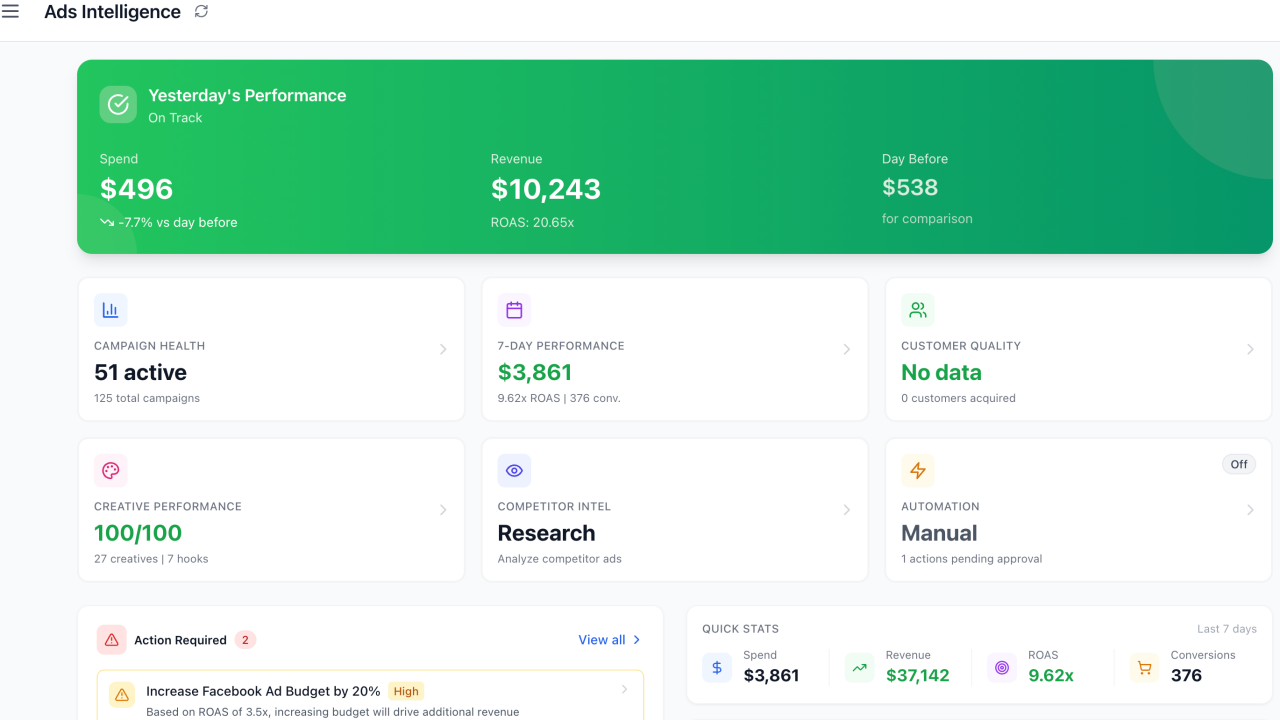
Search results for "Triple Whale alternatives" return 10+ listicle articles comparing the same 8-10 tools: SegmentStream, Northbeam, Rockerbox, Polar Analytics, ThoughtMetric, Cometly, Hyros, Wicked Reports. Each article is structured the same way: a comparison table, then 10 tool sections, then a verdict that recommends whichever tool the article's author is selling.
This article is different. The honest read on Triple Whale alternatives in 2026 is that 80 percent of brands switching from Triple Whale do not actually need a different attribution tool. They need the layer above attribution: an executive layer that reads the attribution data from any tool, reconciles it against Shopify ground truth, and ships decisions.
This guide covers both options: when to swap Triple Whale for another attribution tool, and when to keep Triple Whale (or any attribution tool) and add the executive layer instead.
Why brands are leaving Triple Whale
Looking at the public complaints, three patterns dominate.
Cost scaling. Triple Whale's revenue-based pricing model means costs scale with revenue rather than with feature complexity. A $5M brand on Triple Whale pays roughly $400-$700 per month. A $20M brand pays $1,500-$3,000. A $50M brand pays $5,000+. The pricing is not unreasonable for the feature set, but operators feel they are paying more for the same product as they grow.
Reporting without action. The most common public complaint: "I see the data, I do not know what to do with it." Triple Whale shows blended ROAS, MER, attribution by channel, creative performance. It does not tell you which campaign to pause, which budget to shift, or which creative to refresh. The interpretation work is still on the operator.
Attribution gaps. Like every attribution tool, Triple Whale has gaps. Some users report attribution outages, model disagreements with Meta or Shopify direct, and reporting that does not match what they see in raw platforms. The gap is structural to attribution (every tool has it) rather than a Triple Whale-specific failure, but it triggers the search for alternatives.
Pixel installation complexity. Triple Whale relies on its own pixel for first-party tracking. Some brands report integration complexity, especially on headless Shopify or non-standard checkouts.
The honest read on these complaints: only the last two are Triple Whale-specific. Cost scaling and reporting-without-action are problems that exist with every attribution tool. Switching to Northbeam or SegmentStream solves the Triple Whale-specific complaints but leaves the structural ones in place.
The two replacement strategies
Strategy A: Swap Triple Whale for another attribution tool. Best for brands with very specific attribution methodology requirements (incrementality testing, multi-touch with custom weighting, marketing mix modeling). The alternatives that actually deliver something Triple Whale does not:
- SegmentStream for brands spending $100K+/month who need ML-driven attribution with automated budget optimization. Pricing custom, typically $2K-$5K+/month.
- Rockerbox for brands running offline channels (TV, podcast, OOH) alongside digital. MMM functionality that Triple Whale lacks. $2K+/month.
- Northbeam for brands wanting marketing mix modeling and incrementality testing. ~$1K-$3K/month.
- Polar Analytics for mid-market DTC ($5M-$20M) wanting attribution plus BI in one tool. ~$450-$1,000/month.
- ThoughtMetric for cost-conscious brands wanting solid attribution without enterprise pricing. $99-$400/month.
Each of these is a real upgrade for a specific use case. None of them solves the "reporting without action" problem.
Strategy B: Keep Triple Whale (or any attribution tool) and add the executive layer. Best for brands whose primary complaint is "I do not know what to do with the data," not "the attribution methodology is wrong." This is the unconventional answer.
The executive layer is an AI CMO that reads attribution data from any source (Triple Whale, Northbeam, Shopify direct, raw Meta + Google), reconciles the conflicts, identifies the highest-impact decisions for the week, and ships campaigns through Klaviyo, Postscript, and ad platforms. Attribution becomes an input rather than the destination.
The cost comparison: Triple Whale plus an AI CMO is roughly $1,000-$5,500 per month for a $5M-$20M brand. Switching Triple Whale for SegmentStream is $2K-$5K per month for SegmentStream alone, plus you still need to interpret the data and ship the campaigns yourself. For most $5M-$20M brands, keeping Triple Whale and adding the AI CMO is the cheaper and faster path.
When you should switch attribution tools
Switching makes sense in three specific cases.
Case 1: You need methodology Triple Whale does not offer. Specifically: incrementality testing with geo holdouts, marketing mix modeling for offline channels, or fully custom attribution weighting. SegmentStream and Rockerbox are the right answers for these cases. Not because Triple Whale is bad but because they offer something different.
Case 2: Your spend is below $1M annually and the Triple Whale price is too high. Drop down to Polar Analytics, ThoughtMetric, or Attribuly for similar dashboard functionality at lower cost. The differences in attribution accuracy at this scale are noise. The differences in cost are real.
Case 3: You are on enterprise spend ($500K+/month) and the platform is the bottleneck. SegmentStream, Rockerbox, or building in-house with a data warehouse plus custom modeling. At this scale, the gains from sophisticated attribution methodology are large enough to justify the cost.
For everyone else, the structural problem is not the attribution tool. It is the interpretation and execution layer above it.
When you should keep your attribution tool and add an executive layer
Three signals that you are in this case.
Signal 1: You spend more time interpreting data than running campaigns. Your team pulls reports, reconciles numbers, and argues about which dashboard to trust. The bottleneck is decision-making, not data quality.
Signal 2: You ship fewer than 5 marketing experiments per month despite knowing you should ship more. Experimentation cadence is the lever. The reason most brands ship few experiments is not lack of ideas. It is lack of bandwidth to translate ideas into campaigns. An AI CMO ships the campaigns.
Signal 3: Your retention and acquisition data live in different silos. Triple Whale handles acquisition attribution. Klaviyo handles retention. Recharge handles subscriptions. No one is looking at all three together and deciding what to ship this week. The AI CMO unifies them.
If any of these apply, switching Triple Whale for Northbeam will not fix the actual problem. The actual problem is that nobody is reading the data and shipping the work. A different dashboard delivers the same outcome.
The honest comparison: Triple Whale alone vs Triple Whale plus Finsi
| Capability | Triple Whale alone | Triple Whale + Finsi |
|---|---|---|
| Attribution dashboards | Yes | Yes (Triple Whale data) |
| Channel performance | Yes | Yes (reconciled across sources) |
| Weekly priority list | No | Yes |
| Campaign execution | No (operator does it) | Yes (ships through Klaviyo, Postscript, ad platforms) |
| Retention orchestration | No | Yes |
| Written weekly memo | No | Yes |
| Predictive churn | No | Yes |
| Decision recommendations | No | Yes |
| Cost (at $5M revenue) | ~$500/mo | ~$1,000-$1,500/mo |
| Cost (at $20M revenue) | ~$1,500-$3,000/mo | ~$3,500-$6,000/mo |
The relevant question is what you would have to spend to get the right side of the table some other way. The traditional path is a fractional CMO ($8K-$15K/mo) plus an execution agency ($5K-$15K/mo). The AI CMO path is 3-5x cheaper for the same coverage.
What does Finsi actually do
Finsi is the AI CMO purpose-built for $1M-$50M Shopify and DTC brands. It reads your Triple Whale data (or any attribution tool you already pay for), unified Shopify orders, Klaviyo and email performance, Recharge subscription events, ad spend and creative performance from Meta, Google, and TikTok, and support sentiment from Gorgias.
Every week it ships:
- A ranked list of the three highest-impact growth moves
- Specific budget reallocations across paid channels
- A list of at-risk customers scored individually for churn risk
- The email and ad campaigns to ship this week
- A written memo summarizing what changed and what to do about it
It does not replace Triple Whale. It reads Triple Whale (or Northbeam, or Polar) as an input and produces decisions as the output. For brands whose problem is "we have the data, we do not know what to do with it," Finsi is the answer.
Read more about the AI CMO category, the retention loop framework, or book a free audit and we will read your Triple Whale data and produce your first weekly memo.
Quick decision guide
- You spend $50K+/month on Meta and Google, your attribution is approximately right, and your problem is decision-making: keep Triple Whale, add Finsi.
- You spend $100K+/month, you need incrementality testing or MMM: switch to SegmentStream or Rockerbox, then add Finsi on top.
- You spend $20K-$50K/month and Triple Whale costs too much: switch to Polar Analytics or ThoughtMetric. Decide on Finsi separately.
- You are below $1M revenue: skip the dedicated attribution tool entirely. Use Shopify direct plus Meta and Google reporting plus Finsi for interpretation.
The wrong question is "which Triple Whale alternative should I pick?" The right question is "what is actually broken, and which tool fixes it?" For most brands the answer is not another attribution tool.
Frequently asked questions
What is the best Triple Whale alternative?
Depends on the problem. For brands spending $100K+/month who need incrementality testing, SegmentStream. For brands running offline channels, Rockerbox. For mid-market DTC at $5M-$20M, Polar Analytics. For cost-conscious brands under $1M annual spend, ThoughtMetric or Attribuly. For brands whose actual problem is decision-making rather than attribution methodology, keep Triple Whale and add an AI CMO layer.
How much does Triple Whale cost compared to alternatives?
Triple Whale runs roughly $400-$700/month at $5M revenue, scaling to $5,000+/month at $50M. Alternatives: SegmentStream custom (typically $2K-$5K+), Northbeam $1K-$3K, Polar Analytics $450-$1K, ThoughtMetric $99-$400, Rockerbox $2K+. The cheapest path is often not switching but keeping a basic attribution tool and adding decision automation.
Is Triple Whale being replaced by AI?
Triple Whale is being augmented, not replaced. Attribution is a data layer. AI CMOs and similar executive-layer platforms read attribution data (from Triple Whale or any other tool) and produce decisions. The two categories serve different functions. The error is treating attribution as the destination instead of an input.
Can Triple Whale handle offline marketing channels?
Limited. Triple Whale focuses on digital attribution. For TV, podcast, OOH, or other offline channels, Rockerbox is the leading alternative with built-in marketing mix modeling. For brands with primarily digital spend, Triple Whale is fine.
Should I switch from Triple Whale to Northbeam?
Switch if you specifically need Northbeam's incrementality testing or marketing mix modeling. Do not switch if your primary complaint is "I do not know what to do with the data." Northbeam will not solve that. The executive layer above attribution does.
What is the executive layer above attribution?
An AI CMO or AI executive platform that reads attribution data, retention data, and operations data together, then produces weekly priorities, ships campaigns, and reports outcomes. Examples include Finsi and a handful of emerging competitors. The category is new (2024-2026) and growing as brands realize they have enough attribution and not enough execution.