
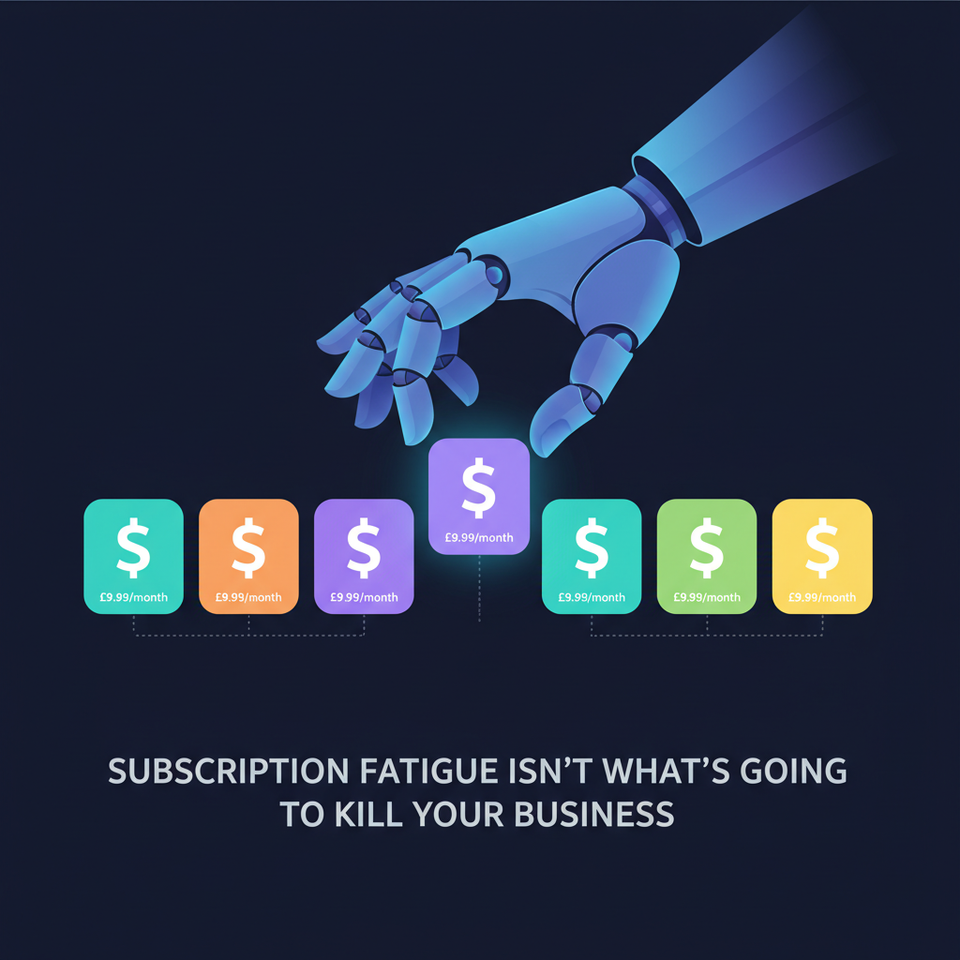
Subscription Fatigue Isn't What's Going to Kill Your Business
TLDR:
- Subscription fatigue is real but overblown — 77% of consumers plan to keep their current subscriptions. The real shift is that each subscription now competes for a fixed number of slots.
- The actual threat is AI agents (ChatGPT, Gemini, Siri, Google Assistant) that will proactively audit subscriptions, compare alternatives, and recommend cancellations based on usage data.
- When AI removes the friction from canceling, the only defense is proving your subscription delivers measurable value — engagement data, usage patterns, ROI signals.
- Brands that invest in retention data infrastructure now (cohort LTV, engagement scoring, churn prediction) are building the moat that AI agents can't easily recommend cutting.
The "Subscription Fatigue" Narrative Is Wrong
Every other article about subscriptions in 2025 and 2026 leads with the same stat: 41% of consumers say they have subscription fatigue. Headlines declare the subscription model is dying. Analysts predict a reckoning.
But here's what those articles leave out: 77% of consumers plan to keep their current subscriptions. Not reduce. Not pause. Keep.
Those two numbers don't contradict each other. They describe the same shift from different angles. Consumers aren't abandoning subscriptions. They're done adding new ones carelessly. The "subscribe to everything" era is over.
What's actually happening is more nuanced and more important for subscription brands to understand. Consumers have settled on a fixed number of subscription slots — maybe 8 to 12 — and every brand is competing for one of those spots. If a new subscription enters, an existing one gets cut. It's a zero-sum game now.
This means churn isn't driven by blanket fatigue. It's driven by comparison. Your subscription isn't getting canceled because the customer is tired of subscriptions. It's getting canceled because something else proved more valuable for that slot.
In my experience working with subscription brands, the ones panicking about "subscription fatigue" are usually the ones who can't articulate why their product deserves a monthly slot. They're focused on acquisition — getting the first order, nailing the trial conversion — and they've underinvested in proving ongoing value.
That's a problem today. But it's about to become a much bigger problem.
The Real Threat: AI Agents as Subscription Auditors
Here's what I think most subscription operators are missing entirely.
Right now, canceling a subscription requires effort. You have to remember you have it, log in, navigate a cancel flow, maybe sit through a retention offer, confirm twice. That friction is a feature for subscription brands. A meaningful percentage of subscribers stay simply because canceling is inconvenient.
AI agents are about to eliminate that friction entirely.
ChatGPT, Gemini, Claude, Apple Intelligence — these tools are already helping consumers audit their spending. "What subscriptions am I paying for?" is a common prompt. But that's the early, passive version. The next step is active management.
Within the next 18 to 24 months, AI assistants will proactively monitor your subscriptions. They'll track which ones you actually use, compare prices against alternatives, and flag the ones that aren't delivering value. The query "Hey Siri, which of my subscriptions am I not using enough?" is coming. And the follow-up — "Cancel the bottom three" — will be a one-tap action.
Think about what this means for a subscription brand whose customers haven't opened the app in 45 days. Or a beauty box where the last three shipments sat unopened. Or a SaaS tool where login frequency dropped 60% after onboarding.
Today, those customers might stick around for months — inertia, forgetfulness, a vague intention to "get back to it." When an AI agent is reviewing their subscriptions weekly, that grace period disappears.
The brands that survive this shift won't be the ones with clever cancel flow tricks. Dark patterns, guilt-trip copy, hidden cancel buttons — none of that works when the AI handles the cancellation process. The brands that survive will be the ones where the AI can see genuine, measurable value being delivered.
And that distinction — measurable value — is everything.
What AI Subscription Auditors Will Evaluate
To understand the threat, you need to think about what signals an AI agent will use when deciding whether to recommend keeping or canceling a subscription. This isn't speculation. These are the same signals any rational auditor — human or AI — would look at.
Engagement frequency. Did the customer actually use the product? Open the app? Wear the item? Read the content? AI agents will have access to screen time data, app usage logs, email open history, and purchase behavior. A subscription the customer interacts with weekly is safe. One they haven't touched in a month is a cancellation candidate.
Value delivery. Can the AI measure that this subscription provides a return? For SaaS, this might be features used, time saved, or workflows completed. For e-commerce subscriptions, it's whether items were consumed, reviewed, or reordered. The harder it is for the AI to quantify your value, the easier it is to recommend cutting you.
Price vs. alternatives. AI agents will comparison-shop. They'll know that your $49/month subscription has a competitor offering similar value at $35. They'll factor in switching costs, but if the value gap is wide enough, they'll recommend the switch. Brands without differentiation on value — not just features, but demonstrated value to that specific customer — lose this comparison.
Customer sentiment signals. Support tickets, negative reviews, social media complaints — AI agents will cross-reference these. A subscription with two unresolved support tickets and a 2-star review is getting flagged. Conversely, positive signals (high NPS response, referrals, social shares) strengthen the "keep" recommendation.
Usage trajectory. This is the one most brands don't track. It's not just current engagement — it's the trend. Is usage increasing, stable, or declining? An AI agent that sees three consecutive months of declining engagement will recommend cancellation before the customer even thinks about it.
The brands with clean retention data — proper cohort analysis, LTV tracking, individual engagement scoring — will be the ones AI agents recommend keeping. Not because the AI reads your marketing copy. Because the data proves the subscription is worth the money.
What This Means for Subscription Brands Right Now
If AI subscription auditing is 18 to 24 months away from mainstream adoption, that gives brands a window. But it's a narrow one. Here's what matters.
Stop optimizing cancel flows. Start optimizing value delivery.
I still see brands spending months A/B testing their cancellation page — testing different offers, different guilt trips, different friction points. That entire effort becomes worthless when an AI agent handles cancellation. The resources you're spending on cancel flow optimization should go toward making your product so valuable that neither the customer nor their AI assistant wants to cancel.
We've written about letting customers leave gracefully before. The same principle applies here, amplified. If your retention strategy depends on making it hard to leave, you don't have a retention strategy.
Build retention infrastructure that proves value at the individual level.
Aggregate churn metrics — "our monthly churn is 7%" — tell you nothing about individual subscriber health. You need engagement scoring at the subscriber level. Which customers are actively using the product? Which ones are drifting? Which ones are one bad month away from being flagged by an AI auditor?
This means tracking engagement events (logins, opens, usage, consumption), building health scores per subscriber, and creating automated interventions when scores drop. Not a quarterly review. Real-time monitoring.
Make your value machine-readable.
This is the part most brands haven't considered. When an AI agent evaluates your subscription, it will look for data. Open rates. Usage logs. Transaction history. Review sentiment. If your value is intangible — "it makes me feel good" — the AI has nothing to work with. The brands that make their value quantifiable and accessible will have an advantage.
Practical example: a meal kit subscription that tracks recipes cooked, dietary goals met, and money saved vs. eating out gives the AI clear retention signals. A meal kit that just ships boxes and hopes for the best is invisible to the auditor.
Invest in predictive retention, not reactive retention.
Most brands today react to churn. A customer cancels, and then the retention team springs into action with win-back campaigns. That's already too late — and it's especially too late in an AI-audited world where the cancellation happens automatically.
Predictive churn signals — identifying at-risk subscribers 30, 60, 90 days before they churn — become essential. If you can intervene before the AI flags a declining engagement pattern, you keep the subscriber. If you wait for the cancellation request, you've already lost.
The Subscription Brands That Will Win the AI Audit
I spent 11 years as CTO at Scentbird, where we scaled to over a million subscribers. The single biggest lesson from that experience: retention is infrastructure, not a campaign.
The brands that survived competitive pressure at Scentbird's scale were the ones that obsessed over when and why people leave. Not in aggregate. At the individual subscriber level. We built systems that tracked engagement signals, predicted churn risk, and triggered interventions before the customer made a decision. That infrastructure was the difference between growing and dying.
The same logic applies to the AI auditor threat, but the stakes are higher. When a human considers canceling, you have time — the thought sits in their head for days or weeks, and they might forget about it. When an AI recommends canceling, it happens in seconds.
The brands investing in retention intelligence today are building a moat. Cohort LTV analysis that shows improving retention over time. Engagement scoring that proves subscribers are actively using the product. Churn prediction that catches problems before they become cancellations. The right retention software that ties all of this together.
These brands won't just survive the AI audit. They'll benefit from it. Because when the AI evaluates their subscription against a competitor that has no engagement data, no LTV tracking, no proof of value — the recommendation is obvious. Keep the one with the data. Cancel the one without it.
This is why we built Finsi. We spent over a decade building retention systems at Scentbird, and we saw firsthand that most subscription brands don't have the engineering resources to build this infrastructure themselves. Finsi connects to the tools you already use — Shopify, Recharge, Klaviyo — and gives you the retention data layer that proves your product's value. Cohort analysis, churn prediction, engagement scoring, and the AI agents that act on those signals before a subscriber becomes a cancellation statistic.
The window to build this infrastructure is now. Once AI subscription management goes mainstream, the brands without retention data will be playing defense. The brands with it will already be winning.
See What Your Retention Data Looks Like
Finsi gives subscription brands the retention intelligence layer they need — cohort LTV tracking, predictive churn signals, and engagement scoring that proves your product's value at the individual subscriber level.
Explore the live demo dashboard — no signup required:
Login: demo@finsi.ai / demo2026!
FAQ: AI Agents and Subscription Retention
Will AI agents actually cancel subscriptions automatically?
Not immediately — the first wave will be recommendations ("you haven't used this in 60 days, want to cancel?"). But as AI assistants gain more permissions and trust, automated actions will follow. Apple Intelligence, Google Assistant, and third-party tools like Truebill already handle subscription tracking. The progression from "track" to "recommend" to "act" is a matter of time, not technology.
How can subscription brands prepare for AI-driven cancellation?
Focus on three things: track engagement at the individual subscriber level (not just aggregate churn), build predictive churn models that intervene before disengagement becomes cancellation, and make your value quantifiable. If an AI agent can see that your subscriber is actively using your product, you're safe. If it can't find usage data, you're a cancellation candidate.
Is subscription fatigue actually increasing churn rates?
Not directly. Average churn rates for subscription e-commerce brands hover around 8-12% monthly, which hasn't changed dramatically despite "subscription fatigue" headlines. What has changed is that consumers are more selective about new subscriptions. Acquisition is harder, but existing subscriber behavior is relatively stable — for now. The real disruption comes when AI tools lower the effort required to evaluate and cancel underperforming subscriptions.
What retention metrics matter most in an AI-audited world?
Individual engagement scores (per subscriber, not averages), cohort LTV trends (are newer cohorts retaining better or worse?), time-to-value (how quickly do new subscribers experience the product's benefit?), and usage trajectory (is engagement stable, growing, or declining?). These are the signals an AI agent will evaluate, and they're the same signals that drive effective human retention programs today.