
Subscription Churn Analysis: Finding and Fixing Revenue Leaks
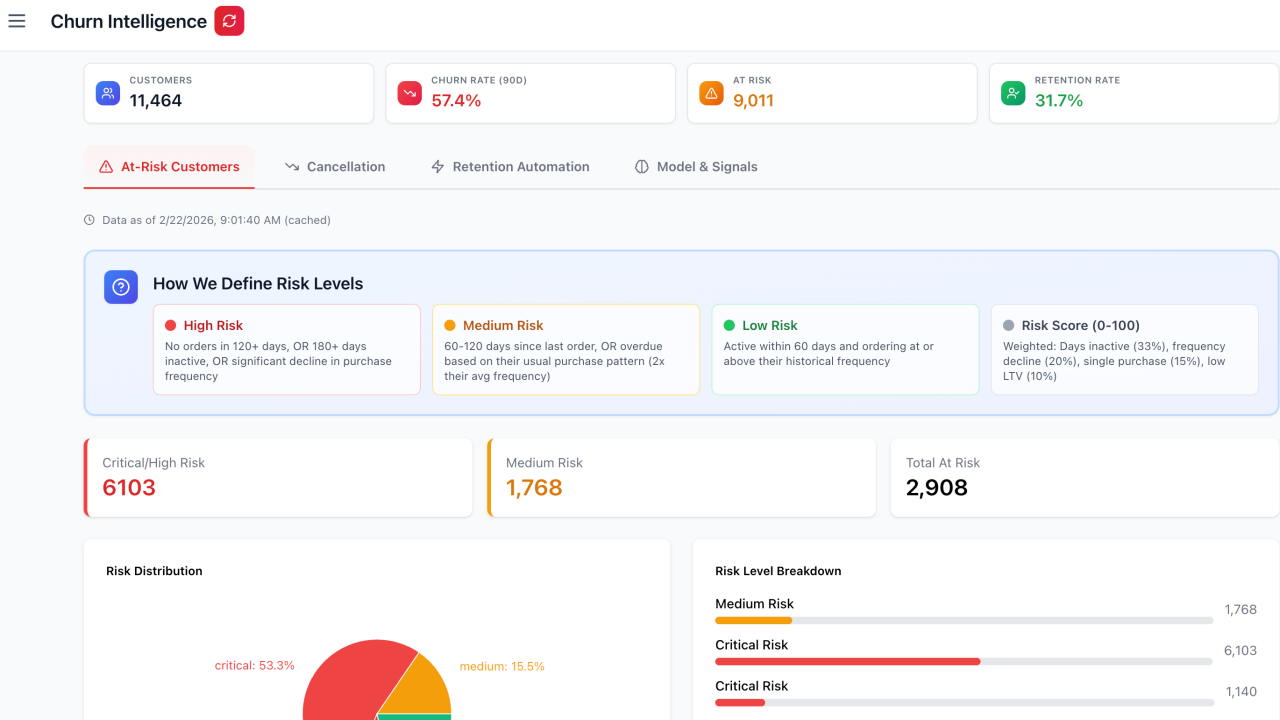
Every subscription business leaks revenue. Some leaks are obvious - a spike in cancellations after a price increase, a batch of failed credit card charges. Others are subtle and slow - a gradual decline in retention among customers acquired from a specific channel, or an increase in subscription pauses that quietly precedes full cancellations.
Subscription churn analysis is the discipline of finding these leaks, understanding their causes, and systematically fixing them. This guide provides a full framework for analyzing and reducing churn in subscription e-commerce businesses.
Understanding Subscription Churn
Subscription churn rate is the percentage of subscribers who cancel or fail to renew within a given period. The monthly formula is:
Monthly Churn Rate = (Subscribers Lost During Month / Subscribers at Start of Month) x 100
A 5% monthly churn rate might not sound alarming, but compounded over a year, it means losing nearly 46% of your subscriber base. This is why even small improvements in monthly churn rate have an outsized impact on annual revenue and business valuation.
Subscription businesses are fundamentally valued on their ability to retain customers over time. A business with 3% monthly churn is worth dramatically more than one with 6% monthly churn, even if they have the same current revenue. The difference in lifetime value per subscriber cascades through every financial model.
Voluntary vs. Involuntary Churn: A Deep Dive
The first and most important distinction in churn analysis is between voluntary and involuntary churn. They have different causes, different solutions, and different levels of difficulty to address.
Voluntary Churn
Voluntary churn occurs when a customer makes a conscious decision to cancel their subscription. The common drivers include:
Perceived value erosion. The customer no longer feels the subscription is worth the price. This might be because the product quality has declined, their needs have changed, or competitors are offering something they perceive as better.
Product accumulation. Particularly common in physical product subscriptions - the customer has accumulated more product than they can use. They feel wasteful continuing to receive shipments.
Financial pressure. The customer is cutting discretionary spending and your subscription is not essential enough to survive the cut. This is often seasonal or correlated with broader economic conditions.
Experience friction. Poor customer service interactions, shipping problems, or website usability issues that make the subscription feel like a hassle rather than a convenience.
Buyer's remorse or impulse signup. The customer signed up during a promotion or moment of enthusiasm and never formed a genuine habit around the product.
Involuntary Churn
Involuntary churn happens when the subscription ends due to payment failure, without the customer actively deciding to cancel. Common causes:
Expired credit cards. The most common cause of involuntary churn. Cards expire regularly, and unless the customer proactively updates their payment information, the next charge will fail.
Insufficient funds. The charge is attempted when the customer's account lacks sufficient funds. This can be timing-related (charge hitting before payday) or reflect genuine financial constraints.
Card issuer declines. Banks and card issuers may decline charges due to fraud alerts, spending limits, or other risk flags, even when the customer intends to continue the subscription.
Account closures. The customer has closed or changed their bank account or credit card, often without remembering all the subscriptions attached to the old card.
For most subscription businesses, involuntary churn represents 20-40% of total churn. Because these customers did not choose to leave, the recovery potential is significant - and addressing involuntary churn is typically the fastest path to reducing overall churn rate.
Analyzing Churn by Cohort
Cohort analysis is the backbone of subscription churn analysis. By grouping subscribers by their signup month and tracking their retention over time, you can identify patterns that aggregate metrics hide.
Building a Churn Cohort Analysis
- Group subscribers by signup month. Each monthly cohort starts at 100%.
- Track the percentage remaining at each subsequent month. Month 1 retention, month 2 retention, through month 12 and beyond.
- Plot retention curves for each cohort. This visual representation immediately reveals trends.
What to Look for in Cohort Data
Early-stage churn patterns. Most subscription businesses see their highest churn in months one through three. This is when uncommitted subscribers leave. If your month-one churn is significantly higher than benchmarks (above 10-12%), your acquisition strategy may be bringing in low-intent subscribers, or your onboarding experience needs improvement.
Churn cliff stabilization. After the initial high-churn period, monthly churn should stabilize at a lower rate. The level at which it stabilizes - your steady-state churn rate - is one of the most important metrics for your business. This is the rate that determines long-term subscriber economics.
Cohort comparison. Are newer cohorts retaining better or worse than older ones? Improving cohort retention means your product or experience improvements are working. Declining cohort retention is an urgent warning signal.
Seasonal patterns. Some months produce systematically different retention patterns. January cohorts often include New Year resolution signups who churn at higher rates. Holiday cohorts may include gift subscriptions that naturally have limited lifespans.
Analyzing Churn by Segment
Beyond cohort analysis, segmenting your churn data reveals which types of customers are most and least prone to leaving.
By Acquisition Channel
Different acquisition channels attract different customer profiles with different retention characteristics. Analyze churn rate by source:
- Organic search subscribers may retain differently than social media-acquired subscribers
- Referral-based subscribers often show the strongest retention
- Heavily promoted signup offers can attract deal-seekers with higher churn propensity
- Influencer-driven signups may have high initial enthusiasm but variable long-term retention
This analysis should directly inform your acquisition strategy and your LTV:CAC calculations by channel.
By Plan or Product
If you offer multiple subscription tiers or products, churn rates will vary between them. You might find that your premium tier retains significantly better than your basic tier - suggesting that customers who invest more are more committed. Or you might find that a specific product has improved churn, pointing to a product quality or fit issue.
By Customer Behavior
Behavioral segments reveal churn patterns that demographic or acquisition-based segments miss. Subscribers who engaged with your content or community in their first month may retain at twice the rate of those who did not. Subscribers who customized their box on the first delivery may show stronger retention than those who accepted the default.
These behavioral insights point directly to interventions - if community engagement correlates with retention, investing in community building becomes a retention strategy, not just a brand-building exercise.
By Cancellation Reason
This is the most directly actionable segmentation, but it requires capturing cancellation reasons effectively.
Cancellation Reason Categorization
When a subscriber cancels, you should capture why. But the quality of cancellation data depends on how you collect it.
Building an Effective Cancellation Survey
Make it required but short. A single-question survey with pre-defined options and a free-text field is the right balance. Do not make customers jump through hoops to cancel - it creates resentment and will eventually draw regulatory attention.
Use specific, actionable categories. "I'm not satisfied" is too vague to be useful. Better options include:
- "I have too much product / can't use it fast enough"
- "The product isn't right for me / my needs changed"
- "It's too expensive for my budget right now"
- "I found an alternative I prefer"
- "I had a problem with shipping or delivery"
- "I didn't like the product selection or variety"
- "I only meant to order once / signed up by mistake"
Include a free-text field. Pre-defined options capture the broad categories, but free-text responses often reveal specific, fixable issues that you would never think to list as options.
Analyzing Cancellation Data
Track cancellation reasons over time, not just in aggregate. A sudden increase in "too expensive" cancellations after a price change gives you immediate feedback. A gradual rise in "found an alternative" signals competitive pressure that needs a strategic response.
Cross-reference cancellation reasons with subscriber characteristics. If "too much product" is the top reason among subscribers on your monthly plan but rarely cited by bi-monthly subscribers, the solution might be promoting plan flexibility rather than changing the product.
Dunning Optimization for Involuntary Churn
Dunning - the process of recovering failed payments - is the most cost-effective churn reduction strategy for most subscription businesses. Every recovered payment is a subscriber saved without any discount, incentive, or intervention cost.
Pre-Dunning: Preventing Failures Before They Happen
Card expiration alerts. Send email and SMS reminders 30, 14, and 3 days before a card on file is set to expire. Include a direct link to update payment information. This single tactic can prevent a significant percentage of involuntary churn.
Account updater services. Many payment processors offer automatic card updating services that refresh expired card details without customer action. This is the lowest-friction solution and should be enabled if your processor supports it.
Active Dunning: Recovering Failed Payments
Smart retry logic. Not all failed payments should be retried immediately. The optimal retry schedule depends on the failure reason:
- Insufficient funds: Retry a few days later, ideally aligned with common pay cycle dates (1st, 15th of the month)
- Temporary processor issues: Retry within hours
- Hard declines (closed account, stolen card): Do not retry; contact the customer directly
Escalating communication. When a payment fails, begin a communication sequence:
- Immediate notification. A simple, non-alarming email letting them know their payment did not go through and providing a one-click link to update their payment method.
- Reminder at 3-5 days. A follow-up if the payment still has not been resolved, emphasizing that their subscription is at risk.
- Final notice at 7-10 days. A clear message that their subscription will be paused or cancelled if payment is not resolved, with an easy resolution path.
- SMS follow-up. If email has not produced a response, an SMS can cut through inbox noise.
Optimized timing. Test the time of day and day of week for both retries and dunning emails. Payment retries on certain days (aligned with payroll cycles) often have higher success rates. Dunning emails sent at specific times may get higher open and action rates.
Measuring Dunning Performance
Track these dunning metrics:
- Initial payment failure rate: What percentage of charge attempts fail?
- Recovery rate: What percentage of failed payments are eventually recovered?
- Time to recovery: How long does it take to recover a failed payment on average?
- Recovery by method: What percentage is recovered via automatic retry vs. customer action?
- Final churn rate from failed payments: What percentage of failed payments ultimately result in lost subscribers?
A well-optimized dunning process recovers 50-70% of failed payments. If your recovery rate is below 40%, there is significant room for improvement.
Subscription Pause and Downgrade Alternatives
One of the most effective voluntary churn reduction strategies is giving subscribers alternatives to outright cancellation.
Pause Options
Allow subscribers to pause their subscription for a defined period (one to three months). A subscriber who pauses is dramatically more likely to resume than a subscriber who cancels and must go through the signup process again.
Track pause conversion rate (percentage of would-be cancellers who choose to pause instead), resume rate (percentage of paused subscribers who resume), and time to resume (how long paused subscribers take to reactivate).
If your pause-to-resume rate is above 50%, your pause option is saving a significant number of subscribers.
Downgrade Options
If you offer multiple tiers, presenting a downgrade option during the cancellation flow can save subscribers whose primary objection is price. A subscriber who drops from a $49/month plan to a $29/month plan is still generating $29 in monthly revenue and remains in your ecosystem.
Frequency Adjustments
For product subscriptions, allowing customers to switch from monthly to bi-monthly or quarterly delivery addresses the "too much product" cancellation reason without losing the subscriber entirely.
Product Swap or Customization
Allowing subscribers to change what products they receive can address "I didn't like the selection" cancellation reasons. The more control subscribers feel they have over their subscription, the less likely they are to cancel.
Building a Churn Prevention Program
Effective churn prevention is not a collection of one-off tactics. It is an ongoing program with defined processes, metrics, and ownership.
Step 1: Establish Baseline Metrics
Before you can improve churn, you need to know exactly where you stand. Calculate your monthly churn rate split by voluntary and involuntary. Build cohort retention curves for at least the last 12 months. Categorize your cancellation reasons by frequency. Calculate your current dunning recovery rate.
Step 2: Fix Involuntary Churn First
Involuntary churn is almost always the quickest win. Implement card expiration alerts, optimize your retry logic, build a dunning email sequence, and enable account updater services. These changes can reduce involuntary churn by 30-50% with relatively little effort.
Step 3: Implement Cancellation Alternatives
Add pause, downgrade, and frequency adjustment options to your cancellation flow. Track the save rate of each option and optimize based on which alternatives are most effective for which cancellation reasons.
Step 4: Build Early Warning Systems
Use engagement data, behavioral signals, and predictive models to identify at-risk subscribers before they reach the cancellation page. Finsi's retention intelligence provides automated churn risk scoring that flags subscribers showing disengagement patterns.
Intervene early with targeted outreach - a check-in email, a product recommendation, an invitation to provide feedback. The earlier you engage with an at-risk subscriber, the more likely you are to save them.
Step 5: Create Segment-Specific Retention Plays
Different subscriber segments churn for different reasons and respond to different interventions. Build retention playbooks for your key segments:
- New subscribers (months 1-3): Focus on onboarding, product education, and habit formation
- Mid-tenure subscribers (months 4-12): Focus on value reinforcement, variety, and community
- Long-term subscribers (12+ months): Focus on recognition, VIP treatment, and deepening the relationship
- Price-sensitive churners: Offer downgrades or promotional pricing to extend the relationship
- Product-dissatisfied churners: Offer product swaps, customization, or direct feedback channels
Step 6: Build Win-Back Campaigns
Some churn is inevitable. But cancelled subscribers are far easier to reactivate than entirely new customers - they already know your brand and have made the purchase decision once before.
Build a structured win-back sequence that begins shortly after cancellation and includes relevant offers based on the cancellation reason:
- Cancelled due to price: Win-back with a discounted rate or smaller plan
- Cancelled due to product accumulation: Win-back with a less frequent plan
- Cancelled due to dissatisfaction: Win-back after you have addressed the issue, with a specific message about what has changed
Track win-back conversion rates by cancellation reason and by time since cancellation. Most win-back success happens within the first 30-60 days after cancellation. After 90 days, the probability of reactivation drops significantly.
Step 7: Measure, Learn, and Iterate
Churn prevention is an ongoing discipline, not a one-time project. Establish a regular cadence for reviewing churn metrics:
- Weekly: Monitor overall churn rate and dunning recovery rate for sudden changes
- Monthly: Review cohort retention trends, cancellation reason distribution, and intervention effectiveness
- Quarterly: Conduct deep analysis of churn patterns by segment, channel, and product; update retention playbooks based on findings
Revenue Impact Modeling
To build organizational buy-in for churn prevention investment, quantify the revenue impact of churn improvements.
Here is a simple model: If you have 10,000 subscribers paying $40/month and your monthly churn rate is 6%, you are losing approximately 600 subscribers per month, or $24,000 in monthly recurring revenue. Over a year, this compounds to a significant drag on growth.
If you reduce monthly churn from 6% to 5% - a one percentage point improvement - you retain an additional 100 subscribers per month. After 12 months, this compounds to approximately 780 additional active subscribers, representing $31,200 in additional monthly revenue and $374,400 in additional annual revenue. This far exceeds the cost of virtually any churn prevention program.
Conclusion
Subscription churn is a solvable problem, but it requires systematic analysis and sustained effort. The brands that achieve best-in-class retention treat churn prevention as a core business function, not an afterthought.
Start by understanding your churn composition - how much is voluntary vs. involuntary, which cohorts and segments are most affected, and what reasons drive cancellations. Fix involuntary churn first for the quickest wins. Then build toward proactive, predictive approaches that identify and intervene with at-risk subscribers before they reach the cancellation page.
The difference between a 5% and a 3% monthly churn rate may sound small, but it compounds into a fundamentally different business over 12 to 24 months. Every percentage point of churn you eliminate flows directly to your bottom line and your business valuation. That makes churn analysis and prevention one of the highest-return investments any subscription business can make.
Frequently Asked Questions
How do you analyze subscription churn?
Start by calculating your monthly churn rate split by voluntary (customer-initiated cancellations) and involuntary (payment failures). Then build cohort retention curves by grouping subscribers by signup month and tracking what percentage remain active at each subsequent month. Segment your churn data by acquisition channel, plan type, and cancellation reason to identify which customer groups churn most and why. Cross-reference cancellation survey responses with subscriber characteristics to uncover specific, fixable issues. Platforms with retention intelligence automate this analysis and surface the patterns that matter most.
What methods are used in churn analysis?
The core methods include cohort retention analysis (tracking groups of subscribers over their lifecycle), segmented churn analysis (breaking down churn by channel, plan, and behavior), cancellation reason categorization (capturing and analyzing why subscribers leave), and dunning performance analysis (measuring payment failure and recovery rates). More advanced approaches include predictive churn scoring using behavioral signals, customer health scores, and revenue impact modeling that quantifies the financial value of reducing churn by specific amounts. The best churn analysis programs combine all of these methods into a regular review cadence.
What causes subscription churn in e-commerce?
Voluntary churn is driven by perceived value erosion, product accumulation (too much product), financial pressure, experience friction, and impulse signups that never formed a habit. Involuntary churn - which accounts for 20-40% of total churn in most businesses - is caused by expired credit cards, insufficient funds, card issuer declines, and closed accounts. Early-stage churn (months one through three) is typically the highest, driven by uncommitted subscribers. Understanding the breakdown between voluntary and involuntary churn is critical because they require completely different solutions - dunning optimization for involuntary, and cancel flow design and proactive retention for voluntary.
What tools help with subscription churn analysis?
Basic churn tracking is available in most subscription platforms (Recharge, Skio, Chargebee), but these tools typically offer limited segmentation and no predictive capabilities. For deeper analysis, brands use dedicated analytics platforms that unify subscription data with behavioral signals from email, ads, and support. Finsi's retention intelligence provides automated churn risk scoring, cohort visualization, cancellation reason tracking, and predictive LTV projections - all connected to your full data stack. Finance leaders use these insights for revenue forecasting, while retention teams use them to design targeted interventions. Start a free trial to see your churn data analyzed automatically.
What is the difference between leading and lagging churn indicators?
Lagging indicators tell you churn has already happened - monthly churn rate, cancellation volume, and MRR lost. Leading indicators predict churn before it occurs - declining email engagement, reduced browsing frequency, support ticket volume, skipped deliveries, and changes in order frequency. The most effective churn prevention programs monitor leading indicators and intervene early, rather than waiting for cancellations to spike. For example, a subscriber who stops opening emails and skips a delivery is far more likely to cancel within 60 days. Identifying these patterns through cohort analysis and behavioral scoring lets you reach at-risk subscribers with a relevant message before they reach the cancel page.