
Stuck at $2M? It's Probably Not Acquisition.
Most founders hitting $2M ARR for the first time have the same instinct when growth stalls: pour more into acquisition. Hire a media buyer. Open a new channel. Hit the leadership team with a CAC target.
A few months later the dashboard hasn't moved. The pipeline is full, the spend is up, and revenue still won't break $2.2M.
This isn't an acquisition problem. It's a math problem.
Run the numbers
$2M ARR at 10% monthly churnWhere your customer base goes if you don't replace it100%50%0%M0M2M4M6M8M10~100% lostEvery acquisition dollar replaces a dollar that just walked out. Net new = 0.
Take a subscription brand at $2M ARR with 10% monthly churn. That's not a worst-case figure. For a mid-AOV consumables or replenishment brand, it's a normal year-one churn curve.
At 10% monthly, you lose 100% of your customer base every ten months. To stay flat, every dollar your acquisition team brings in is replacing a dollar that just walked out the door. Net new is zero. Gross new looks great in the deck, but the cohort behind the deck is bleeding.
Now layer on a CAC that's gone up 30% over the last two years. Now your replacement customers cost more than the ones you lost. Net new is negative.
This is what stalling at $2M looks like from inside the data. It does not feel like a retention problem from the outside. It feels like an acquisition problem. The funnel feels too narrow. The team wants to throw budget at the top of it.
The instinct is wrong because the leak is invisible. Nobody sees a customer who didn't churn. You only see the ones who do — and only after they're gone.
The two metrics nobody is watching
The two metrics nobody is watchingSecond-purchase rate< 40%inside the first 60 days= acquisition $ is sandDormant cohort revenueHundredsof customers, unaddressed= CAC you already paid
Two things separate brands that break through $2M from brands that don't, and they're both retention-side.
Second-purchase rate. This is the percentage of first-time buyers who place a second order, on whatever cadence your category supports. For most subscription brands the meaningful window is the first 60 days after their first delivery. If less than 40% of your customers come back inside that window, every acquisition dollar you spend is sand through your fingers.
The brutal part: second-purchase rate is mostly set in the first 14 days. It's a product-and-onboarding problem masquerading as a churn problem. The fix isn't a winback email. It's making the first experience worth coming back for.
Dormant cohort revenue. Every brand at $2M has a dormant segment they're not emailing — customers who bought once, didn't churn officially, but went quiet. Most brands don't have these people segmented at all. They sit in Klaviyo as "active" because they technically still have an account.
We've seen brands surface a few hundred dormant customers in their first week of looking and recover meaningful revenue from a single reactivation email. Not because the email was clever. Because nobody had been talking to those people for six months.
Why the conversation usually goes the other way
The reason founders default to "we need more leads" is that the acquisition side is legible. You can see the ad spend. You can see the cost per click. You can put a number on the channel.
Retention is illegible without infrastructure. Most $1M-$5M brands don't have cohort analysis running. They look at MRR and a churn percentage. That's it. The thing that's actually pulling growth down doesn't show up on the dashboard, so nobody acts on it.
When teams do try to look, they hit the second problem: their data lives in five tools that don't talk to each other. Shopify knows orders. Recharge knows subscriptions. Klaviyo knows emails. None of them know the cohort. Building the picture by hand takes a week and breaks the next time a customer changes plans.
What to do this quarter
If you're stalled at $2M, do these three things before opening another acquisition channel:
- Pull cohort retention curves by acquisition month. Look at month-3, month-6, month-12 retention by cohort. If the curves are flat by month 3, you have an onboarding problem. If they decay smoothly, you have a product-fit problem. The shape tells you what to fix.
- Identify your dormant segment. Anyone who bought in the last 12 months, didn't cancel, and hasn't ordered in 60+ days. Count them. That count is revenue you've already paid CAC for and aren't talking to.
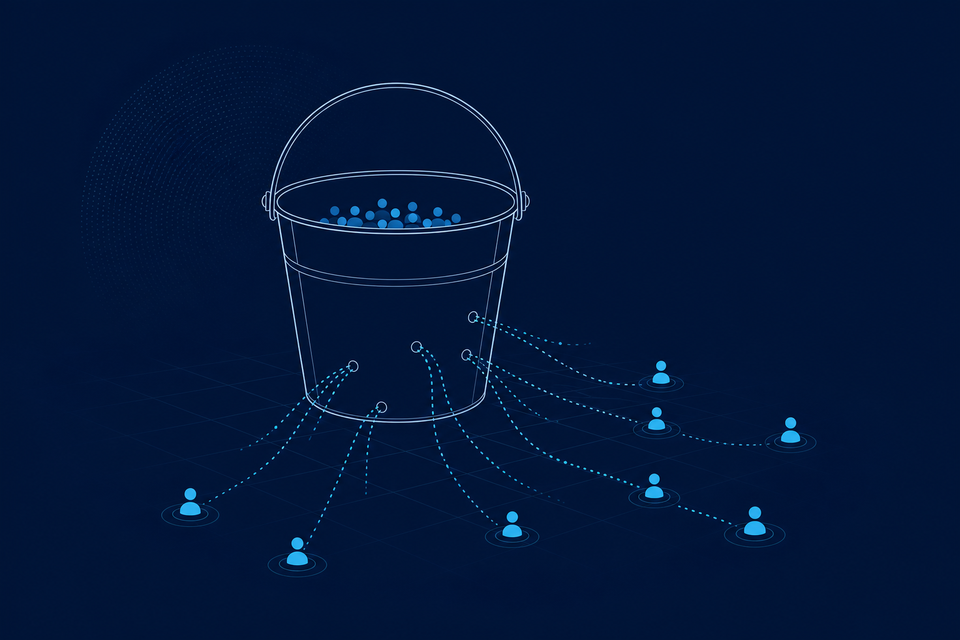
- Don't open a new acquisition channel until #1 and #2 are fixed. Every dollar that comes in over a leaky bucket comes back out. Plug the bucket first.
The brands that break $2M and keep going do this work first. The ones that stall keep pouring.
How Finsi fits
We built Finsi because the analytics tooling for this work is broken at the size where it matters most. A 5-person brand can't afford a data team. The general-purpose dashboards don't surface the questions above. So the founder either flies blind or pays for three tools that each show 30% of the picture.
Finsi connects to Shopify, Recharge, and Klaviyo, pulls the cohort math automatically, and surfaces the dormant segment without an analyst in the loop. Setup is 15 minutes.
If you're stuck at $2M and want a read on which leak is actually the problem, we'll do a free 30-day trial. No migration, no integration project. You'll either find the leak or you won't — and you'll know which one we're talking about.
Start the trial at finsi.ai, or book a 20-minute walkthrough if you want to look at your numbers together first.