
Shopify Analytics: Why Built-in Reports Aren't Enough and What to Use Instead
Shopify's built-in analytics have improved significantly over the years. The dashboard gives you sales totals, traffic sources, conversion rates, and basic customer reports. For a brand just starting out, it is genuinely useful. But there is a ceiling - and most growing brands hit it faster than they expect.
The problem is not that Shopify analytics are bad. They are fine for what they are: a transactional reporting layer for your store. The problem is that running and growing an e-commerce business requires a fundamentally different type of analytics than "how many orders did we get yesterday." You need to understand customer lifetime value, cohort behavior, cross-channel attribution, predictive churn, profitability by segment, and more. Shopify was not built to answer those questions.
This guide covers exactly where Shopify analytics falls short, what you actually need as a growth-stage brand, and how to build an analytics stack that gives you the insights to make better decisions.
What Shopify Analytics Actually Provides
Before talking about gaps, let us give credit where it is due. Shopify's reporting suite includes:
Sales reports. Total sales, sales by product, sales by channel, sales by discount code, average order value over time. These are transactional basics, and Shopify handles them well. You can filter by date range, compare periods, and export data.
Traffic reports. Sessions by source, landing page performance, device breakdown, geographic distribution. These reports pull from Shopify's own tracking (not Google Analytics), so they capture checkout behavior that GA sometimes misses.
Customer reports. First-time vs. returning customers, customers by location, customers over time. Shopify also provides a basic customer segmentation tool that lets you filter by purchase history, email subscription status, and other attributes.
Behavior reports. Top online store searches, sessions by landing page, sessions with cart additions. These help you understand how visitors navigate your store.
Finance reports. Gross sales, returns, net sales, taxes, shipping charges, and payments by provider. Useful for basic bookkeeping and reconciliation.
Live view. Real-time visitor activity on your store. Mostly useful during product launches and sales events.
For a brand doing under $500K in revenue with a straightforward business model, these reports cover the basics. The trouble starts when you need to go deeper.
Where Shopify Analytics Falls Short
No True Lifetime Value Analysis
Shopify can tell you that a customer has placed 3 orders totaling $287. It cannot tell you what that customer's predicted future value is, how they compare to similar customers at the same point in their lifecycle, or whether they are likely to place a fourth order.
True LTV analysis requires cohort tracking (how do customers acquired in January behave differently from those acquired in June?), predictive modeling (based on purchase patterns, what is the expected future revenue?), and segmentation (which customer segments have the highest LTV and why?). Shopify provides none of this natively.
This matters because LTV determines how much you can afford to spend on acquisition. Without accurate LTV data, you are either overspending on customers who will never return or underspending on high-value segments that would justify higher acquisition costs. Tools that specialize in predictive LTV can forecast customer value within 30-60 days of their first purchase, giving you a massive advantage in allocation decisions.
No Cohort Analysis
Cohort analysis groups customers by when they were acquired and tracks their behavior over time. It answers questions like: "Are customers acquired this quarter retaining better than those acquired last quarter?" and "How does purchase frequency change over months 3-6 compared to months 1-3?"
Shopify shows you customers over time as a flat list. You cannot group by acquisition date, compare cohorts side by side, or visualize retention curves. This is one of the most fundamental analytics capabilities for subscription and repeat-purchase businesses, and its absence from Shopify is a significant gap.
No Cross-Channel Attribution
If a customer sees a Meta ad, clicks a Google search result two days later, opens a Klaviyo email the following week, and then buys - who gets the credit? Shopify will attribute that sale to the last touchpoint (probably "direct" or "email"), which tells you almost nothing about what actually drove the purchase.
Cross-channel attribution requires stitching together customer touchpoints across platforms, applying statistical models to estimate each channel's contribution, and adjusting for the reality that customer journeys are non-linear and multi-touch. Shopify does not attempt any of this.
The consequence is that you misallocate your marketing budget. You over-invest in channels that capture demand (like branded search and email) and under-invest in channels that create demand (like Meta prospecting and TikTok awareness). Over time, this leads to a shrinking top of funnel and plateauing growth.
No Predictive Models
Shopify tells you what happened. It does not tell you what is about to happen. There are no churn predictions, no forecasts of future revenue by segment, no identification of at-risk customers before they lapse.
Predictive analytics transforms how you operate because it shifts you from reactive to proactive. Instead of waiting for customers to churn and then trying to win them back (expensive), you identify at-risk customers early and intervene before they lapse (much cheaper). Instead of guessing which segments will grow, you model future behavior based on historical patterns.
No Email or Ads Integration
Your Shopify data exists in isolation from your marketing data. You cannot see email campaign performance alongside purchase data in a unified view. You cannot correlate ad creative performance with customer LTV. You cannot understand which Klaviyo flows drive the highest-value repeat purchases or which Meta campaigns attract one-time buyers.
This separation forces you to context-switch between platforms and mentally stitch together data that should be presented together. It also means you miss correlations that are only visible when data is unified.
No Profitability Analysis
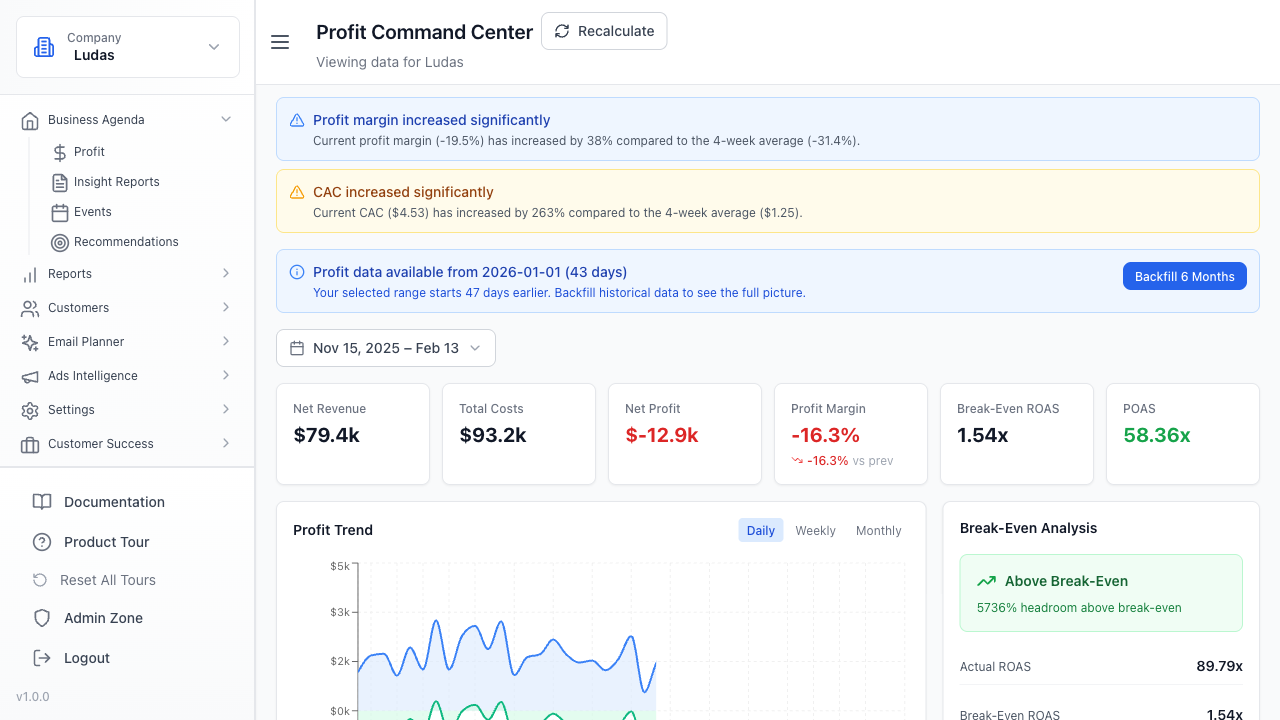
Shopify shows you gross revenue but not true profitability. It does not factor in COGS at the product level, shipping costs, ad spend, platform fees, or return costs to give you a real-time P&L. You can calculate these manually in a spreadsheet, but that is a time-consuming process that quickly becomes outdated.
Knowing revenue is nice. Knowing profit is essential. Many brands discover that their best-selling products are actually margin-negative when all costs are included, or that a high-revenue channel is unprofitable after accounting for ad spend and returns. Without profit intelligence integrated into your analytics, you are flying blind on the metric that actually matters.
What Growth-Stage Brands Actually Need
Once you pass the $1M revenue mark, your analytics needs expand significantly. Here is what a proper analytics stack should cover:
Unified Customer View
Every touchpoint - purchases, email opens, ad impressions, support tickets, subscription activity - should be connected to a single customer profile. This is the foundation for every other type of analysis. Without it, you are looking at fragmented snapshots rather than complete customer stories.
Cohort-Based Retention Tracking
You need to see how each acquisition cohort behaves over time: purchase frequency, average order value, retention rate, and revenue per customer by month. This reveals trends that aggregate metrics hide. Your overall retention rate might look stable while your most recent cohorts are actually retaining much worse - a leading indicator of future trouble.
Predictive LTV and Churn Scoring
Every customer should have a predicted lifetime value and a churn probability score. These scores should update in real time as new behavior data comes in. They enable smarter decisions about acquisition spending, retention investment, and customer service prioritization.
Multi-Touch Attribution
You need attribution that goes beyond last-click. Whether it is a statistical model, media mix modeling, or a hybrid approach, your attribution system should give you a more realistic picture of each channel's contribution to revenue and customer acquisition.
Real-Time Profitability
Revenue is vanity, profit is sanity. Your analytics should show you real-time profitability at the product level, channel level, and campaign level. This means integrating COGS, ad spend, shipping, returns, and platform fees into a single P&L view.
Actionable Recommendations
The best analytics do not just present data - they tell you what to do. This is the emerging frontier of e-commerce analytics, where AI analyzes your unified data and surfaces prioritized recommendations: "Scale this campaign because it acquires high-LTV customers," "Launch a win-back flow targeting this segment," "Pause this ad set because it is margin-negative."
Categories of Tools That Fill the Gaps
The Shopify analytics gap can be filled by several categories of tools:
Attribution platforms (Northbeam, Triple Whale) focus on solving the channel attribution problem. They deploy server-side pixels and statistical models to give you better visibility into which marketing channels drive real value.
LTV and retention tools (Lifetimely, Peel Insights) specialize in cohort analysis, customer lifetime value tracking, and retention metrics. They connect to Shopify and present the retention analytics that Shopify lacks.
Business intelligence platforms (Polar Analytics, Glew) provide customizable dashboards that unify data from multiple sources. They require more configuration but offer flexibility in how you visualize and analyze data.
Full-stack analytics platforms (Finsi) combine attribution, retention, LTV, profitability, email analytics, and AI recommendations in a single platform. These are the most full option but require the most commitment.
How to Build a Shopify Analytics Stack
There are three approaches to extending your analytics beyond Shopify:
Approach 1: Point Solutions
Pick individual tools for each gap. Use Northbeam for attribution, Lifetimely for LTV, and build manual reports for everything else. This approach is affordable and lets you solve one problem at a time.
Pros: Lower initial cost, solve one problem at a time, easy to swap individual tools.
Cons: Data silos between tools, no unified customer view, more manual work to connect insights, higher total cost as you add tools.
Approach 2: BI Platform Plus Integrations
Use a platform like Polar Analytics to connect your data sources and build custom dashboards. This gives you flexibility and a more unified view, though you still need to know what questions to ask.
Pros: Flexible, customizable, unified data view.
Cons: Requires analytics expertise to set up properly, no built-in recommendations, you get dashboards but not actions.
Approach 3: Full-Stack Platform
Use a full platform like Finsi that covers analytics, attribution, retention, LTV, email intelligence, and AI recommendations in a single tool. This is the most complete approach and eliminates data silos entirely.
Pros: Unified data, AI-driven recommendations, covers all analytics needs, no context-switching between tools.
Cons: Larger commitment, learning curve across features, less flexibility than a custom BI setup.
Which Approach Is Right for You?
If you are a brand under $1M in revenue, start with Approach 1. Install Lifetimely from the Shopify App Store and get comfortable with cohort analysis and LTV tracking. That alone will change how you think about your business.
If you are between $1M and $5M, consider Approach 2 or 3 depending on whether you have analytics expertise in-house. A BI platform works well if you have someone who knows what to build. A full-stack platform works better if you want to be told what matters.
If you are above $5M, Approach 3 is almost certainly the right move. At this scale, the cost of data silos and manual analysis exceeds the cost of a full platform. The time your team spends switching between tools and stitching data together is time they are not spending on growth.
Getting Started
The first step is honest assessment. Look at the decisions you made last week that involved data. Where did that data come from? How long did it take to compile? Were you confident in the numbers?
If the honest answers are "Shopify and spreadsheets," "hours," and "not really," then it is time to upgrade your analytics stack. The tools exist to give you faster, more accurate, and more actionable insights. The only question is which approach fits your brand's stage and needs.
For Shopify brands specifically, the Shopify integration is the foundation of any analytics upgrade - make sure whichever tool you choose connects deeply with your store data, not just surface-level metrics.
Frequently Asked Questions
What analytics does Shopify provide out of the box?
Shopify includes sales reports (total sales, sales by product, channel, and discount code), traffic reports (sessions by source, landing page, and device), customer reports (first-time vs. returning, location), behavior reports (top searches, cart additions), finance reports (gross/net sales, taxes, shipping), and a real-time live view. These cover transactional basics well and are sufficient for brands under $500K in revenue with a straightforward business model. For a broader view of what metrics matter most, see our e-commerce KPIs and metrics guide.
What are the main limitations of Shopify's built-in reports?
Shopify lacks true lifetime value analysis, cohort-based retention tracking, cross-channel attribution, predictive models (churn scoring, LTV forecasting), email and ads integration, and profitability analysis that accounts for COGS, ad spend, and return costs. It tells you what happened yesterday but cannot tell you what is about to happen or why. For growth teams and founders making allocation decisions across channels, these gaps mean relying on incomplete data or manually stitching together spreadsheets from multiple platforms.
What are the best Shopify analytics apps and tools?
The main categories are attribution platforms (Northbeam, Triple Whale) for cross-channel attribution, LTV and retention tools (Lifetimely, Peel Insights) for cohort analysis and customer lifetime value, BI platforms (Polar Analytics, Glew) for customizable multi-source dashboards, and full-stack analytics platforms like Finsi that combine attribution, retention, LTV, profitability, email intelligence, and AI recommendations in a single tool. The right choice depends on your revenue stage and whether you have analytics expertise in-house. Brands under $1M can start with a point solution; brands above $5M typically benefit most from a full-stack approach.
Do I really need a separate analytics tool if I already use Shopify?
If you are making decisions about customer acquisition cost, marketing budget allocation, retention strategy, or product profitability, then yes. Shopify's reports are designed for store operations - inventory, orders, and basic sales tracking - not for the strategic decisions that drive growth. The moment you need to answer questions like "which acquisition channel produces the highest-LTV customers?" or "which customer segments are at risk of churning?" you have outgrown Shopify's native analytics. A predictive LTV or retention intelligence platform pays for itself by preventing wasted ad spend and catching at-risk customers before they leave. Start a free retention audit to see what Shopify's reports are not showing you.
How does Shopify analytics compare to third-party analytics platforms?
Shopify analytics is a transactional reporting layer - it excels at answering "how many orders, how much revenue, from which channels." Third-party platforms add the analytical depth needed for strategic decisions: cohort analysis, RFM segmentation, predictive modeling, cross-channel attribution, and real-time profitability. The comparison is not "better or worse" but "different purposes." Most successful Shopify brands use both - Shopify for day-to-day store operations and a dedicated analytics platform for growth strategy. For finance leaders who need accurate unit economics and margin visibility, third-party tools are essential because Shopify does not incorporate COGS, ad spend, or return costs into its reporting.
Stop guessing. Start knowing.
Finsi connects your e-commerce data, tells you what to do, and executes it — email campaigns, ad optimization, retention flows. Free 30-day trial.
Start Free Trial