
How to Set CAC Targets by Channel
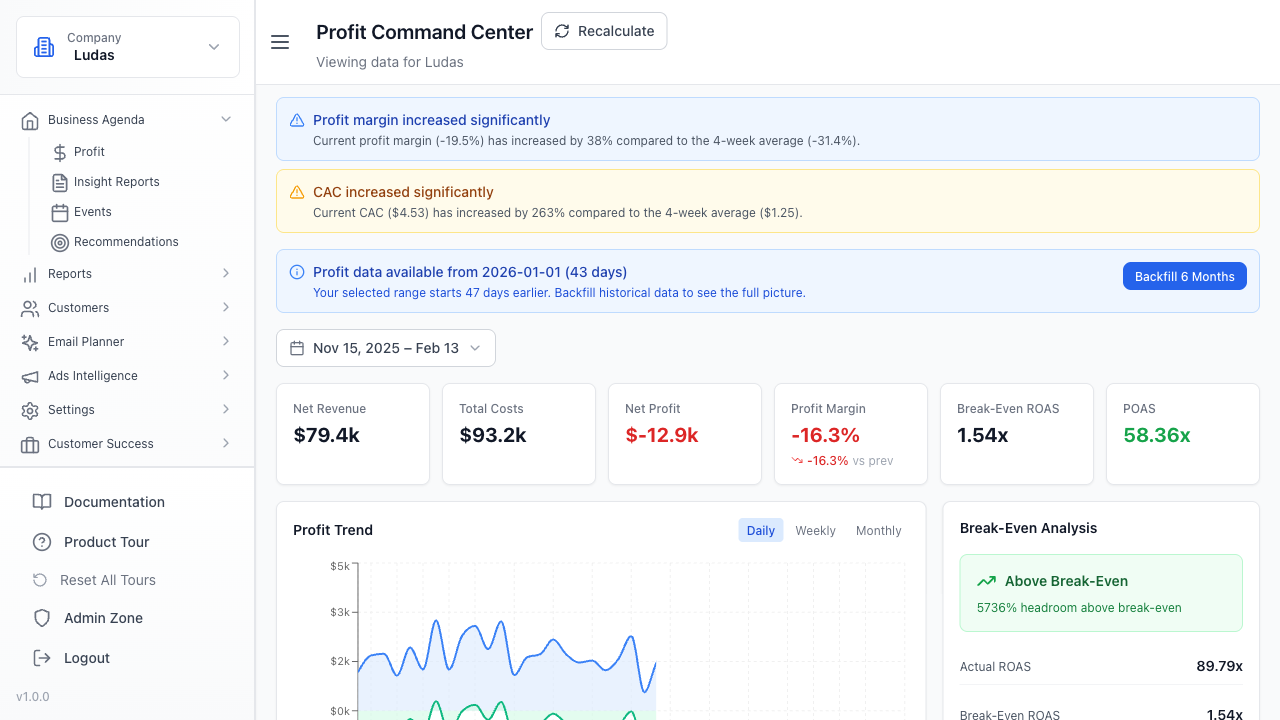
Customer Acquisition Cost (CAC) target is the maximum allowable spend per new customer on a given channel, derived from lifetime value, gross margin, and payback period constraints.
Why Channel-Specific CAC Targets Matter
Most DTC operators track a single blended CAC across all channels. This creates a false floor. Paid social might sustain a $45 CAC while email-driven acquisition should cost $8. Blending them obscures which channels are actually profitable and which are dragging down returns.
Channel-specific targets force clarity on unit economics. They expose which acquisition levers are working and which need optimization or shutdown. A brand running paid search, TikTok, and affiliate simultaneously needs to know the ceiling for each - not an average that hides underperformance.
Setting targets also prevents the common trap of scaling unprofitable channels. Without a defined CAC ceiling per channel, operators often chase volume on whichever channel is cheapest to acquire from, only to discover months later that those customers have terrible retention or order value.
The Core Formula: From LTV to Max CAC
Start with gross margin per customer, not revenue. If a brand sells a $100 product with 60% COGS, gross profit is $60. This is the only pool available to cover acquisition, fulfillment, support, and overhead.
Next, estimate customer lifetime value (LTV). For a typical DTC brand with repeat purchase behavior, LTV = (average order value × gross margin %) × repeat purchase rate × customer lifespan (in months or years). A $100 AOV at 60% margin with 40% repeat purchase rate and 24-month lifespan yields: $100 × 0.60 × 0.40 × 24 = $5,760 gross profit LTV.
From LTV, subtract all non-acquisition costs: fulfillment, payment processing, customer support, returns, and a buffer for overhead. Call this total 'fully loaded unit cost.' If those costs sum to $25 per customer, the acquisition pool is $5,760 - $25 = $5,735.
Apply a payback period constraint. Most operators want CAC repaid within 3 - 6 months. If payback is 6 months and repeat purchase rate is 40%, the customer will have made roughly 2 - 3 repeat purchases by then. Use this to calculate a conservative CAC ceiling: max CAC = (LTV × payback period %) - non-acquisition costs. A 6-month payback on $5,735 LTV suggests a max CAC around $1,150 - $1,500 depending on repeat velocity.
- LTV = (AOV × gross margin %) × repeat rate × customer lifespan
- Payback period typically 3 - 6 months for DTC
- Max CAC = (LTV × payback %) - fully loaded unit costs
- Recalculate quarterly as margins and retention shift
Adjusting Targets by Channel Economics
Not all customers are equal. A customer acquired via paid search may have higher AOV and repeat rate than one from TikTok. A customer from email referral typically has lower CAC but also lower LTV. Channel-specific LTV is the missing piece most operators skip.
Analyze cohort LTV by acquisition channel over the past 6 - 12 months. Pull repeat purchase rate, average repeat AOV, and churn by source. A brand might find that paid search customers have 50% repeat rate and $85 repeat AOV, while TikTok customers have 25% repeat rate and $60 repeat AOV. This 2x difference in repeat behavior justifies a 2x difference in CAC ceiling.
Apply channel-specific margin adjustments too. Affiliate channels often carry higher commissions (10 - 30%), which reduces the effective margin available for acquisition. A 60% gross margin becomes 45% after affiliate commission, lowering the CAC ceiling proportionally.
Seasonal and competitive factors also shift targets. During Q4, paid search CPCs spike 40 - 60%, making the same CAC harder to achieve. Adjust targets downward or accept lower volume. In off-season, lower CPCs may justify testing higher CAC targets to capture market share.
- Calculate LTV separately for each acquisition channel
- Account for channel-specific commissions and fees
- Adjust targets seasonally for cost inflation or deflation
- Weight targets by customer quality (AOV, repeat rate, churn)
Building a CAC Target Scorecard
Create a simple matrix: channel, blended LTV, channel-specific LTV, fully loaded unit cost, payback period, and resulting max CAC. Update it quarterly. This becomes the operating document that guides spend allocation and channel performance reviews.
Example for a skincare brand: Paid Search has channel LTV of $2,100, unit cost of $18, 6-month payback target, yielding max CAC of $315. TikTok has channel LTV of $1,200, unit cost of $15, 6-month payback, yielding max CAC of $165. Email (organic) has channel LTV of $900, unit cost of $8, 12-month payback, yielding max CAC of $67.
Use the scorecard to set monthly or weekly CAC budgets per channel. If paid search is running at $280 CAC against a $315 target, it's healthy. If TikTok is at $185 against a $165 target, it's over budget and needs optimization or pause. This prevents drift and keeps teams accountable.
Share the scorecard with marketing, finance, and product teams. Transparency on CAC targets reduces finger-pointing and aligns incentives. When a channel owner sees their target in writing, they know what success looks like.
- Update scorecard quarterly or after major product/pricing changes
- Include channel LTV, unit cost, payback period, and max CAC
- Use as the source of truth for spend allocation decisions
- Review actual CAC vs. target in weekly or monthly business reviews
Common Pitfalls and Adjustments
Pitfall 1: Using blended LTV across all channels. This hides channel-specific quality and leads to overspending on low-LTV sources. Always segment LTV by channel before setting targets.
Pitfall 2: Ignoring payback period constraints. A $500 CAC might be mathematically justified by LTV, but if it takes 18 months to repay, cash flow breaks before the payback arrives. Enforce a 3 - 6 month payback rule to protect working capital.
Pitfall 3: Setting targets too tight. If a channel's actual CAC is consistently 10 - 15% above target, the target may be unrealistic. Adjust upward or accept lower volume. Chasing an impossible target wastes time and demoralizes teams.
Pitfall 4: Forgetting to account for incrementality. Not all paid customers are incremental. Some would have purchased anyway (organic leakage). If 20% of paid search volume is non-incremental, effective CAC is 25% higher than reported. Adjust targets down to account for this leakage.
Pitfall 5: Treating CAC targets as static. Margins compress, retention drops, competition intensifies. Recalculate targets every quarter. A target set in January may be obsolete by April if product margins fell or churn spiked.
- Segment LTV by channel; never use blended LTV for all channels
- Enforce payback period constraints to protect cash flow
- Adjust targets upward if consistently unachievable
- Account for non-incremental volume and organic leakage
- Recalculate quarterly as unit economics shift
Stress-Testing Your Targets
Once targets are set, run scenarios. What if repeat purchase rate drops 10%? What if COGS rise 5%? What if churn accelerates? Model the impact on LTV and CAC ceiling. A 10% drop in repeat rate might lower CAC ceiling by $200 - $300. Knowing this in advance prevents surprises.
Test targets against historical performance. Pull the last 12 months of customer cohorts and calculate actual payback by channel. If actual payback is 8 months but target assumes 6, the target is too aggressive. Adjust.
Run a sensitivity analysis on the two biggest drivers: repeat purchase rate and customer lifespan. Most DTC brands are most sensitive to repeat rate. A 5% swing in repeat rate often moves CAC ceiling by 10 - 15%. Identify your sensitivity and monitor it closely.
Benchmark against industry peers if data is available. Fintech and beauty brands typically sustain higher CAC targets (due to higher LTV) than apparel or home goods. Know where your brand sits and why. This context prevents both overconfidence and unnecessary conservatism.
- Model scenarios: repeat rate down 10%, COGS up 5%, churn up 20%
- Validate targets against actual historical payback by channel
- Identify the two biggest LTV drivers and monitor them weekly
- Benchmark CAC targets against category peers
Operationalizing Targets Across Teams
CAC targets are only useful if they drive decisions. Embed them into weekly performance reviews. If a channel is above target, ask why. Is it a temporary CPM spike, or is the channel deteriorating? If below target, ask if volume is being left on the table.
Connect CAC targets to budget allocation. If paid search is at $280 CAC against a $315 target with room to scale, increase budget. If TikTok is at $200 against a $165 target, reduce spend or pause until optimization brings it back in line. This creates a feedback loop that naturally optimizes spend.
Train the team on the logic behind targets. Operators who understand that CAC targets come from LTV and payback period constraints are more likely to respect them and less likely to chase volume at any cost. Share the scorecard, explain the math, and reinforce it monthly.
Automate CAC tracking by channel in your analytics platform. Manual spreadsheets drift and become stale. Real-time dashboards showing actual CAC vs. target by channel keep teams aligned and enable rapid course correction.
- Review actual CAC vs. target in weekly business reviews
- Adjust spend allocation based on target performance
- Train teams on the LTV and payback logic behind targets
- Automate CAC tracking and reporting by channel
FAQ
How often should CAC targets be recalculated?
Quarterly is standard. Recalculate sooner if there's a major change: product price increase or decrease, significant margin compression, acquisition of a new customer segment, or a shift in repeat purchase behavior. Most brands also recalculate before peak season (Q4) to adjust for higher CPCs and competitive intensity.
What if a channel's actual CAC is consistently above target?
First, verify the CAC calculation is correct and accounts for all costs. Second, check if the channel LTV is actually lower than assumed - pull recent cohorts and validate repeat rate and churn. If LTV is lower, lower the target. If LTV is correct but CAC is high, either optimize the channel (improve conversion, reduce CPC) or reduce spend. Chasing an unrealistic target wastes budget.
Should CAC targets include or exclude non-incremental volume?
Exclude it. If 20% of paid search volume would have purchased anyway (organic leakage), your effective CAC is 25% higher than reported. Adjust targets downward to account for this. Use incrementality testing or attribution modeling to estimate leakage, then apply a discount to reported CAC before comparing to target.
How do I handle channels with very different LTVs?
Set separate targets for each. A high-LTV channel (e.g., paid search with 50% repeat rate) can sustain a higher CAC ceiling than a low-LTV channel (e.g., TikTok with 25% repeat rate). Calculate channel-specific LTV over 6 - 12 months of cohort data, then apply the same payback period formula to each. This ensures each channel is evaluated fairly based on the actual value of customers it acquires.
FAQ
How often should CAC targets be recalculated?
Quarterly is standard. Recalculate sooner if there's a major change: product price increase or decrease, significant margin compression, acquisition of a new customer segment, or a shift in repeat purchase behavior. Most brands also recalculate before peak season (Q4) to adjust for higher CPCs and competitive intensity.
What if a channel's actual CAC is consistently above target?
First, verify the CAC calculation is correct and accounts for all costs. Second, check if the channel LTV is actually lower than assumed - pull recent cohorts and validate repeat rate and churn. If LTV is lower, lower the target. If LTV is correct but CAC is high, either optimize the channel (improve conversion, reduce CPC) or reduce spend. Chasing an unrealistic target wastes budget.
Should CAC targets include or exclude non-incremental volume?
Exclude it. If 20% of paid search volume would have purchased anyway (organic leakage), your effective CAC is 25% higher than reported. Adjust targets downward to account for this. Use incrementality testing or attribution modeling to estimate leakage, then apply a discount to reported CAC before comparing to target.
How do I handle channels with very different LTVs?
Set separate targets for each. A high-LTV channel (e.g., paid search with 50% repeat rate) can sustain a higher CAC ceiling than a low-LTV channel (e.g., TikTok with 25% repeat rate). Calculate channel-specific LTV over 6 - 12 months of cohort data, then apply the same payback period formula to each. This ensures each channel is evaluated fairly based on the actual value of customers it acquires.