
How to Scale Meta Spend Without Killing MER
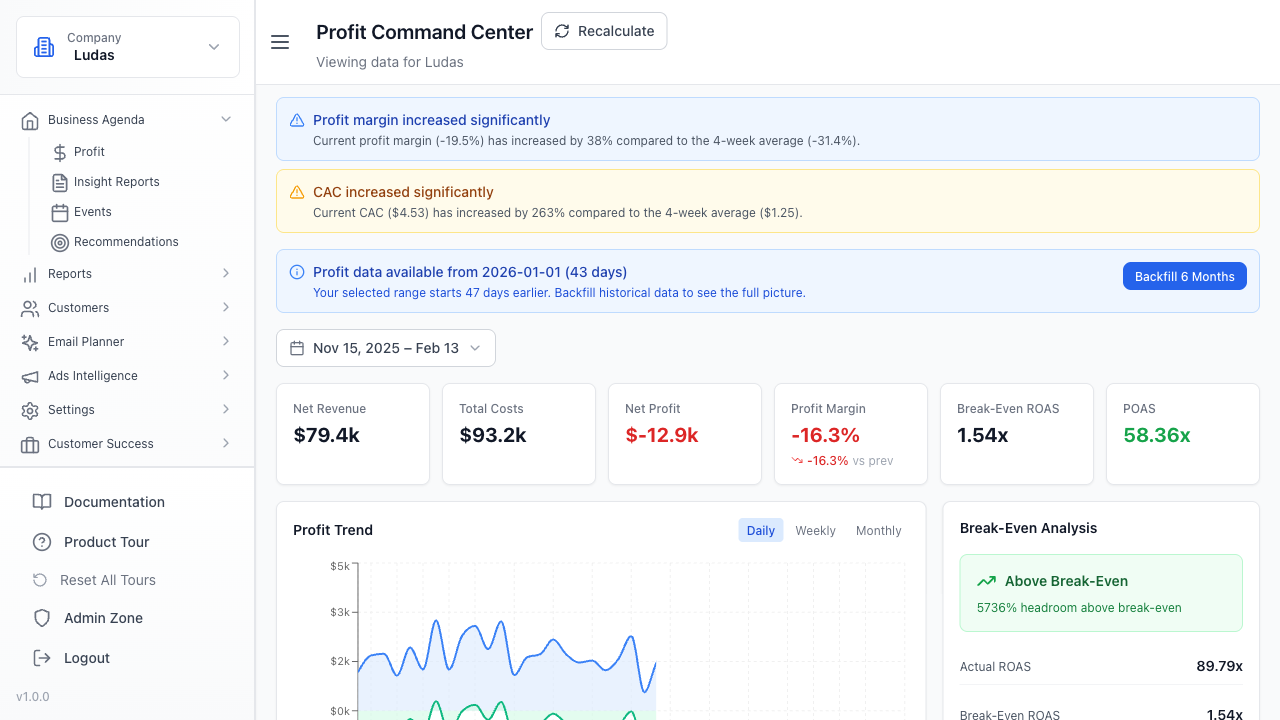
Scaling Meta spend profitably requires isolating new budget allocation into learning phases with defined performance floors, preventing algorithm degradation from collapsing unit economics across your entire account.
Why Scaling Meta Spend Kills MER (And How to Prevent It)
Most operators hit a wall around 2x - 3x baseline spend. The instinct is sound: if $10k/day works, $30k/day should work proportionally. It doesn't. Meta's algorithm needs training data to optimize for your conversion event at scale. When you dump budget into an audience or campaign without guardrails, the system explores lower-intent users faster than it can optimize, driving CPC up and conversion rate down. MER (marketing efficiency ratio) collapses because the algorithm is learning on your dime across a wider, colder audience.
The core problem: Meta doesn't distinguish between 'this user is a good fit' and 'this user is cheap to reach.' At low spend, the algorithm defaults to high-intent users because they convert faster. At high spend without proper structure, it optimizes for volume and delivery speed, not quality. You end up paying for scale you didn't actually want.
Define Your Learning Budget and Performance Floor
A learning budget is the incremental spend you allocate to test new scale, separate from your proven baseline. This is not a percentage of total spend - it's a fixed dollar amount you're willing to lose to gather signal. If your baseline is $10k/day at 3.5 MER, your learning budget might be $3k/day in a new campaign or audience segment. That $3k is your tuition for understanding whether 4x scale is viable.
Set a performance floor before you launch. This is the minimum MER you'll accept during the learning phase. If your baseline is 3.5 MER, your floor might be 2.8 MER - a 20% decline you can absorb. If the learning budget hits 2.8 MER and stays there after 500 - 1000 conversions, you know that audience or creative doesn't scale. Kill it. If it improves toward 3.2 - 3.4 MER after learning, you have a signal to graduate it to baseline spend.
Conversion volume matters more than time. Meta's algorithm needs roughly 50 conversions per day per ad set to train effectively. If you're running $3k/day learning budget across 6 ad sets, you're spreading signal too thin. Consolidate into 2 - 3 ad sets so each hits 25 - 30 conversions/day and the algorithm can actually learn.
Segment Your Spend: Proven, Learning, and Experimental
Treat your Meta account like a portfolio. Proven spend is your baseline - the campaigns and audiences that consistently hit your target MER. This is 60 - 70% of total budget. You optimize for efficiency here, not growth. Learning spend is 20 - 30% of budget allocated to scaling proven audiences or testing new creative within proven audiences. Experimental spend is 5 - 10% for entirely new audiences or campaign structures.
This segmentation prevents a single bad learning phase from dragging down your entire account. If your experimental spend tanks, it's isolated. If your learning spend underperforms, you can pause it without losing the signal from your proven baseline. Operators who mix all three together can't tell what's working because the math is muddied.
Track each segment's MER independently. Your dashboard should show Proven MER, Learning MER, and Experimental MER as separate metrics. If Proven MER is 3.5, Learning MER is 2.9, and Experimental MER is 1.8, you know exactly where the problem is and whether it's worth continuing. This clarity is what separates profitable scaling from reckless spend increases.
Use Bid Caps and Budget Pacing to Control Learning Speed
Bid caps are your guardrail against Meta's algorithm running away with your budget. If your baseline CPC is $1.20 and your target MER is 3.5, your bid cap during learning should be $1.50 - $1.80. This forces the algorithm to stay disciplined while it explores. Without a bid cap, Meta will happily spend $3 - $4 per click during the learning phase because it's optimizing for volume, not efficiency.
Daily budget pacing is equally critical. Instead of setting a learning budget to $3k/day and letting Meta spend it all in the first 12 hours, use a daily budget cap that spreads spend evenly. This gives the algorithm more data points throughout the day and prevents the 'spend cliff' where you blow through budget on cheap, low-intent traffic. If your learning ad set has a $3k daily budget, Meta should spend roughly $125/hour, not $500 in the first 6 hours.
Combine bid caps with conversion value optimization. If you're scaling an audience, tell Meta to optimize for purchases above a certain AOV threshold, not just any purchase. This keeps the algorithm focused on high-value conversions during learning, even if it means fewer total conversions. You're training the system to find your best customers at scale, not just any customer.
The Learning Phase Checklist: 500 - 1000 Conversions
Don't make scaling decisions on day 3. Meta's algorithm needs volume to stabilize. The minimum viable learning phase is 500 conversions per ad set. At 25 conversions/day, that's 20 days. At 50 conversions/day, it's 10 days. Anything less and you're reacting to noise, not signal.
During the learning phase, monitor these metrics daily but don't optimize daily. Check MER, CPC, and conversion rate. If MER is trending toward your floor (2.8 in our example) after 200 conversions, you have a problem. If it's hovering at 3.2 - 3.3 after 300 conversions, let it run. The algorithm is still learning. Pause and pivot only if you hit your floor and stay there for 100+ conversions.
Once you hit 500 - 1000 conversions, make a binary decision: graduate this spend to baseline (because MER stabilized above your floor) or kill it (because it stayed at or below your floor). Don't let learning budgets drift indefinitely. They're temporary by design.
- Minimum 500 conversions before deciding to scale or kill
- Monitor MER, CPC, and conversion rate daily but don't optimize daily
- If MER hits your floor and stays there for 100+ conversions, kill the ad set
- If MER trends toward baseline MER after 300 - 400 conversions, graduate to baseline spend
Scaling Sequentially: The 1.5x Rule
Don't jump from $10k/day to $30k/day. Scale in 1.5x increments. $10k to $15k, prove it works, then $15k to $22.5k, prove it works, then $22.5k to $33k. Each step gets its own learning phase with its own performance floor. This is slower but it's the difference between sustainable growth and a catastrophic MER collapse.
Each 1.5x step should use the same guardrails: isolated learning budget, defined performance floor, bid caps, and daily pacing. The learning phase for step two might be shorter (300 - 400 conversions instead of 500 - 1000) because you already have signal from step one. But don't skip it. The algorithm needs to retrain at each scale level.
If any 1.5x step fails (MER hits your floor and stays there), you've found your ceiling. That's valuable information. You now know your account can profitably support 1.5x or 2x baseline spend, but not 3x. Build your growth plan around that reality instead of chasing scale that doesn't exist.
Common Scaling Mistakes and How to Avoid Them
Mistake 1: Increasing bid caps too aggressively. Operators see MER decline and assume they need to bid higher to 'win better placements.' Wrong. Higher bids during learning just train the algorithm to spend more on worse users. Keep bid caps tight. If MER is declining, the problem is audience quality or creative fatigue, not insufficient bids.
Mistake 2: Mixing learning and proven spend in the same campaign. If you increase a proven campaign's budget by 50% while also testing a new audience, you can't tell which one caused the MER decline. Separate them. Run proven audiences in one campaign, learning audiences in another. This isolation is non-negotiable.
Mistake 3: Ignoring creative fatigue during scaling. When you increase spend, you're showing the same creative to more people. Frequency increases, relevance score drops, CPC rises. Before you blame the algorithm or the audience, refresh creative. A 1.5x spend increase often needs 2 - 3 new creative variations to maintain MER.
Mistake 4: Scaling too many things at once. New audience + new creative + new campaign structure + 2x budget = no signal. You won't know what worked. Scale one variable at a time. Prove the audience works at 1.5x spend with existing creative. Then test new creative. Then test a new audience. Sequence matters.
FAQ
What's the difference between a learning budget and a testing budget?
A testing budget is exploratory - you're validating whether an idea has any merit at all. A learning budget is scaling - you've already validated the idea and you're now training Meta's algorithm to deliver it at higher volume. Testing might be $500/day for 3 days. Learning is $3k/day for 20 days. Testing answers 'does this work?' Learning answers 'how much can we scale this?'
Should I use the same performance floor for all learning phases, or adjust it by audience?
Adjust it by audience type and campaign objective. A cold traffic audience might have a 20% lower floor than a warm retargeting audience. A ROAS-optimized campaign might have a different floor than a CPC-optimized campaign. The floor should reflect the baseline MER of that specific audience or campaign type, minus 15 - 25%. Don't use a one-size-fits-all floor across your entire account.
How do I know if I've hit my account's true scaling ceiling?
You've hit your ceiling when you complete 2 - 3 sequential 1.5x scaling phases and the last one fails (MER hits your floor and stays there for 500+ conversions). At that point, you've found the maximum profitable spend level for your current audience pool, creative, and offer. To scale beyond that, you need new audiences, new creative, or a new offer. Trying to force more spend past that point just burns money.
Can I run learning phases on multiple audiences simultaneously, or should I do them one at a time?
You can run multiple learning phases simultaneously as long as each one is isolated (separate ad sets, separate budgets, separate performance tracking). What you can't do is run them in the same ad set or campaign because the data gets muddied. If you have $10k/day to allocate, you could run 3 learning audiences at $2k/day each, or 2 at $3k/day each, as long as each one hits 25 - 30 conversions/day for the algorithm to learn. The key is isolation and sufficient volume per ad set.
FAQ
What's the difference between a learning budget and a testing budget?
A testing budget is exploratory - you're validating whether an idea has any merit at all. A learning budget is scaling - you've already validated the idea and you're now training Meta's algorithm to deliver it at higher volume. Testing might be $500/day for 3 days. Learning is $3k/day for 20 days. Testing answers 'does this work?' Learning answers 'how much can we scale this?'
Should I use the same performance floor for all learning phases, or adjust it by audience?
Adjust it by audience type and campaign objective. A cold traffic audience might have a 20% lower floor than a warm retargeting audience. A ROAS-optimized campaign might have a different floor than a CPC-optimized campaign. The floor should reflect the baseline MER of that specific audience or campaign type, minus 15 - 25%. Don't use a one-size-fits-all floor across your entire account.
How do I know if I've hit my account's true scaling ceiling?
You've hit your ceiling when you complete 2 - 3 sequential 1.5x scaling phases and the last one fails (MER hits your floor and stays there for 500+ conversions). At that point, you've found the maximum profitable spend level for your current audience pool, creative, and offer. To scale beyond that, you need new audiences, new creative, or a new offer. Trying to force more spend past that point just burns money.
Can I run learning phases on multiple audiences simultaneously, or should I do them one at a time?
You can run multiple learning phases simultaneously as long as each one is isolated (separate ad sets, separate budgets, separate performance tracking). What you can't do is run them in the same ad set or campaign because the data gets muddied. If you have $10k/day to allocate, you could run 3 learning audiences at $2k/day each, or 2 at $3k/day each, as long as each one hits 25 - 30 conversions/day for the algorithm to learn. The key is isolation and sufficient volume per ad set.