
SaaS Isn't Dying. The Undifferentiated Middle Is.
TLDRBuilding software is the easy part. Maintaining it -- migrations, updates, edge cases at 2am -- is where most "I'll just build my own" plans quietly die.Features will converge across all SaaS. What won't converge is who the software is built for and what it's optimized toward.The new differentiator isn't product -- it's forward deployed engineers who fine-tune AI and software to specific customers at scale.More interesting software companies are coming, not fewer. The ones that survive will carry deep knowledge, not a long feature list.
The "SaaS is dead" crowd has been loud lately. Their argument: AI lets anyone build software, companies will build their own, and SaaS vendors are the next fax machines. I get the appeal. I've sat in rooms where this feels like obvious consensus.
Jessica Herrin, founder of Marklo, put it perfectly at the AI in Commerce conference this week. She brought up Tupperware: technically, you can heat food in it. In practice, that's a terrible idea. The gap between what's technically possible and what's actually a good use of your time is exactly where most of the "we'll just build our own" conversation lives.
Who Is Actually Building Things
People who build software tend to be surrounded by other people who build software. Founders, engineers, early adopters -- everyone in the room has shipped something recently. It feels like consensus. It isn't. What it is, is a bubble.
SlashData estimates roughly 47 million developers worldwide out of a global population of 8 billion. That's under 0.6%. And within that group, the subset who can actually ship and maintain production-quality software that runs a real business is smaller still. Founders will build. Technical operators who are obsessed with their workflow will build. But this group is genuinely the 1% of the 1%.
Take Tobi Lutke at Shopify. He codes, he ships things, he talks openly about using AI to build. But the software that processes millions of merchants' transactions isn't coming from his personal terminal. He's not about to fire his engineering org and build Shopify's production systems himself. The things a founder builds for fun or experimentation are not the same as the software that runs a company.
Here's the thing people miss when they say "building is easy": writing software is the easy part. The hard part is everything that comes after. Migrations, updates, resolving edge cases that only appear under load, fixing issues that surface from conversations with actual users, keeping the thing running when something breaks at the worst possible moment. If you've shipped production software, you know this. If you haven't, it doesn't occur to you.
The employee at a company mid-transformation -- the one chasing quarterly KPIs and dealing with their actual job responsibilities -- is not going to take on this burden. Not because they can't, but because it's not rational. Their mental bandwidth is already committed. The idea that enterprise employees will replace their software tools by building and maintaining their own is a founder's fantasy projected onto people who were never interested in that project.
The Market Won't Collapse. It Will Reorganize.
Here's a take I've heard from investors lately: AI will cause the software market to shrink dramatically. Too many companies doing the same things, not enough differentiation, and AI makes it cheap enough to build anything -- so why pay for it?
I think the first part is right and the conclusion is wrong.
Try counting how many companies sell protein powder. You'll run out of fingers quickly. Protein is protein. Macros are macros. And yet dozens of brands sell it, none of them are going away, and they're not competing on who has the best leucine ratio. People buy Ghost for one reason, Momentous for another, the Costco tub for a third. It's all branding, taste, relationship, community. The market didn't collapse to one winner. It organized around trust.
SaaS is heading in the same direction. When AI makes features cheap to build, features stop being the moat. Every platform will have dashboards, automations, and integrations. That convergence is already happening fast. What won't converge is the fundamental orientation of the software -- who it's built for and what it's trying to optimize.
Think of it like renovating a house. I'm actually in the middle of rebuilding mine -- removed half the structure, still reusing the foundation. But reusing a foundation doesn't convert a split-level into a colonial. The bones shape what's possible. The same is true for software companies. If a company started as analytics software, its data models, its defaults, its team's instincts are all organized around analytics. If it started as a supply chain solution, everything points toward supply chain problems. You can bolt on features from the other world, but the center of gravity doesn't move.
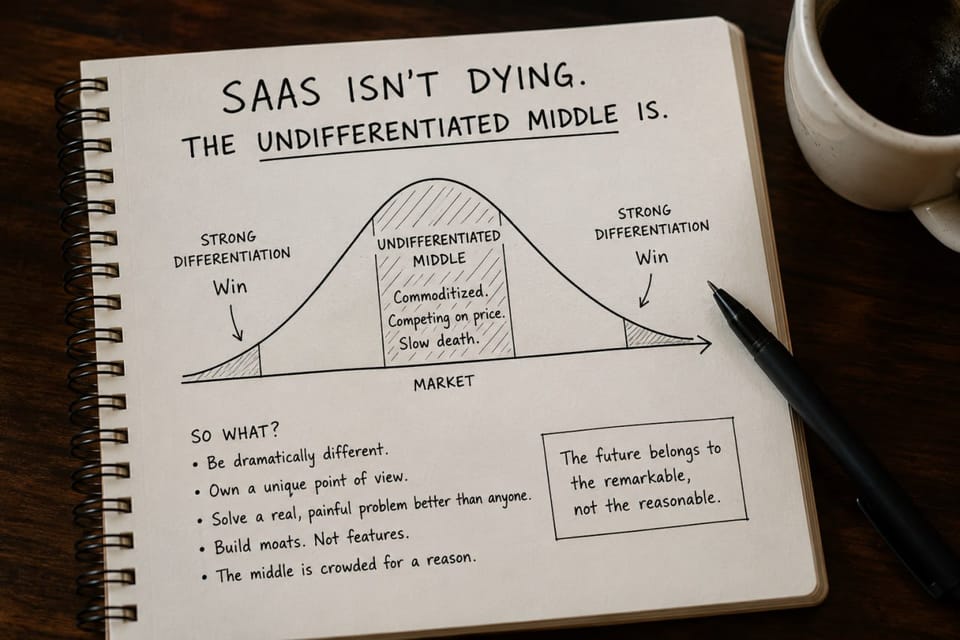
So there will be plenty of CRMs. Plenty of marketing platforms. Plenty of companies in the same space doing similar things. What's disappearing is the undifferentiated middle -- the vendors competing purely on feature lists and pricing, with no clear point of view on who they're actually for.
The New Differentiator: Forward Deployed Engineers
If AI builds features for everyone, what's left to compete on? Here's where I think the real answer is, and it's not what most people are talking about.
Forward deployed engineers aren't a new concept -- this role has existed at various companies for a while. But AI is about to make them the central differentiator in SaaS. These are people who fine-tune software, models, AI agents, and prompts to specific customers. Not building generic features, but doing the deep configuration work that makes a platform actually fit how a particular business operates.
Here's why this matters now: because AI can build features cheaply, the cost of standing up capabilities drops dramatically. That frees up room for the expensive, high-judgment work -- which is understanding a specific customer's business deeply enough to configure the system for their actual problem, not a generic version of it. One good forward deployed engineer can support multiple clients. They get better and faster with each one. And that accumulation of specific knowledge -- how this industry works, how this type of buyer thinks -- is the thing that's genuinely hard to copy.
The SaaS companies that win will be the ones that invest in these people and give them tools that are actually configurable to specific use cases. The ones that try to serve everyone with a one-size-fits-all product will lose to whoever has the most specialized understanding of any given customer's problem.
The Conway's Law Flip
There's a structural shift underneath all of this that goes beyond "AI makes software cheaper."
In 1968, Melvin Conway published a paper with a principle that turned out to be more durable than most software trends: organizations which design systems are constrained to produce designs which mirror their own communication structures. Your org chart ships in your product.
Siloed departments produce siloed software. Microsoft's Copilot famously felt like three different products fighting each other because three different divisions built competing components. That's Conway's Law doing exactly what it does.
For decades, this meant: change how your org is structured, then the software will follow. The org led.
AI is starting to flip this. When a small team can build what used to require a large, segmented engineering organization, the software architecture stops being constrained by how you're organized. A lean team can now ship something coherent that a large, siloed organization structurally cannot. The organizational debt shows up in the product, and customers are increasingly able to feel it.
This is a forcing function for existing SaaS companies. Layering AI on top of an org structure built for a different era produces exactly what Conway predicted: something that mirrors the org chart. The companies that restructure around outcomes rather than departments -- that get focused rather than comprehensive -- are the ones that will actually benefit from what AI makes possible.
Where This Actually Lands
Here's something I spent 11 years thinking about at Scentbird: how do you connect what an individual engineer is working on to whether the company survives?
Every company that wants to survive eventually has to think about profitability -- not just growth, not just reach. The path goes: reach, then growth, then cost discipline, then profitability. And somewhere along that path, most organizations lose the thread between what individuals are doing day-to-day and what the company is actually trying to achieve.
I believe AI is making something possible that wasn't before: companies with genuinely small organizations where every person can see the direct line from their work to the business bottom line. Not a vague sense of contribution -- actual measurement, actual impact. The forward deployed engineer who fine-tunes a retention model for a specific customer can see what that tuning does to churn. That feedback loop changes how people work.
That experience is a big part of why we built Finsi. The goal isn't another analytics platform. It's giving subscription businesses the ability to see exactly how every decision connects to the metrics that matter -- so that both leaders and the people doing the work can see their impact clearly. The tool is fast to use because the domain knowledge underneath it took a long time to accumulate.
SaaS is not dying. We're going to see more interesting software companies over the next decade, not fewer. Smaller teams carrying deep knowledge about specific industries, specific buyers, specific problems. That knowledge combined with AI's ability to build fast is what creates something genuinely hard to copy.
The era of winning on features is over. The era of winning on focus, accumulated knowledge, and actually understanding your customer's business is just starting.