
RFM Analysis for E-commerce: The Complete Guide to Data-Driven Customer Segmentation
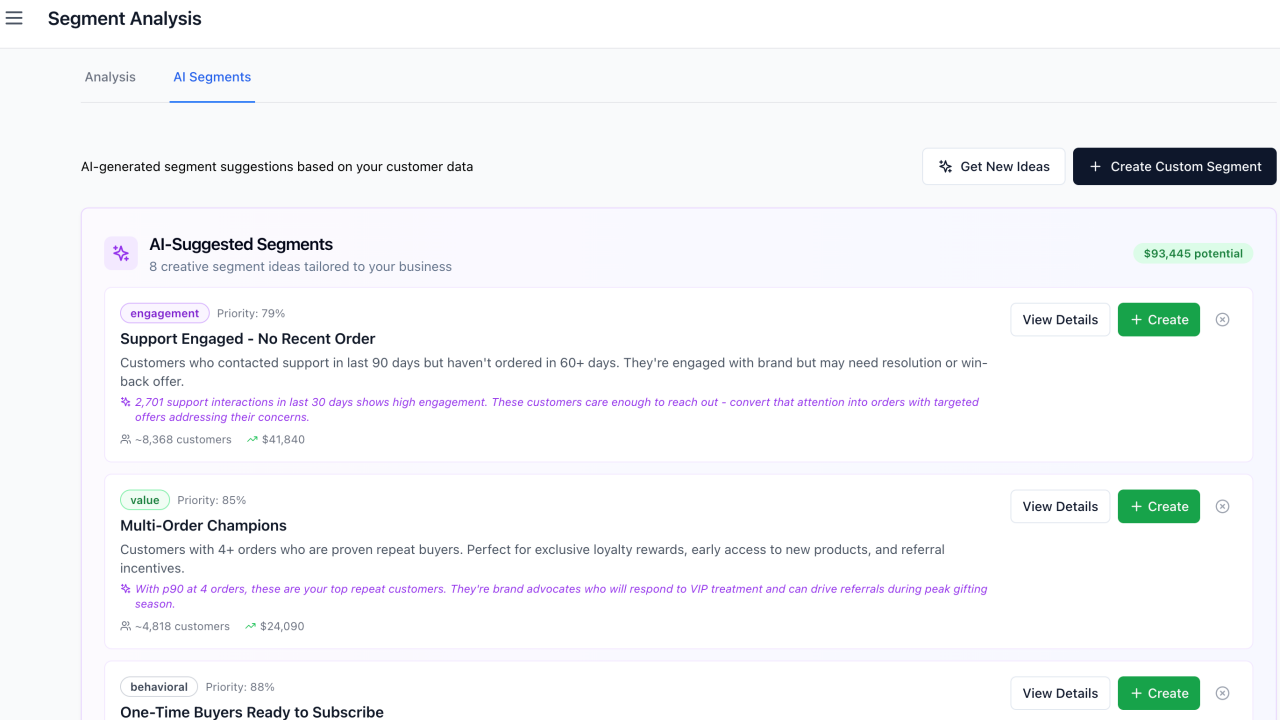
RFM analysis is a data-driven customer segmentation method that scores customers on three dimensions - Recency (how recently they purchased), Frequency (how often they purchase), and Monetary value (how much they spend) - to identify your most valuable customers, those at risk of churning, and those who need re-engagement. It is the most practical and actionable segmentation framework available to e-commerce brands because it uses data you already have (purchase history) and produces segments that directly map to marketing actions.
Unlike demographic or psychographic segmentation, which requires surveys and assumptions, RFM segmentation is built entirely on observed behavior. A customer who bought last week, buys monthly, and spends $200 per order is demonstrably more valuable than a customer who bought six months ago, has purchased once, and spent $35. RFM quantifies this difference and groups customers into actionable segments.
What RFM Stands For
Recency (R)
Recency measures how recently a customer made their last purchase. It is the single most predictive dimension of future purchasing behavior. A customer who bought yesterday is far more likely to buy again than one who bought six months ago - regardless of how much they have spent or how frequently they purchased in the past.
Recency is measured in days since the last purchase. A lower number (more recent) is better.
Frequency (F)
Frequency measures how many times a customer has purchased within a defined time period (typically 12 months). Frequency captures the strength and depth of the customer relationship. A customer who has placed 8 orders demonstrates a habitual purchasing pattern that a one-time buyer does not.
Frequency is measured as the total count of orders. A higher number is better.
Monetary (M)
Monetary value measures the total amount a customer has spent within the defined time period. It captures the economic value of the customer relationship. High-monetary customers contribute disproportionately to revenue - the Pareto principle applies, with 20% of customers typically generating 60-80% of revenue.
Monetary is measured as total spend in dollars. A higher number is better.
The RFM Scoring Methodology
Step 1: Calculate Raw Values
For each customer, calculate three values based on your order data:
- Recency: Days since their most recent order
- Frequency: Total number of orders in the analysis period (typically 12-24 months)
- Monetary: Total revenue from their orders in the analysis period
Step 2: Assign Scores (1-5 Scale)
Divide your customer base into quintiles (five equal groups) for each dimension. Assign a score of 1 (lowest) to 5 (highest) based on which quintile the customer falls into.
Recency scoring (inverted - lower days = higher score):
| Quintile | Days Since Last Purchase | Score |
|---|---|---|
| Top 20% | 0-14 days | 5 |
| Next 20% | 15-35 days | 4 |
| Middle 20% | 36-75 days | 3 |
| Next 20% | 76-150 days | 2 |
| Bottom 20% | 151+ days | 1 |
Frequency scoring:
| Quintile | Order Count (12 months) | Score |
|---|---|---|
| Top 20% | 8+ orders | 5 |
| Next 20% | 5-7 orders | 4 |
| Middle 20% | 3-4 orders | 3 |
| Next 20% | 2 orders | 2 |
| Bottom 20% | 1 order | 1 |
Monetary scoring:
| Quintile | Total Spend (12 months) | Score |
|---|---|---|
| Top 20% | $500+ | 5 |
| Next 20% | $300-499 | 4 |
| Middle 20% | $150-299 | 3 |
| Next 20% | $75-149 | 2 |
| Bottom 20% | Under $75 | 1 |
Note: The exact thresholds depend on your business. The quintile approach automatically adapts to your customer distribution. A luxury brand's bottom quintile might start at $200, while a consumables brand's top quintile might start at $300.
Step 3: Create the RFM Score
Combine the three scores into a three-digit RFM code. A customer with Recency=5, Frequency=4, Monetary=5 has an RFM score of 545. This code tells you immediately that this customer purchased very recently, buys frequently, and spends a lot - a high-value, highly engaged customer.
RFM Segment Definitions
The three-digit RFM score maps to named segments that are actionable for marketing. Here are the primary segments and their characteristics:
| Segment Name | RFM Scores | Description | Size (typical) |
|---|---|---|---|
| Champions | 555, 554, 545, 544 | Best customers. Recent, frequent, high-spend. | 5-10% |
| Loyal Customers | 435, 534, 543, 444, 445 | Consistent buyers with strong engagement. | 10-15% |
| Potential Loyalists | 453, 353, 443, 434, 343 | Recent buyers with growing frequency. | 10-15% |
| Recent Customers | 512, 511, 412, 411 | New buyers with only 1-2 purchases. | 10-15% |
| Promising | 425, 325, 324, 415 | Moderate recency and spend, room to grow. | 10-15% |
| Need Attention | 334, 333, 244, 243 | Above average historically, declining recently. | 10-15% |
| About to Sleep | 233, 232, 223, 222 | Below average across all dimensions, drifting away. | 5-10% |
| At Risk | 244, 144, 245, 145 | Previously valuable, now lapsing. | 5-10% |
| Cannot Lose | 155, 154, 145, 255 | Made large purchases in the past but have not returned. | 3-5% |
| Hibernating | 111, 112, 121, 122 | Lowest scores across all dimensions. Long lapsed. | 10-15% |
| Lost | 111 | No recent activity, single purchase, low spend. | 5-10% |
The RFM Scoring Matrix
A visual matrix helps teams quickly understand where each segment sits. The following simplified matrix uses R (rows) and F (columns) with M indicated by the segment name:
| F=5 (Most Frequent) | F=4 | F=3 | F=2 | F=1 (Least Frequent) | |
|---|---|---|---|---|---|
| R=5 (Most Recent) | Champions | Loyal Customers | Potential Loyalists | Recent Customers | New Customers |
| R=4 | Loyal Customers | Promising | Need Attention | Promising | Recent Customers |
| R=3 | Potential Loyalists | Need Attention | Need Attention | About to Sleep | Promising |
| R=2 | At Risk | At Risk | About to Sleep | About to Sleep | Hibernating |
| R=1 (Least Recent) | Cannot Lose | Cannot Lose | At Risk | Hibernating | Lost |
How to Use RFM Segments for Targeted Marketing
The value of RFM segmentation is that each segment has a clear, distinct marketing strategy. Here is how to treat each segment:
Champions (RFM: 5-5-5 range)
Strategy: Reward and use. These are your best customers - treat them that way.
- Enroll in VIP loyalty tier with exclusive benefits
- Offer early access to new product launches
- Invite into referral and ambassador programs
- Send exclusive content and behind-the-scenes updates
- Never send them generic discount emails - they buy at full price
Loyal Customers (RFM: 4-3-4 to 5-4-5 range)
Strategy: Deepen the relationship and increase share of wallet.
- Cross-sell into new product categories
- Offer loyalty program upgrades
- Recommend products based on purchase history
- Feature customer reviews and UGC opportunities
- Introduce subscription options for replenishable products
Potential Loyalists (RFM: 3-4-3 to 4-5-3 range)
Strategy: Nurture toward loyalty. These customers are engaged but have not yet committed.
- Send product education and brand story content
- Offer a small incentive for the next purchase (free shipping, 10% off)
- Introduce the loyalty program with a signup bonus
- Personalize recommendations based on first purchases
- Monitor engagement closely - these customers can go either way
At Risk (RFM: 1-4-4 to 2-4-5 range)
Strategy: Urgent re-engagement. These were valuable customers who are slipping away.
- Trigger win-back campaigns with strong incentives (20-25% off)
- Send "we miss you" messaging that references their past purchases
- Offer a personalized bundle based on their purchase history
- Use SMS and retargeting in addition to email
- Escalate to a personal outreach for highest-value customers
Cannot Lose (RFM: 1-5-5 range)
Strategy: Maximum effort recovery. These are high-value customers who have gone completely quiet.
- Send a personalized email from the founder or customer success team
- Offer the most aggressive incentive in your toolkit (30%+ off, free gift)
- Understand why they left - send a brief survey or offer a phone call
- If they had a negative support experience, acknowledge and resolve it
- Accept that some will not return - but the ones you save are extremely valuable
Hibernating and Lost (RFM: 1-1-1 to 1-2-2 range)
Strategy: Minimal investment. These customers are unlikely to return, and the cost of aggressive reactivation exceeds the expected value.
- Send one final win-back email with a modest offer
- If no response, move to a quarterly reactivation cadence or suppress from active lists
- Reduce email frequency to avoid damaging sender reputation
- Focus your budget on higher-potential segments
Common RFM Analysis Mistakes
Using Fixed Thresholds Instead of Quintiles
Setting arbitrary thresholds (e.g., "recency score 5 if purchased in last 7 days") creates uneven segments that do not reflect your actual customer distribution. Quintiles ensure each score level contains approximately 20% of customers, giving you evenly sized, actionable segments.
Ignoring Product Category Context
A customer who buys mattresses every 8 years is not comparable to one who buys coffee every 2 weeks. If your product catalog spans different repurchase cycles, consider running separate RFM analyses by product category or adjusting the time window for each category.
Over-Weighting Monetary Value
High-spend customers are important, but Monetary value is the least predictive of future behavior among the three dimensions. Recency is the strongest predictor, followed by Frequency. Do not let a high monetary score mask declining recency and frequency signals.
Static Segmentation
RFM segments should be recalculated regularly - weekly or at least monthly. Customers move between segments as their behavior changes. A static snapshot from three months ago is misleading.
Automating RFM with Finsi
Manual RFM analysis requires exporting order data, building scoring logic in a spreadsheet, and updating segments periodically. This works for initial exploration but does not scale.
Finsi's smart segmentation automates the entire RFM process - calculating scores in real time, assigning customers to segments as their behavior changes, and triggering segment-specific campaigns automatically. The platform extends beyond basic RFM by incorporating engagement signals (email opens, site visits, support tickets) and predictive modeling to identify customers who are about to move between segments before the transition happens, enabling proactive intervention through retention intelligence.
Frequently Asked Questions
What is RFM analysis?
RFM analysis is a data-driven customer segmentation method that scores every customer on three dimensions: Recency (how recently they purchased), Frequency (how often they purchase), and Monetary value (how much they spend). Each dimension is scored on a 1-5 scale using quintiles, and the three scores combine into a three-digit code (e.g., 545) that immediately tells you the customer's engagement level and economic value. It is one of the most practical segmentation frameworks for e-commerce because it uses purchase data you already have and produces segments that directly map to marketing actions. For a broader view of segmentation approaches, see our customer segmentation strategies guide.
How do I calculate RFM scores?
Start by calculating three raw values for each customer: days since their most recent order (Recency), total number of orders in the analysis period (Frequency), and total revenue from their orders (Monetary). Then divide your customer base into quintiles for each dimension - the top 20% of customers on each metric receive a score of 5, the next 20% receive a 4, and so on down to 1. Combine the three scores into a three-digit RFM code. Use your own data distribution rather than fixed thresholds so that segments are evenly sized and reflect your actual customer base. Recalculate scores weekly or monthly to keep segments current.
What are the key RFM segments for e-commerce?
The primary segments include Champions (555, 554 - your best, most engaged customers), Loyal Customers (consistent high-frequency buyers), Potential Loyalists (recent buyers with growing frequency), At Risk (previously valuable customers who are lapsing), Cannot Lose (high-spend customers who have gone quiet), and Hibernating/Lost (long-lapsed, low-engagement customers). Each segment maps to a specific marketing strategy: Champions get VIP treatment and referral invitations, At Risk customers get urgent win-back campaigns with strong incentives, and Cannot Lose customers warrant personal outreach from the retention team. The full segment matrix helps prioritize where to invest limited marketing resources.
How does RFM analysis compare to behavioral segmentation?
RFM analysis is based purely on purchase transactions - it tells you what customers have done in terms of buying behavior. Behavioral segmentation goes broader by incorporating non-purchase signals like email engagement, site browsing patterns, support interactions, loyalty program activity, and subscription modifications. RFM is simpler to implement and interpret, making it an excellent starting point. Behavioral segmentation provides richer, more predictive signals - a customer whose RFM score looks healthy but who has stopped opening emails for three weeks may be at risk in ways RFM alone would miss. The best approach combines both: use RFM as the foundation and layer in behavioral signals for a more complete picture. Platforms with customer health scoring effectively merge RFM with behavioral data into a single actionable metric.
What tools can I use for RFM analysis?
You can build a basic RFM model manually using SQL queries or spreadsheets - export your order data, calculate the three dimensions, assign quintile scores, and create segments. This works for initial exploration but requires manual updates and does not scale well beyond a few thousand customers. For automation, Finsi's smart segmentation calculates RFM scores in real time, updates segments as customer behavior changes, and triggers segment-specific campaigns automatically. It also extends beyond basic RFM by incorporating predictive LTV and engagement signals so you can identify customers about to shift segments before it happens. For growth teams and founders who want actionable segmentation without building custom data pipelines, start a free retention audit to see your RFM distribution and identify the highest-impact segments to target first.
Stop guessing. Start knowing.
Finsi connects your e-commerce data, tells you what to do, and executes it — email campaigns, ad optimization, retention flows. Free 30-day trial.
Start Free Trial