
How to Reduce E-commerce Churn: A Data-Driven Guide
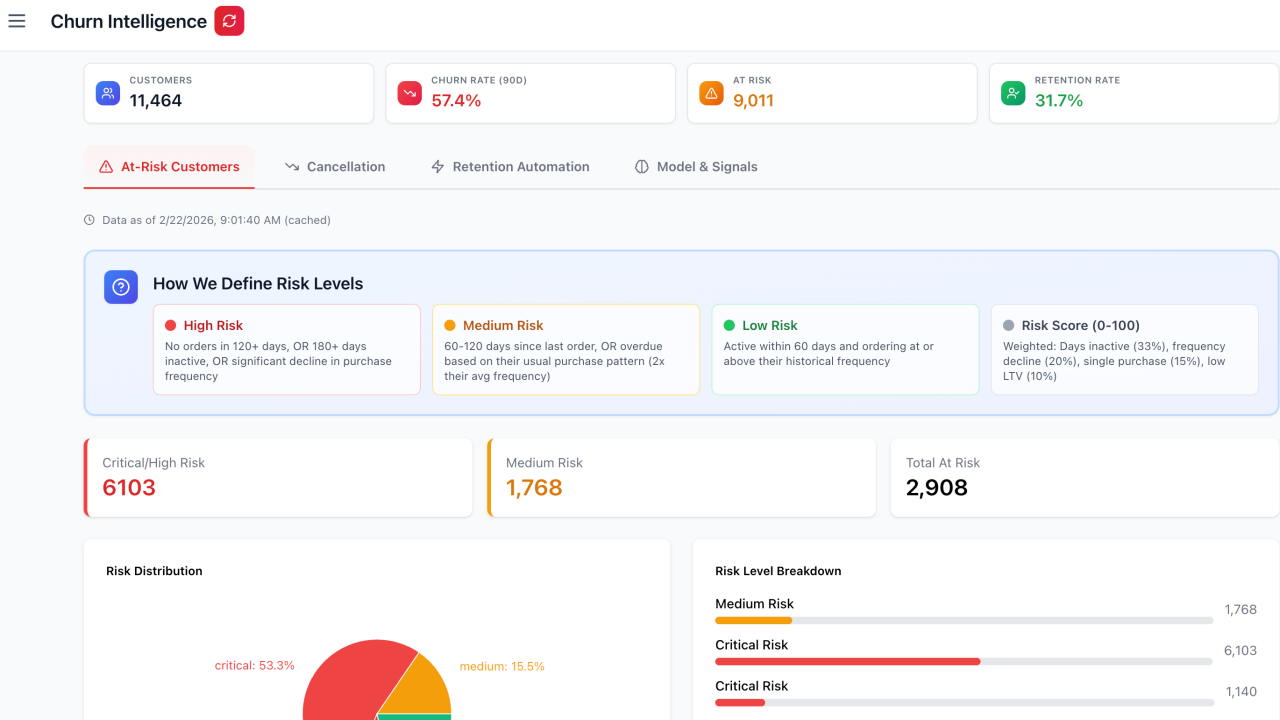
Customer churn is one of the most expensive problems in e-commerce. Every customer who stops buying from you represents not just a lost sale, but the full cost of acquiring them in the first place - plus all the future revenue they would have generated. For most e-commerce brands, reducing churn by even a few percentage points can have a dramatic impact on profitability.
Yet many brands treat churn as an inevitability rather than a solvable problem. They focus almost entirely on acquisition, pouring money into Meta and Google ads while their existing customer base quietly erodes. This guide covers a practical, data-driven approach to understanding and reducing churn in your e-commerce business.
What is churn in e-commerce?
Churn in subscription businesses is straightforward: a customer cancels their subscription. In non-subscription e-commerce, the definition is more nuanced. A customer "churns" when they stop purchasing from you - but since there is no explicit cancellation event, you have to define the threshold yourself.
The most common approach is to define churn based on the expected repurchase window. If your average customer buys every 45 days, a customer who hasn't purchased in 90 or 120 days might reasonably be considered churned. The exact threshold depends on your product category, purchase cycle, and business model.
Voluntary vs. Involuntary Churn
Not all churn is the same, and distinguishing between the two types is critical for choosing the right intervention.
Voluntary churn occurs when a customer actively decides to stop buying from you. This might be driven by dissatisfaction with product quality, finding a competitor they prefer, price sensitivity, or simply no longer needing what you sell. Voluntary churn requires understanding the root cause and addressing it - often through better products, service, or communication.
Involuntary churn happens without the customer making a conscious decision to leave. In subscription e-commerce, this is primarily failed payment processing - expired credit cards, insufficient funds, or payment gateway errors. In non-subscription commerce, involuntary churn can include things like email deliverability issues that prevent your marketing from reaching the customer. Involuntary churn is often the easier type to fix because the customer hasn't actually decided to leave.
How to measure e-commerce churn rate
The basic churn rate formula is:
Churn Rate = (Customers Lost During Period / Customers at Start of Period) x 100
For subscription businesses, this is calculated monthly or annually. For non-subscription e-commerce, you need to adapt the formula using your defined churn threshold.
A more sophisticated approach is cohort-based churn analysis. Group customers by their acquisition month, then track what percentage of each cohort makes a repeat purchase in subsequent months. This reveals trends over time and helps you evaluate whether recent changes to your product, pricing, or marketing are actually improving retention.
For example, if your January 2026 cohort shows 35% making a second purchase within 90 days, compared to 28% for your January 2025 cohort, that is a meaningful signal that your retention efforts are working.
Key signals of at-risk customers
The most effective churn reduction happens before the customer actually leaves. Identifying at-risk customers early gives you a window to intervene. Here are the signals to watch.
Declining Purchase Frequency
If a customer who used to buy monthly starts stretching to every two or three months, that deceleration is a leading indicator of churn. Tracking changes in individual purchase velocity against their historical baseline is one of the most reliable early warning signals.
Engagement Drops
Behavioral engagement data tells you a lot about intent. Watch for customers who stop opening emails, stop visiting your site, or reduce their browsing frequency. A customer who used to click through every weekly email but hasn't opened the last five is showing disengagement that often precedes churn.
Support Ticket Patterns
Customers who file complaints or support tickets can go either way. If their issue is resolved well, they often become more loyal. But unresolved issues, repeated complaints about the same problem, or negative sentiment in support interactions are strong churn predictors.
Decreasing Order Value
A shrinking average order value from a specific customer can signal reduced commitment to your brand. They may be testing alternatives and gradually shifting their spending elsewhere.
Subscription Modifications
For subscription brands, downgrades, skips, and frequency reductions are the clearest warning signs. A customer who goes from monthly to every-other-month delivery is often one step away from cancellation.
Proven strategies to reduce churn
1. Proactive Outreach Before Churn Happens
The highest-use churn reduction tactic is reaching out to at-risk customers before they leave, not after. This requires a system that identifies risk signals in real time and triggers appropriate outreach.
The outreach itself should feel genuine, not desperate. A simple check-in email asking if everything is going well with their last purchase, or a personalized product recommendation based on their history, is more effective than a discount code with an urgent subject line.
2. Segment Your Customers by Risk and Value
Not all customers deserve the same retention investment. A high-LTV customer showing early signs of disengagement warrants a personal touch - perhaps a phone call or a premium offer. A low-value, one-time buyer who is drifting away might not justify the same level of effort.
Effective segmentation lets you allocate your retention resources where they will have the greatest return. Build segments based on both customer value (LTV, AOV, purchase frequency) and risk level (engagement trends, time since last purchase, behavioral signals).
3. Personalized Offers and Incentives
Generic "we miss you" emails with a blanket 10% discount are table stakes. They work occasionally, but they leave money on the table and can train customers to wait for discounts before purchasing.
Better approaches include:
- Product-specific recommendations based on purchase history and browsing behavior
- Replenishment reminders timed to when they are likely running low on consumable products
- Exclusive early access to new products for customers who value novelty
- Loyalty rewards that recognize their cumulative spending rather than incentivizing a single purchase
- Bundle offers that increase the perceived value without simply cutting price
The key is matching the incentive to what the specific customer actually values, which requires knowing your segments well.
4. Subscription Flexibility
For subscription brands, rigid subscription structures are a primary driver of voluntary churn. Customers cancel because they have too much product, their needs changed, or they want to try something different - not necessarily because they dislike your brand.
Offering easy options to pause, skip, swap products, adjust frequency, or downgrade gives customers an alternative to outright cancellation. A customer who pauses for a month is infinitely more valuable than one who cancels entirely.
5. Post-Purchase Experience Optimization
Many brands spend heavily on the pre-purchase experience and neglect what happens after the order is placed. But the post-purchase period is when the customer is forming their opinion about whether to buy again.
Focus on shipping speed and communication, unboxing experience, product education (how to get the most out of what they bought), and timely follow-up that adds value. A well-timed email two weeks after delivery asking how they are enjoying the product - with tips for getting more value from it - builds the kind of relationship that prevents churn.
6. Win-Back Campaigns for Recently Churned Customers
Some churn is inevitable. But customers who have recently lapsed are far easier to reactivate than those who left months ago. Build a structured win-back sequence that deploys within days of a customer crossing your churn threshold, with escalating incentives over a defined period.
Track which win-back offers work for which segments, and continually optimize. A customer who originally purchased during a sale may respond to a discount offer, while a customer who bought at full price may respond better to a new product announcement.
7. Address Involuntary Churn Systematically
If you run a subscription business and you are not actively managing failed payments, you are likely losing 5-10% of subscribers to involuntary churn every year. Implement a dunning process that includes pre-expiration card update reminders, intelligent retry logic (retrying failed charges at optimal times), in-app and email notifications about payment issues, and easy card update flows that minimize friction.
How predictive analytics and ai transform churn prevention
The strategies above are effective, but they become dramatically more powerful when combined with predictive analytics. Traditional churn prevention is reactive - you set rules based on observable behaviors and trigger actions when those rules are met. Predictive models go further by identifying at-risk customers before the behavioral signals become obvious.
Machine learning models trained on your historical customer data can identify subtle patterns that correlate with future churn - combinations of signals that a human analyst would never spot. These might include specific product combinations that correlate with lower retention, time-of-day purchasing patterns that differ between loyal and churning customers, or the interaction between support contact frequency and order value trends.
Platforms like Finsi provide retention intelligence that applies predictive churn models to your customer base automatically. Rather than building and maintaining your own models, you get a continuously updated view of which customers are at risk and recommended actions for each segment. The models improve over time as they learn from your specific customer behavior patterns.
The practical advantage of predictive churn scoring is efficiency. Instead of treating all customers who have not purchased in 60 days the same way, you can focus your highest-touch retention efforts on the customers the model identifies as both high-value and high-risk. This means better outcomes with less wasted effort and budget.
Building a churn reduction program
Reducing churn is not a one-time project. It is an ongoing program that requires measurement, experimentation, and iteration. Here is a framework for getting started:
Month 1: Baseline and Measurement. Define your churn threshold, calculate your current churn rate, and set up cohort tracking. Identify your top churn segments and reasons.
Month 2: Quick Wins. Address involuntary churn with dunning improvements. Launch a basic win-back email sequence. Add subscription flexibility options if you are a subscription brand.
Month 3: Segmentation and Targeting. Build at-risk customer segments based on behavioral signals. Create differentiated retention offers for your highest-value at-risk customers. Start A/B testing different retention messaging.
Month 4 and Beyond: Predictive and Proactive. Implement predictive churn scoring to identify at-risk customers earlier. Build automated workflows that trigger personalized outreach based on risk scores. Continuously test and optimize retention tactics by segment.
Measuring Success
Track these metrics to evaluate your churn reduction efforts:
- Overall churn rate (monthly and annual)
- Churn rate by cohort (to see if newer cohorts retain better)
- Churn rate by segment (to identify which customer groups need more attention)
- Win-back conversion rate (percentage of churned customers who return)
- Time to churn (whether you are extending customer lifetimes)
- Net revenue retention (revenue from existing customers including expansion and contraction)
The goal is not just to reduce churn in aggregate, but to understand which interventions work for which customer segments. This is where having strong segmentation capabilities becomes essential - you need to slice your churn data in many dimensions to find the insights that drive improvement.
Conclusion
Reducing e-commerce churn is one of the highest-ROI investments you can make. Acquiring a new customer typically costs five to seven times more than retaining an existing one, and even modest improvements in retention compound dramatically over time.
The brands that win at retention are the ones that treat it as a systematic, data-driven discipline - not an afterthought. They measure churn rigorously, identify at-risk customers early, segment their base intelligently, and deploy targeted interventions that match the customer's specific situation and value.
Start with the basics: know your churn rate, understand why customers leave, and address the easiest fixes first. Then build toward more sophisticated predictive approaches that let you stay ahead of churn rather than reacting to it.
Frequently asked questions
What are the fastest ways to reduce e-commerce churn?
The quickest wins come from fixing involuntary churn first - implementing smart dunning and card updater services can recover 30-50% of failed-payment cancellations within the first month. On the voluntary side, adding pause-and-skip flexibility to subscriptions and launching a cancellation retention flow with targeted offers typically reduce voluntary churn by 10-25% within 4-8 weeks. These tactical changes require relatively little engineering effort compared to longer-term product or experience improvements. Start a free retention audit to identify which quick wins will have the largest impact for your brand.
What are good churn reduction benchmarks?
For subscription e-commerce, a monthly churn rate of 5-7% is average, while best-in-class brands achieve 3-4%. Non-subscription brands should track repeat purchase rate instead - a 30-40% second-order rate within 90 days is typical, with top performers reaching 50% or higher. After implementing a structured churn reduction program, most brands see a 15-30% relative improvement in the first 90 days. Use cohort analysis to compare retention curves across acquisition periods and ensure newer cohorts are genuinely improving, not just riding seasonal tailwinds.
How do I fix voluntary versus involuntary churn differently?
Voluntary and involuntary churn require completely different playbooks. Involuntary churn is a technical problem - solve it with smart retry logic, multi-channel payment recovery, pre-expiration card update reminders, and network tokenization. Voluntary churn is a value and experience problem - solve it with better onboarding, subscription flexibility, cancellation retention flows, and proactive outreach to at-risk customers. The critical first step is separating the two in your data so you can measure and address each one independently. Retention teams that track them separately consistently outperform those that lump them into a single churn number.
What role does onboarding play in churn reduction?
Onboarding is one of the most underrated levers for reducing churn. Brands that drive product engagement in the first 30 days - through welcome sequences, usage education, and first-experience optimization - see 20-40% better retention in months 2-6 compared to brands that skip structured onboarding. The reason is that early engagement builds habits and perceived value before the initial excitement fades. If a customer does not experience meaningful value within the first few interactions, the probability of long-term retention drops sharply. Combining onboarding data with predictive LTV models helps you identify which new customers are on track and which need additional nurturing.
How do I measure whether my churn reduction efforts are working?
Track churn rate by cohort (not just in aggregate) so you can see whether newer cohorts retain better than older ones. Monitor win-back conversion rate, time-to-churn (are customer lifetimes extending?), and net revenue retention across segments. A/B test your retention interventions whenever possible - compare the churn rate of customers who receive a new retention flow against a holdout group. Finsi's retention intelligence provides cohort-level churn dashboards, segment-specific retention metrics, and automated A/B test tracking so founders and growth teams can measure impact without building custom reports.
Stop guessing. Start knowing.
Finsi connects your e-commerce data, tells you what to do, and executes it — email campaigns, ad optimization, retention flows. Free 30-day trial.
Start Free Trial