
GA4 vs Triple Whale for DTC: Free Analytics vs Paid Attribution
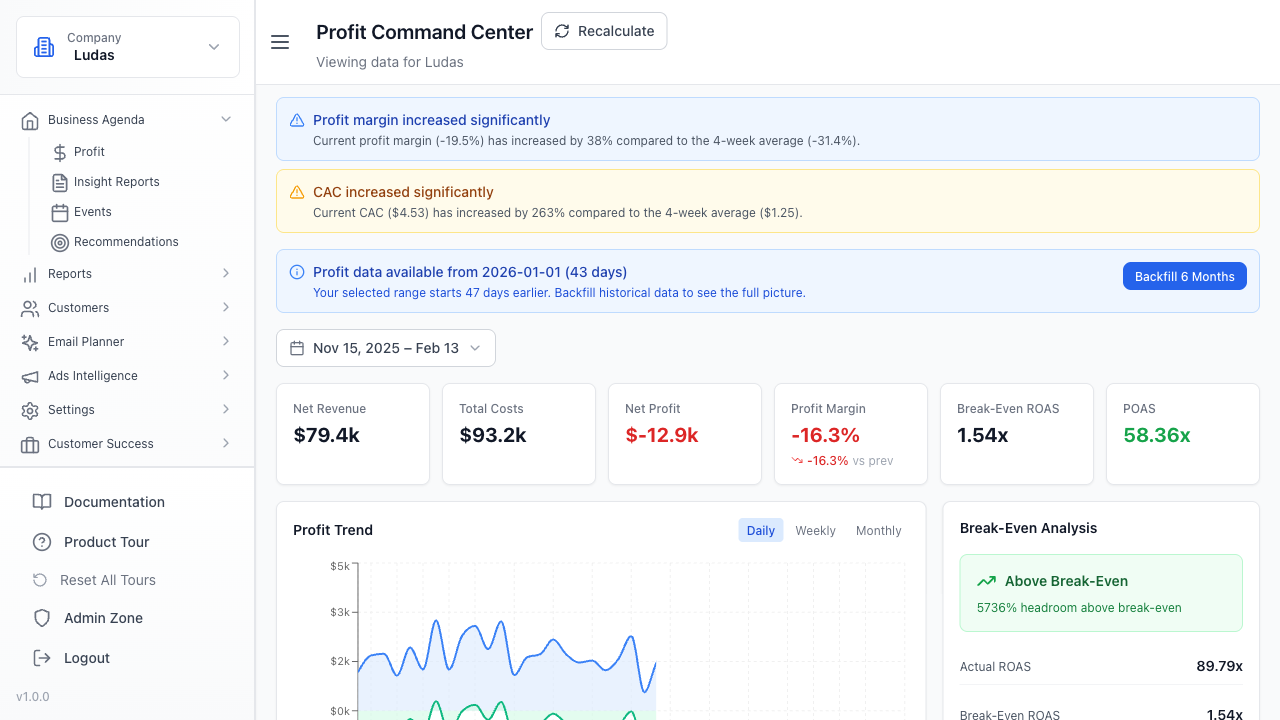
GA4 is Google's free web analytics platform tracking user behavior across devices; Triple Whale is a paid SaaS dashboard combining Shopify data, ad spend, and attribution into operator-grade metrics.
What Each Platform Does
GA4 tracks user sessions, page views, events, and conversions across web and app. It's free, integrates with Google Ads and Search Console, and stores data in BigQuery for advanced querying. Setup requires GTM (Google Tag Manager) or direct event instrumentation. Data is owned by Google and subject to their retention policies.
Triple Whale pulls Shopify revenue, inventory, and customer data in real-time, layers in ad spend from Meta, Google, and TikTok, and surfaces attribution via multi-touch models and LTV cohorts. It costs $99 - $499/month depending on revenue tier. The platform is built for DTC operators who need a single source of truth for P&L and channel performance.
Cost Structure and Hidden Fees
GA4 is free for standard analytics. If you exceed 10 million events per property per month, Google charges for additional events at scale, but most DTC brands stay under that threshold. BigQuery export (needed for custom analysis) costs $6.25 per TB queried after a 1 TB free monthly allowance.
Triple Whale charges a percentage of revenue or a fixed tier. A $1M/month brand pays roughly $299/month; $5M/month pays $499/month. No per-event overage. Some operators layer in additional tools (Klaviyo, Gorgias, Attentive) that feed data into Triple Whale, adding cost elsewhere but not to Triple Whale itself.
Attribution and Channel Performance
GA4 uses last-click and data-driven attribution models. Last-click assigns 100% credit to the final touchpoint before conversion; data-driven uses machine learning to weight earlier interactions. Neither is perfect for multi-channel DTC. GA4 struggles with iOS privacy changes (ATT) and cross-domain tracking, so mobile-first brands see incomplete funnels.
Triple Whale applies multi-touch attribution by default, distributing credit across the customer journey. It ingests ad spend from Meta, Google, and TikTok natively, so ROAS calculations are immediate and tied to actual spend. Because it pulls Shopify revenue directly, there's no reliance on UTM parameters or pixel tracking. This matters: a customer who clicks a TikTok ad, browses on Instagram, and buys via direct traffic gets weighted across all three channels in Triple Whale, whereas GA4 might credit only the last click.
Real-Time Dashboards vs Historical Reporting
GA4 reports are updated with a 24 - 48 hour latency in standard reports. Real-time reporting exists but shows only the last 30 minutes of activity and is limited to 100 concurrent users. For a brand running a flash sale or testing a new campaign, GA4 real-time is too narrow to act on.
Triple Whale updates metrics every 15 - 30 minutes. Operators can see revenue, AOV, conversion rate, and ROAS by channel as the day unfolds. This is critical for DTC: if a TikTok campaign is underperforming by noon, the operator knows it and can pause spend before wasting budget. The dashboard is built for glanceability - key metrics are front and center, not buried in three menu clicks.
Data Ownership and Integrations
GA4 data lives in Google's infrastructure. You can export to BigQuery or use the Measurement Protocol to send data in, but Google owns the processing layer. Integrations with third-party tools (Shopify, Klaviyo, Segment) require custom setup or middleware. GA4 does not natively ingest Shopify revenue or inventory.
Triple Whale owns the dashboard but sources data from Shopify, ad platforms, and your email/SMS tools via API. Data flows in one direction: from your sources into Triple Whale. You cannot easily export raw Triple Whale data to a data warehouse, so it's less flexible for teams building custom models. However, the trade-off is simplicity: no GTM configuration, no event schema design, no data pipeline maintenance.
When to Use GA4 Alone
GA4 is sufficient if the brand is early-stage (under $100k/month revenue), has a small ad budget, or operates primarily on owned channels (email, organic, direct). The free cost is unbeatable. GA4 also works well for content-heavy sites or apps where user engagement (scroll depth, video watch time, custom events) matters more than purchase attribution.
Teams with strong analytics chops can build custom dashboards in Looker Studio or Data Studio, pulling GA4 data via BigQuery. This approach scales but requires SQL knowledge and ongoing maintenance. For a solo founder or small marketing team, this overhead is often not worth the savings.
When to Add Triple Whale
Triple Whale becomes valuable once a brand hits $500k - $1M/month revenue and runs multi-channel paid campaigns. At that scale, the $99 - $299/month cost is trivial against the operational efficiency gained. An operator can glance at the Triple Whale dashboard and know whether the day is on track, which channels are profitable, and where to allocate budget tomorrow.
Triple Whale is also the right choice if the brand uses Shopify (native integration), runs ads across Meta, Google, and TikTok simultaneously, or lacks in-house analytics engineering. It removes the need to stitch together GA4, Shopify admin, and ad platform dashboards manually. Many DTC operators use both GA4 (for detailed user behavior and content performance) and Triple Whale (for P&L and channel ROAS) in parallel.
FAQ
Can GA4 replace Triple Whale?
Not fully. GA4 tracks user behavior and conversions; Triple Whale tracks profitability and channel ROAS. GA4 requires manual UTM setup and has attribution gaps due to iOS privacy. Triple Whale ingests ad spend and Shopify revenue directly. For a brand running $10k+/month in paid ads, Triple Whale's real-time attribution and dashboard speed justify the cost. GA4 alone leaves money on the table because you won't catch underperforming campaigns in time.
Does Triple Whale require GA4?
No. Triple Whale pulls data from Shopify, ad platforms, and email tools. It does not depend on GA4. However, many operators keep GA4 for detailed funnel analysis, user segmentation, and content performance metrics that Triple Whale does not cover. They serve different purposes.
How accurate is Triple Whale's attribution?
Triple Whale's multi-touch model is more accurate than GA4's last-click for DTC because it weights the entire customer journey and pulls actual ad spend from platforms. However, no attribution model is 100% accurate. Both platforms miss offline conversions, influencer-driven word-of-mouth, and organic search that started with a paid ad weeks earlier. Use attribution as a guide, not gospel.
What if I use Shopify Plus or a custom platform?
GA4 works with any platform via the Measurement Protocol or GTM. Triple Whale is Shopify-native and works best with standard Shopify stores. If you use Shopify Plus, BigCommerce, or a custom build, Triple Whale's integration is weaker or unavailable. In that case, GA4 plus a custom dashboard (Looker Studio, Tableau) or a data warehouse (Segment, Hightouch) is more appropriate.
FAQ
Can GA4 replace Triple Whale?
Not fully. GA4 tracks user behavior and conversions; Triple Whale tracks profitability and channel ROAS. GA4 requires manual UTM setup and has attribution gaps due to iOS privacy. Triple Whale ingests ad spend and Shopify revenue directly. For a brand running $10k+/month in paid ads, Triple Whale's real-time attribution and dashboard speed justify the cost. GA4 alone leaves money on the table because you won't catch underperforming campaigns in time.
Does Triple Whale require GA4?
No. Triple Whale pulls data from Shopify, ad platforms, and email tools. It does not depend on GA4. However, many operators keep GA4 for detailed funnel analysis, user segmentation, and content performance metrics that Triple Whale does not cover. They serve different purposes.
How accurate is Triple Whale's attribution?
Triple Whale's multi-touch model is more accurate than GA4's last-click for DTC because it weights the entire customer journey and pulls actual ad spend from platforms. However, no attribution model is 100% accurate. Both platforms miss offline conversions, influencer-driven word-of-mouth, and organic search that started with a paid ad weeks earlier. Use attribution as a guide, not gospel.
What if I use Shopify Plus or a custom platform?
GA4 works with any platform via the Measurement Protocol or GTM. Triple Whale is Shopify-native and works best with standard Shopify stores. If you use Shopify Plus, BigCommerce, or a custom build, Triple Whale's integration is weaker or unavailable. In that case, GA4 plus a custom dashboard (Looker Studio, Tableau) or a data warehouse (Segment, Hightouch) is more appropriate.