
Fractional CFO Metrics for DTC: Cash, Runway, and Growth Gates
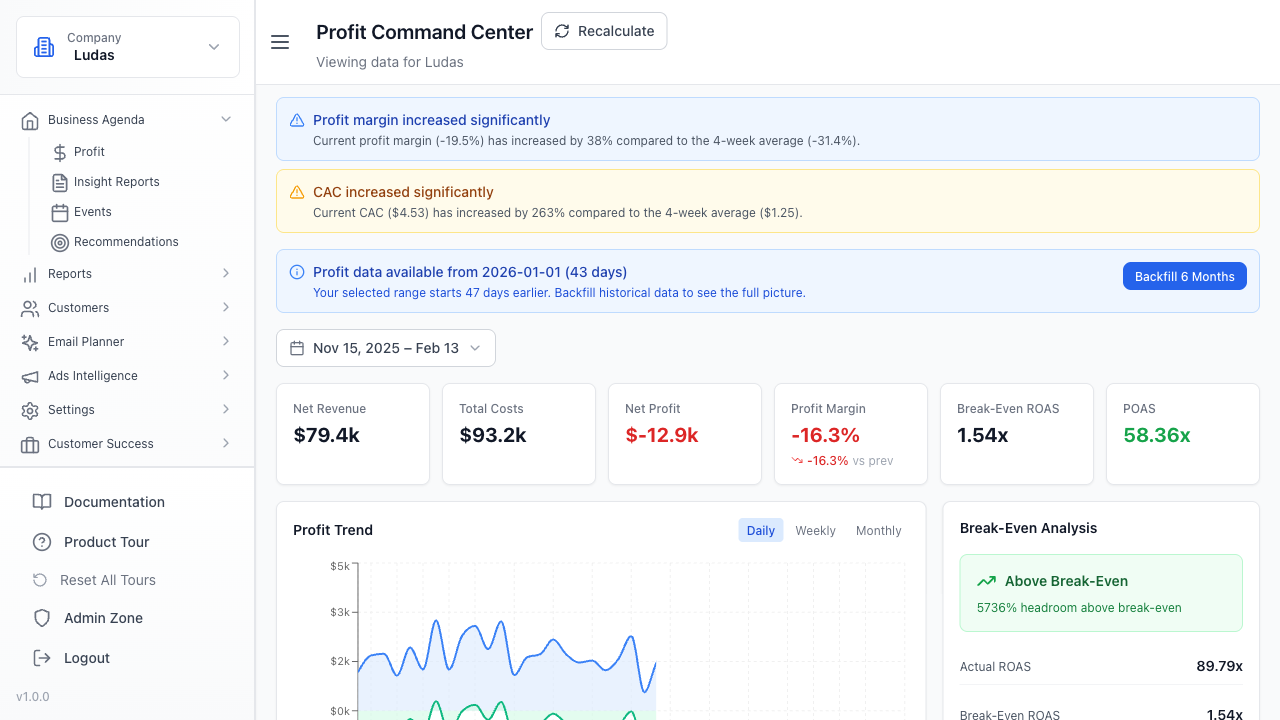
A fractional CFO for DTC monitors cash velocity, gross margin, customer acquisition cost, and runway to identify when a brand can safely accelerate spend or must tighten operations.
Why DTC Brands Need Fractional CFO Discipline
DTC operators live in a cash-sensitive environment. Unlike wholesale or marketplace models, DTC requires upfront inventory, paid media spend, and fulfillment costs before revenue arrives. A fractional CFO translates that constraint into a decision framework. The role is not accounting - it's real-time financial steering.
Most DTC founders optimize for growth rate alone. A fractional CFO optimizes for sustainable growth rate given current cash position and burn. That distinction prevents the common failure mode: scaling too fast, running out of cash, and forced fire sales or dilutive fundraising.
Fractional CFO engagement typically costs 2-5K per month for a brand doing 500K - 5M ARR. That's cheaper than a full-time hire and more rigorous than a bookkeeper. The operator gets weekly or bi-weekly cash forecasts, unit economics reviews, and a decision gate for major spend increases.
Core Metric 1: Cash Position and Burn Rate
Cash position is the numerator. Burn rate is the denominator. Runway is the quotient: months of operating expenses covered by current cash, assuming zero revenue. Formula: (Cash on Hand) / (Monthly Burn) = Months of Runway.
A fractional CFO updates this weekly. Burn includes COGS, fulfillment, payroll, and media spend - not accounting accruals. The goal is a real cash number, not a P&L number. Many founders conflate the two and discover a cash crisis when the credit card declines.
Safe runway thresholds vary by stage. Pre-PMF brands should target 12 - 18 months. Growth-stage brands (1M+ MRR) can operate on 6 - 9 months if cash is growing. Brands with negative unit economics should not scale; they should fix unit economics first or raise capital explicitly to fund the burn.
- Update cash position daily or weekly via bank feeds and accounting software.
- Separate operating burn from growth spend (media, inventory for new SKUs).
- Model runway under three scenarios: base case, 20% revenue miss, 30% revenue miss.
- Flag when runway falls below 6 months; trigger cost review or fundraising conversation.
Core Metric 2: Unit Economics and Gross Margin
Unit economics define whether a customer is profitable before marketing. Gross margin is revenue minus COGS and fulfillment. Formula: (Revenue - COGS - Fulfillment) / Revenue = Gross Margin %.
A fractional CFO tracks gross margin by channel, product, and cohort. A DTC brand selling at 60% gross margin can afford higher CAC and longer payback periods than one at 40%. That margin difference is the difference between scaling and struggling.
Many DTC operators ignore fulfillment cost creep. Shipping rates rise, packaging costs increase, returns spike. A fractional CFO audits fulfillment quarterly and flags when margin compression is material. If gross margin falls below 50%, growth spend becomes dangerous - the unit is not profitable enough to sustain customer acquisition at scale.
- Calculate gross margin monthly; track trend over 12 months.
- Break down by product line, customer cohort, and acquisition channel.
- Audit COGS and fulfillment costs quarterly; flag suppliers with price increases.
- Set a gross margin floor (e.g., 50%); do not scale media spend if margin is below floor.
Core Metric 3: Customer Acquisition Cost and Payback Period
CAC is total marketing spend divided by new customers acquired. Payback period is CAC divided by gross profit per customer per month. Formula: CAC / (Monthly Gross Profit per Customer) = Months to Payback.
A fractional CFO tracks CAC by channel and cohort. Facebook CAC may be 40 dollars; email CAC may be 5 dollars. Blended CAC is useful for benchmarking, but channel-level CAC is what drives spend allocation. If one channel has a 3-month payback and another has a 12-month payback, the decision to scale is obvious.
Payback period is the growth gate. Brands with a 3-month payback can reinvest profit into media and scale. Brands with a 12-month payback are capital-constrained; they must either raise money or accept slower growth. A fractional CFO uses payback period to set media spend budgets and forecast cash impact.
- Calculate CAC by channel monthly; include all marketing costs (ads, tools, salaries).
- Calculate payback period by cohort; track how it changes as brand scales.
- Set a payback period target (e.g., 4 months); do not scale channels above that threshold.
- Model cash impact of CAC changes; if CAC rises 20%, how does that affect runway?
Core Metric 4: Growth Gates and Spend Approval
A fractional CFO establishes growth gates - financial thresholds that must be met before approving major spend increases. These gates prevent the founder from scaling too fast and burning cash on unproven channels.
Common gates: (1) Gross margin must be above 50%. (2) Payback period must be below 4 months. (3) Runway must exceed 9 months after the spend increase. (4) Unit repeat rate must exceed 20% (for repeat-purchase brands). (5) CAC must be stable or declining month-over-month.
When a founder wants to increase media spend by 50%, the fractional CFO runs the numbers: Does gross margin support it? Is payback period acceptable? Will runway remain above 9 months? If any gate fails, the answer is no - or conditional yes with cost cuts elsewhere. This discipline prevents cash crises and forces operators to fix unit economics before scaling.
- Define 4-5 gates based on brand stage and risk tolerance.
- Require fractional CFO sign-off on media spend increases above 25%.
- Review gates quarterly; adjust as brand scales and unit economics improve.
- Document gate decisions in a shared spreadsheet; create an audit trail for future reference.
Forecasting and Scenario Planning
A fractional CFO builds a 13-week cash forecast and a 12-month P&L forecast. The 13-week forecast is precise - it includes payroll dates, inventory purchases, and media spend. The 12-month forecast is directional - it models revenue growth, margin, and burn under different scenarios.
Scenario planning is critical. The base case assumes current growth rate continues. The downside case assumes a 20% revenue miss (due to seasonality, ad fatigue, or market shift). The upside case assumes a 20% revenue beat (due to viral growth or new channel success). A fractional CFO models all three and identifies which scenario triggers a cash crisis.
Many DTC founders operate without a forecast. They react to cash balance and make spend decisions in real time. A fractional CFO flips that: forecast cash position 13 weeks out, identify risks early, and make proactive decisions. If the downside scenario shows a cash crisis in week 9, the operator has 8 weeks to cut costs or raise capital - not a panic in week 9.
- Build a 13-week rolling cash forecast; update weekly with actuals.
- Model base, downside, and upside scenarios for 12-month P&L.
- Identify the cash inflection point - when cumulative cash flow turns positive.
- Flag risks early: seasonality dips, inventory commitments, payroll increases.
Operational Metrics That Support Financial Health
A fractional CFO does not operate in isolation. They track operational metrics that predict financial outcomes: conversion rate, average order value, repeat purchase rate, churn rate, and inventory turnover.
Conversion rate drives revenue. If conversion drops 10%, revenue drops 10% - and cash position deteriorates. A fractional CFO flags conversion declines and works with the operator to diagnose root cause: is it traffic quality, product-market fit, or checkout friction?
Repeat purchase rate and churn determine customer lifetime value. A brand with 30% repeat rate and 5% monthly churn has a very different LTV than one with 10% repeat rate and 15% churn. LTV determines how much CAC the brand can afford. A fractional CFO uses these metrics to set CAC budgets and forecast long-term unit economics.
- Track conversion rate, AOV, and repeat purchase rate weekly.
- Calculate LTV using repeat rate and churn; update quarterly.
- Monitor inventory turnover; flag slow-moving SKUs that tie up cash.
- Link operational metrics to financial outcomes in a dashboard; identify leading indicators of cash stress.
FAQ
When should a DTC brand hire a fractional CFO?
When monthly revenue exceeds 50K and the founder is making major spend decisions without a financial framework. At that stage, the cost of a fractional CFO (2-5K per month) is justified by the risk of cash mismanagement. Earlier-stage brands can use a bookkeeper and a spreadsheet. Later-stage brands (5M+ ARR) typically hire a full-time CFO.
What is a healthy payback period for a DTC brand?
3-4 months is healthy for most DTC brands. That allows the brand to reinvest profit into media and scale. 6+ months is capital-constrained; the brand must raise money to scale or accept slower growth. Below 2 months is rare and usually indicates either very high margin or very low CAC - both are good problems to have.
How often should a fractional CFO update the cash forecast?
Weekly. The 13-week forecast is a rolling forecast - drop the oldest week, add a new week. This keeps the forecast current and allows the operator to spot cash crunches early. Monthly updates are too infrequent for a fast-moving DTC brand.
What happens if a DTC brand fails a growth gate?
The operator has three options: (1) Cut costs to improve the metric (e.g., reduce payroll to improve runway). (2) Raise capital to fund growth despite the failed gate. (3) Accept slower growth and wait for the metric to improve organically. A fractional CFO models the financial impact of each option and recommends the path that maximizes long-term value.
FAQ
When should a DTC brand hire a fractional CFO?
When monthly revenue exceeds 50K and the founder is making major spend decisions without a financial framework. At that stage, the cost of a fractional CFO (2-5K per month) is justified by the risk of cash mismanagement. Earlier-stage brands can use a bookkeeper and a spreadsheet. Later-stage brands (5M+ ARR) typically hire a full-time CFO.
What is a healthy payback period for a DTC brand?
3-4 months is healthy for most DTC brands. That allows the brand to reinvest profit into media and scale. 6+ months is capital-constrained; the brand must raise money to scale or accept slower growth. Below 2 months is rare and usually indicates either very high margin or very low CAC - both are good problems to have.
How often should a fractional CFO update the cash forecast?
Weekly. The 13-week forecast is a rolling forecast - drop the oldest week, add a new week. This keeps the forecast current and allows the operator to spot cash crunches early. Monthly updates are too infrequent for a fast-moving DTC brand.
What happens if a DTC brand fails a growth gate?
The operator has three options: (1) Cut costs to improve the metric (e.g., reduce payroll to improve runway). (2) Raise capital to fund growth despite the failed gate. (3) Accept slower growth and wait for the metric to improve organically. A fractional CFO models the financial impact of each option and recommends the path that maximizes long-term value.