
AI-Powered Recommendations for E-commerce: Beyond Product Suggestions
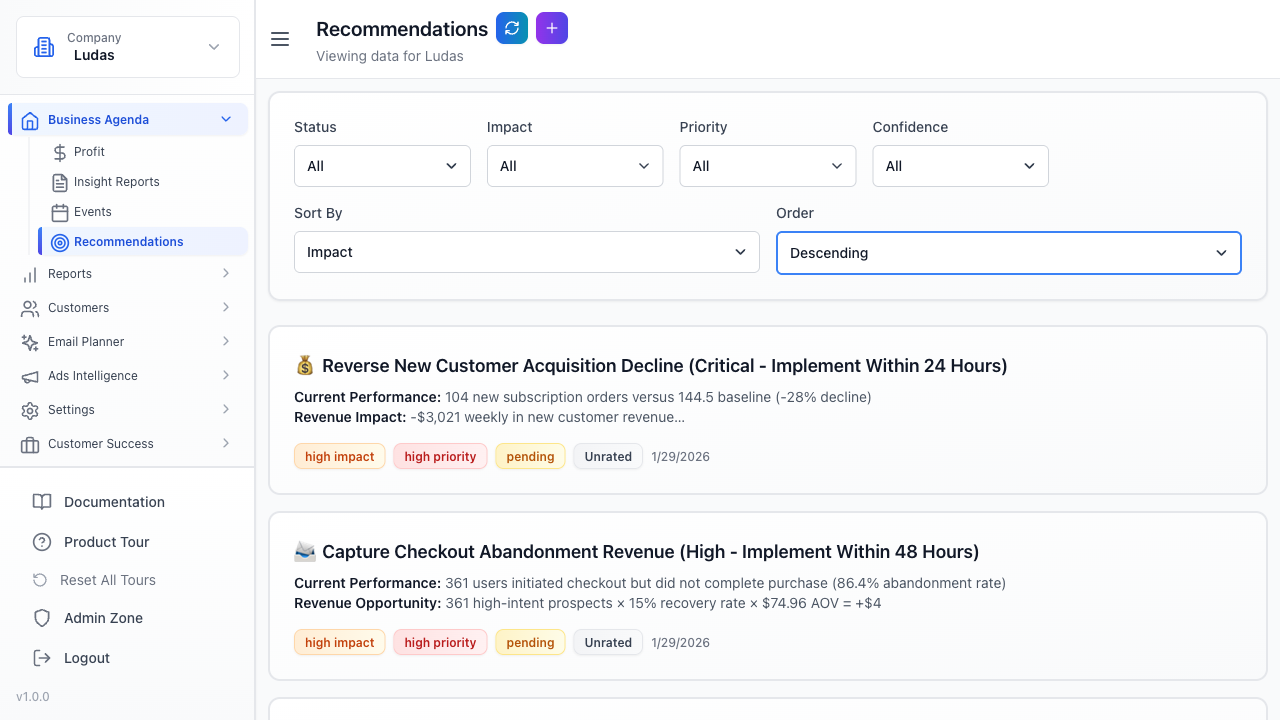
When most people hear "AI recommendations" in e-commerce, they think of product suggestions: "customers who bought this also bought that." Those recommendations are useful, but they represent a tiny fraction of what AI can do for an e-commerce business.
The real power of AI recommendations is strategic. Which customer segments should you target next quarter? Where should you reallocate your ad budget? Which campaigns should you scale and which should you pause? Which customers are about to churn and what should you do about it? These are the decisions that actually move the needle for growth-stage brands, and they are exactly the kinds of decisions that AI recommendation engines are now capable of making.
This guide explores what strategic AI recommendations look like in practice, how the underlying technology works, the different types of recommendations that matter, and how to measure whether recommendations are actually driving results.
The Limits of Product Recommendations
Product recommendation engines have been around for decades. Amazon pioneered collaborative filtering in the late 1990s, and by now every e-commerce platform offers some version of "related products" or "you might also like."
These engines work well for what they do. They increase average order value, improve cross-sell rates, and reduce bounce rates on product pages. If you are not using product recommendations on your store, you should be.
But product recommendations operate at the transaction level. They help a customer who is already on your site decide what to buy next. They do not help you decide:
- Which of your 47 customer segments deserves more marketing investment
- Whether your Meta prospecting campaigns are actually acquiring profitable customers
- How to structure a win-back campaign for lapsed subscribers
- Which email flows are underperforming relative to their potential
- Where your biggest profit leaks are hiding
These are strategic decisions that require analyzing data across multiple systems - your store, ad platforms, email provider, subscription platform, and support tools - and synthesizing patterns that no human would spot by looking at dashboards.
What Strategic AI Recommendations Look Like
Strategic AI recommendations are fundamentally different from product suggestions. Instead of telling a customer what to buy, they tell an operator what to do.
Here is what a strategic recommendation engine might surface on any given day:
"Scale Meta Campaign X by 30%. It is acquiring customers with 2.4x higher predicted LTV than your average campaign, and there is room in the audience before frequency issues arise." This recommendation requires analyzing attribution data, connecting it to customer-level LTV predictions, monitoring frequency metrics, and estimating headroom - a multi-system analysis that would take an analyst hours to perform manually.
"Launch a win-back email targeting the 847 customers who bought Product A between July and September but have not repurchased. Similar cohorts responded best to a new-product-announcement approach rather than discount offers." This requires cohort analysis, purchase pattern detection, and historical A/B test performance analysis across segments.
"Pause Google Shopping Campaign Y. Despite strong ROAS, the customers it acquires have a 73% single-purchase rate and negative margin after accounting for returns and COGS." This requires connecting ad attribution to downstream customer behavior, return rates, and product-level profitability - data that lives in at least four different systems.
"Your subscription churn rate has increased 12% month-over-month, driven primarily by customers in month 4-6 of their subscription. Consider adding a loyalty touchpoint at month 3 with a personalized product recommendation." This requires subscription analytics, cohort segmentation, churn pattern detection, and lifecycle analysis.
These are the kinds of recommendations that the best AI recommendation engines produce. They are specific, actionable, backed by data, and prioritized by expected impact.
How AI Recommendation Engines Work
Behind the scenes, a strategic recommendation engine follows a multi-step process:
Step 1: Data Unification
The foundation is connecting all your data sources into a unified data model. This means ingesting data from your e-commerce platform (Shopify, BigCommerce), ad platforms (Meta, Google, TikTok), email and SMS tools (Klaviyo, Omnisend), subscription platforms (Recharge, Skio), support tools (Gorgias, Zendesk), and analytics tools (Google Analytics, Segment).
Data unification is harder than it sounds. Each platform has its own data model, its own identifiers, its own update cadence, and its own quirks. Matching a Meta ad click to a Shopify order to a Klaviyo email open to a Recharge subscription requires probabilistic identity resolution - connecting records that share some identifiers but not others.
The quality of data unification directly determines the quality of recommendations. Garbage in, garbage out applies more here than almost anywhere else.
Step 2: Pattern Detection
Once data is unified, the AI analyzes it for patterns that humans would miss. This includes:
Temporal patterns. How does customer behavior change over time? Are there seasonal trends? Do certain acquisition cohorts behave differently at specific lifecycle stages?
Correlation patterns. Which marketing activities correlate with downstream behaviors? Does a specific email flow correlate with higher LTV? Do customers who contact support within their first 30 days actually retain better (a counterintuitive finding some brands discover)?
Anomaly patterns. What is changing unexpectedly? Is a particular product's return rate spiking? Has a campaign's performance degraded? Is a customer segment's purchase frequency declining?
Segment patterns. How do different customer groups behave differently? Which segments are growing vs. shrinking? Which have the highest profit margins? Which are most responsive to which channels?
Pattern detection uses a combination of statistical analysis (regression, time series decomposition, clustering) and machine learning (gradient boosted trees, neural networks, probabilistic models). The specific techniques matter less than the outcome: surfacing non-obvious insights from complex, multi-dimensional data.
Step 3: Impact Scoring
Not every pattern is worth acting on. Impact scoring estimates the potential business value of acting on each insight. This involves:
Sizing the opportunity. How many customers or how much revenue does this pattern affect? A retention insight affecting your top 100 customers is more valuable than one affecting your bottom 1,000, even if the pattern is more statistically significant in the latter group.
Estimating actionability. Can you actually do something about this insight with the tools and resources available? A recommendation to "improve your product quality" is not actionable. A recommendation to "adjust your Meta bid strategy for this audience segment" is.
Projecting ROI. What is the expected return if you act on this recommendation? This requires modeling the likely impact of the recommended action, which is inherently uncertain but can be estimated from historical data and analogous situations.
Step 4: Prioritization and Delivery
The final step is ranking recommendations by expected impact and delivering them in a format that enables action. The best systems do not dump 50 recommendations on you - they surface the top 3-5 actions that will have the most impact this week, with clear explanations of why each matters and what to do about it.
This is where the user experience of a recommendation engine matters enormously. A recommendation that sits in a dashboard nobody checks is worthless. A recommendation that appears in your daily workflow, explains itself clearly, and links directly to the action required is transformative.
Types of Strategic Recommendations
Strategic recommendations fall into several categories:
Acquisition Recommendations
These focus on how to acquire customers more efficiently and effectively.
- Channel allocation. Where to increase or decrease ad spend based on LTV-adjusted performance.
- Audience optimization. Which lookalike audiences, interest targets, or geographic regions to prioritize.
- Creative insights. Which ad creative themes, formats, and messages perform best for high-LTV acquisition.
- Budget pacing. When to accelerate or slow spending based on competitive dynamics and seasonal patterns.
Acquisition recommendations are particularly valuable because they directly affect your largest variable cost (typically ad spend) and have compounding effects over time. Moving 10% of your budget from a low-LTV channel to a high-LTV channel does not just improve this month's metrics - it improves your customer base composition for years.
Retention Recommendations
These focus on keeping existing customers engaged and purchasing.
- Churn prevention. Which customers are at risk and what intervention to use (email, discount, personal outreach).
- Lifecycle optimization. Where in the customer lifecycle are you losing people, and what touchpoint to add.
- Reactivation. Which lapsed customers to target, when, and with what message.
- Subscription management. Which subscribers to offer flexibility (skip, swap) vs. which to lock in with incentives.
Retention recommendations often have the highest ROI of any category because the cost of retaining a customer is almost always lower than the cost of acquiring a new one. Even small improvements in retention rates compound into significant revenue impact.
Profitability Recommendations
These focus on improving margins and eliminating waste.
- Product mix. Which products to promote vs. de-emphasize based on fully-loaded margin analysis.
- Pricing opportunities. Where you have room to adjust prices based on demand elasticity and competitive positioning.
- Cost reduction. Where operational costs (shipping, returns, support) are eating into margins and what to do about it.
- Campaign profitability. Which campaigns are revenue-positive but profit-negative when all costs are included.
Profitability recommendations require the deepest data integration because true profitability analysis involves COGS, shipping, returns, ad spend, platform fees, and overhead allocation. This is where the ads autopilot capability becomes particularly valuable - it can automatically adjust campaign spending based on profitability signals rather than just ROAS.
Measuring Recommendation Impact
The ultimate test of any recommendation engine is whether it actually improves business outcomes. Here is how to measure it:
Before/After Analysis
The simplest approach is comparing key metrics before and after acting on recommendations. Did LTV improve? Did churn decrease? Did ROAS increase? This is directionally useful but does not control for other factors that may have changed.
Holdout Testing
A more rigorous approach is to implement recommendations for a subset of customers or campaigns and compare against a holdout group. For example, if the AI recommends a specific win-back strategy for lapsed customers, apply it to 80% of the eligible population and compare results against the 20% holdout.
Revenue Attribution
Track the specific revenue impact of each recommendation acted upon. If the AI recommended scaling a particular campaign, measure the incremental revenue generated by the increased spend. If it recommended a retention intervention, measure the incremental purchases from the treated group.
Decision Velocity
Beyond revenue impact, measure how quickly your team makes decisions. If your weekly planning meetings used to take 3 hours because everyone was digging through dashboards, and now they take 45 minutes because the AI has already surfaced what matters, that time savings has real value.
Recommendation Acceptance Rate
Track what percentage of recommendations your team acts on. If the rate is below 30%, either the recommendations are not good enough or the team does not trust them. Both problems need to be addressed. A healthy acceptance rate is 50-70% - you want to act on most recommendations while reserving judgment for situations where context the AI does not have matters.
Getting Started with Strategic AI Recommendations
If you are currently operating on dashboards and manual analysis, the transition to AI-powered recommendations does not have to happen all at once.
Phase 1: Data foundation. Connect your core data sources - e-commerce platform, ad platforms, email tool. Without unified data, no recommendation engine can function. This is the phase where most teams underestimate the effort required.
Phase 2: Descriptive recommendations. Start with recommendations based on descriptive analytics - things like "this segment's retention rate has dropped 15%" or "this campaign's ROAS is below your target." These are essentially automated anomaly detection and require less sophisticated modeling.
Phase 3: Predictive recommendations. Graduate to recommendations based on predictive models - "this customer segment is likely to churn in the next 30 days" or "this campaign is projected to become unprofitable next month." This requires predictive LTV, churn scoring, and trend forecasting.
Phase 4: Prescriptive recommendations. The final stage is prescriptive recommendations that tell you exactly what to do - "launch this specific campaign targeting this segment with this message and this budget." This requires the most sophisticated modeling and the deepest domain knowledge embedded in the AI.
Platforms like Finsi with a recommendation-first approach can accelerate this progression because the infrastructure for data unification, pattern detection, and recommendation delivery is already built.
The Future of AI Recommendations
We are still early in the evolution of strategic AI recommendations for e-commerce. The current generation of recommendation engines is good at pattern detection and prioritization. The next generation will improve in three areas: causal reasoning (telling you what causes outcomes, not just what correlates with them), counterfactual analysis (what would have happened if you had made a different decision), and autonomous execution (implementing actions directly, beyond recommending them).
For now, the practical takeaway is this: if your analytics stack only tells you what happened, you are operating with one hand tied behind your back. The brands that are pulling ahead are the ones whose analytics tell them what to do next - and they act on it.
Frequently Asked Questions
What are AI recommendations in e-commerce?
AI recommendations in e-commerce go beyond product suggestions like "customers also bought." Strategic AI recommendations analyze data across your entire tech stack - store, ad platforms, email, subscriptions, and support - to surface specific actions that improve acquisition, retention, and profitability. Examples include which customer segments to target, which campaigns to scale or pause, and which subscribers are at risk of churning. These recommendations tell operators what to do next, backed by data and prioritized by expected business impact.
How do AI recommendation engines work?
AI recommendation engines follow a multi-step process. First, they unify data from all your platforms (Shopify, Meta, Klaviyo, Recharge, etc.) into a single customer view. Then they detect patterns across temporal, correlation, anomaly, and segment dimensions using statistical analysis and machine learning. Each pattern is scored by estimated business impact and actionability. Finally, the engine prioritizes the top recommendations and delivers them in a format that enables immediate action. The quality of recommendations depends heavily on the quality of data unification - connecting records across systems with different identifiers and update cadences.
What is the ROI of AI-powered recommendations?
The ROI comes from three sources: better resource allocation (shifting spend from low-LTV to high-LTV channels), faster decision-making (reducing weekly planning meetings from hours to minutes), and catching problems earlier (identifying churn spikes or campaign degradation before they compound). Brands using strategic AI recommendations typically see improvements in customer lifetime value, reduced churn rates, and more efficient ad spend through tools like the ads autopilot. The compounding nature of these improvements means ROI accelerates over time as your customer base composition improves.
How is AI analysis different from manual dashboard analysis?
Manual analysis requires an analyst to form a hypothesis, pull data from multiple systems, build a query, and interpret results - a process that can take hours per insight. AI recommendation engines continuously analyze all your data simultaneously, surfacing patterns that span multiple systems and would be impractical for a human to detect. For instance, connecting a Meta campaign's ad spend to downstream subscription retention rates and product-level return data requires joining four or more data sources - something an AI engine does automatically but an analyst would rarely attempt. The result is a different class of insight, one a human analyst could not surface in any reasonable amount of time. Founders and growth teams find this particularly valuable because it frees them to focus on strategy rather than data wrangling.
How do you evaluate whether AI recommendations are actually good?
Track four metrics: recommendation acceptance rate (healthy is 50-70%), before/after performance on key metrics when you act on recommendations, holdout test results comparing treated vs. control groups, and decision velocity - how quickly your team moves from data to action. If your team acts on fewer than 30% of recommendations, either the recommendation quality needs improvement or trust needs to be built through smaller wins. Start a free trial to see Finsi's AI recommendations applied to your own data and judge the quality against your current analytical process.
Stop guessing. Start knowing.
Finsi connects your e-commerce data, tells you what to do, and executes it — email campaigns, ad optimization, retention flows. Free 30-day trial.
Start Free Trial