
How to Build a Contribution Margin Dashboard
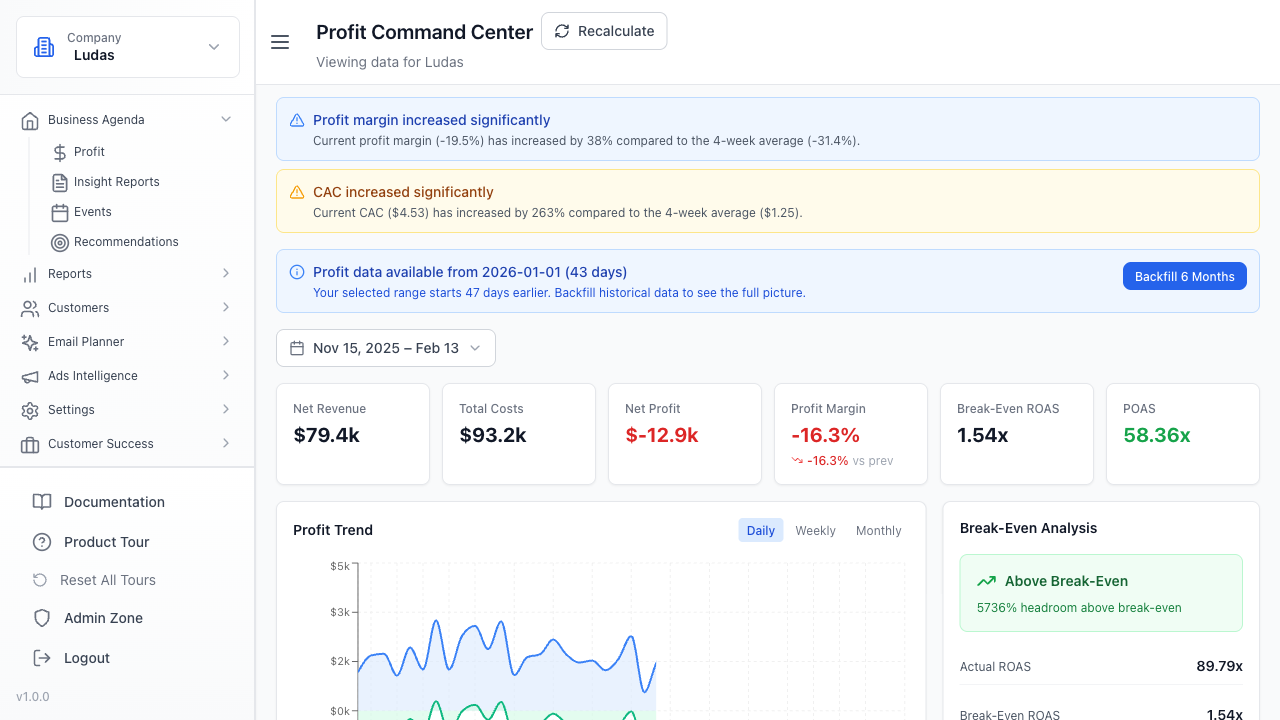
A contribution margin dashboard displays the revenue minus variable costs for each product, channel, or cohort, enabling operators to identify which units generate profit after direct spend.
Why Finance Demands a Contribution Margin View
Gross margin tells you what's left after COGS. Contribution margin tells you what's left after COGS plus all variable costs tied to that unit - ad spend, payment processing, fulfillment labor, returns, discounts. Finance cares about contribution margin because it's the only number that shows whether a customer, SKU, or channel actually funds the business.
Most operators report gross margin and call it a day. Finance then asks: "But what about your CAC? Your return rate? Your shipping subsidy?" The answer is contribution margin. It's the floor below which no unit should trade, because every dollar below zero is a dollar the business has to cover from fixed costs or equity.
A contribution margin dashboard is not optional if you're scaling. It's the first place finance looks when evaluating unit economics, and it's the first place operators should look when deciding which levers to pull - which product to promote, which channel to scale, which cohort to reacquire.
Core Fields Finance Will Audit
Finance will ask for the same fields every time. Build the dashboard with these first, and everything else is optional.
Revenue is straightforward: gross sales before returns and discounts. But you must separate gross revenue from net revenue (after returns). Finance wants to see both because return rate is a leading indicator of product quality and customer satisfaction. If net revenue is 85% of gross, that's a red flag.
COGS is the cost of goods sold - materials, manufacturing, inbound freight. This must be per unit or per order, not a monthly aggregate. If you're selling multiple SKUs, COGS must roll up by SKU so finance can see which products are actually profitable.
Variable costs are the killers. Ad spend is obvious. But include payment processing fees (typically 2.9% + $0.30 per transaction), fulfillment labor, outbound shipping, packaging, and any other cost that scales with volume. If you're subsidizing shipping, that's a variable cost. If you're paying for returns processing, that's a variable cost.
Contribution margin is revenue minus COGS minus all variable costs. Express it both as a dollar amount and as a percentage of revenue. Finance will want to see the percentage trend over time - if it's declining, something is wrong.
- Gross revenue (before returns and discounts)
- Net revenue (after returns and discounts)
- Return rate (net revenue / gross revenue)
- COGS per unit or per order
- Ad spend (by channel if possible)
- Payment processing fees
- Fulfillment and shipping costs
- Contribution margin (dollars and percentage)
Dimensions Finance Expects to See
A single contribution margin number is useless. Finance needs to see contribution margin broken down by the dimensions that drive business decisions.
By product or SKU: Which items are profitable? If you have 50 SKUs and 10 of them are underwater, that's a product strategy problem. Finance will ask why you're still making them. By channel: Is paid search profitable? What about email? Organic? Each channel has different CAC and variable cost structures, and contribution margin by channel shows which channels actually work. By cohort: Are customers acquired in January more profitable than those acquired in July? Cohort analysis reveals whether your marketing efficiency is improving or degrading over time. By geography: If you ship internationally, costs vary wildly. Contribution margin by region shows whether certain markets are viable.
Start with product and channel. Add cohort and geography only if you have the data infrastructure to track them cleanly. Finance will trust a dashboard with fewer dimensions if the data is accurate over a dashboard with many dimensions that finance has to audit.
- Product / SKU
- Channel (paid search, social, email, organic, direct)
- Cohort (acquisition month or quarter)
- Geography (domestic, international, or by region)
- Customer segment (if applicable - new vs. repeat, VIP vs. standard)
Data Sources and Integration
The dashboard is only as good as the data feeding it. Finance will ask where each number comes from, so you need to document the source and the calculation.
Revenue and returns come from your ecommerce platform (Shopify, custom) or order management system. Make sure you're pulling net revenue, not gross. Ad spend comes from your ad platforms (Google Ads, Facebook Ads Manager, TikTok Ads) or your media buying tool. Payment processing fees come from your payment processor (Stripe, Square) - they usually provide a report or API. COGS comes from your accounting system or inventory management tool. If you don't have a system, you'll need to calculate it manually and update it monthly.
Fulfillment costs are the hardest to track. If you use a 3PL, they'll provide a per-order cost. If you fulfill in-house, you need to estimate labor, packaging, and shipping. Break down shipping cost into actual carrier cost plus any subsidy you're eating. Finance will want to see the subsidy explicitly.
The easiest path is to pull revenue and ad spend from your ecommerce and ad platforms, calculate payment fees as a percentage, and import COGS and fulfillment costs from a spreadsheet. As you scale, automate the spreadsheet inputs by connecting your accounting system and 3PL to a data warehouse or BI tool.
- Revenue and returns: ecommerce platform or OMS
- Ad spend: ad platform APIs or media buying tool
- Payment fees: payment processor reports or calculate as percentage
- COGS: accounting system, inventory tool, or manual spreadsheet
- Fulfillment costs: 3PL reports or in-house labor estimates
Formulas and Benchmarks
Contribution margin percentage is the metric finance will obsess over. The formula is simple: (Revenue - COGS - Variable Costs) / Revenue. If your contribution margin is 40%, that means 40 cents of every dollar goes toward fixed costs and profit. If it's 20%, you're burning cash on every order.
Healthy contribution margin varies by business model. For DTC apparel, 50% - 65% is typical. For electronics, 30% - 40%. For consumables with repeat purchase, 40% - 55%. If you're below these ranges, either your COGS is too high, your variable costs are too high, or your pricing is too low. Finance will ask which one.
Contribution margin should improve over time as you scale. Ad spend per customer should decline (better targeting, organic lift). Fulfillment costs should decline (volume discounts, better logistics). COGS should decline (volume purchasing, manufacturing efficiency). If contribution margin is flat or declining, you're not scaling efficiently.
Track contribution margin by channel separately. Paid search might be 35%, email 65%, organic 55%. This tells you where to invest. Channels with high contribution margin can absorb higher CAC. Channels with low contribution margin need to be either optimized or shut down.
- Contribution Margin % = (Revenue - COGS - Variable Costs) / Revenue
- Target: 40% - 65% depending on category
- Trend: should improve 2% - 5% annually as you scale
- By channel: high-margin channels can support higher CAC
Common Mistakes That Fail Finance Audit
Forgetting to include returns in the calculation. If you report gross revenue of $100k but have $15k in returns, your net revenue is $85k. Use net revenue in the contribution margin calculation, not gross. Finance will catch this immediately.
Treating all ad spend as variable cost when some is brand building. This is a gray area, but the safest approach is to include all paid acquisition spend in variable costs. If you're running brand awareness campaigns, separate them and note them as non-variable. Finance will appreciate the transparency.
Not including payment processing fees. They're small individually but add up. At 2.9% + $0.30, a $50 order costs $1.75 to process. That's 3.5% of revenue. Over a year, it's material.
Mixing up COGS and fulfillment. COGS is the cost to make the product. Fulfillment is the cost to get it to the customer. They're separate line items. If you lump them together, finance can't evaluate your manufacturing efficiency or logistics efficiency independently.
Not updating COGS monthly. COGS changes when material costs change, when you negotiate new supplier terms, or when you move to a new manufacturer. If your COGS is stale, your contribution margin is wrong. Update it at least quarterly, monthly if you're scaling fast.
Building the Dashboard in Practice
Start with a spreadsheet. Pull revenue and returns from your ecommerce platform. Pull ad spend from your ad platforms. Calculate payment fees. Import COGS and fulfillment costs. Calculate contribution margin. Share it with finance. Get feedback. Iterate.
Once the spreadsheet is clean and finance signs off on the methodology, move it to a BI tool (Tableau, Looker, Metabase). Connect your ecommerce platform, ad platforms, and accounting system. Build a dashboard that updates daily. Add filters for product, channel, cohort, and date range. Make it accessible to the whole team.
The dashboard should answer these questions in under 30 seconds: What's our overall contribution margin? Which products are most profitable? Which channels are most profitable? Is contribution margin improving? Which cohorts are most valuable? If the dashboard doesn't answer these, it's not useful.
Update the dashboard at least weekly. Review it in your weekly operations meeting. If contribution margin is declining, dig into why - is COGS up? Is ad spend up? Is return rate up? The dashboard is only useful if you act on it.
FAQ
Should I include overhead and fixed costs in contribution margin?
No. Contribution margin is revenue minus variable costs only. Fixed costs (rent, salaries, software) are covered by the contribution margin dollars you generate. If your contribution margin is 50% and your fixed costs are 30% of revenue, you have 20% left for profit. This is why contribution margin matters - it shows you how much each unit contributes to covering fixed costs.
What if my COGS varies by channel or cohort?
It shouldn't, unless you're selling different products through different channels. If you're selling the same product through paid search and email, COGS is the same. What varies is ad spend and fulfillment cost. If COGS does vary, break it down by product first, then by channel. Finance will want to understand why.
How often should I recalculate contribution margin?
At minimum, monthly. Ideally, weekly or daily. If you're running promotions or testing new channels, update it weekly so you can see the impact quickly. If you're in steady state, monthly is fine. But if you're not looking at contribution margin at least monthly, you're flying blind.
What if my contribution margin is negative?
That means you're losing money on every order. This is only acceptable if you're in a customer acquisition phase and willing to subsidize orders to build scale. But it has an expiration date. Finance will ask when you'll be profitable. Have a plan to improve contribution margin - either raise prices, lower COGS, reduce variable costs, or some combination. If you don't have a plan, finance will shut it down.
FAQ
Should I include overhead and fixed costs in contribution margin?
No. Contribution margin is revenue minus variable costs only. Fixed costs (rent, salaries, software) are covered by the contribution margin dollars you generate. If your contribution margin is 50% and your fixed costs are 30% of revenue, you have 20% left for profit. This is why contribution margin matters - it shows you how much each unit contributes to covering fixed costs.
What if my COGS varies by channel or cohort?
It shouldn't, unless you're selling different products through different channels. If you're selling the same product through paid search and email, COGS is the same. What varies is ad spend and fulfillment cost. If COGS does vary, break it down by product first, then by channel. Finance will want to understand why.
How often should I recalculate contribution margin?
At minimum, monthly. Ideally, weekly or daily. If you're running promotions or testing new channels, update it weekly so you can see the impact quickly. If you're in steady state, monthly is fine. But if you're not looking at contribution margin at least monthly, you're flying blind.
What if my contribution margin is negative?
That means you're losing money on every order. This is only acceptable if you're in a customer acquisition phase and willing to subsidize orders to build scale. But it has an expiration date. Finance will ask when you'll be profitable. Have a plan to improve contribution margin - either raise prices, lower COGS, reduce variable costs, or some combination. If you don't have a plan, finance will shut it down.