
Best E-commerce Analytics Tools in 2026: 7 Platforms Compared
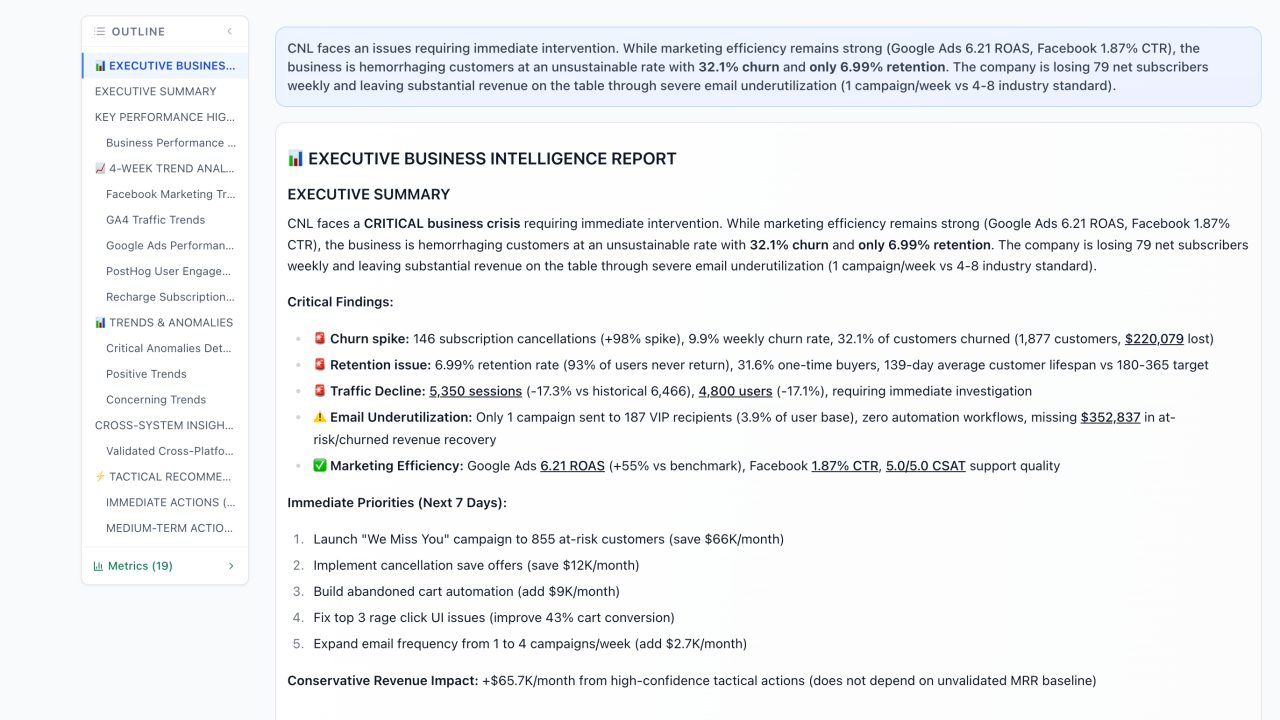
E-commerce analytics has shifted dramatically over the past few years. Privacy changes gutted third-party tracking, rising acquisition costs forced brands to think harder about retention, and AI capabilities moved from "nice to have" to table stakes. Choosing the right analytics tool in 2026 means matching your brand's actual workflow to a platform that will still be useful in two years.
This guide breaks down the major players across every category that matters: dashboards and reporting, attribution, retention analytics, and AI-powered recommendations. We will cover honest pros and cons, compare tools by use case, and help you figure out which one fits your specific situation.
What to Look for in an E-commerce Analytics Tool
Before diving into specific tools, it helps to know what separates a good analytics platform from a mediocre one. Here are the criteria that matter most:
Data unification. Your data lives in Shopify, Klaviyo, Meta Ads, Google Ads, Recharge, Gorgias, and a dozen other places. A good analytics tool connects to all of them and stitches data together into a single customer view. If you are still exporting CSVs and building pivot tables, you are leaving money on the table.
Actionability. Dashboards are only useful if they lead to decisions. The best tools do not just show you what happened - they tell you what to do about it. Look for platforms that surface recommendations, flag anomalies, and prioritize actions by expected impact.
Attribution accuracy. With iOS privacy changes and cookie deprecation, last-click attribution is increasingly unreliable. Modern tools use server-side tracking, statistical modeling, or media mix models to give you a more accurate picture of what is driving revenue.
Retention and LTV analytics. Acquisition-only analytics is a 2020 mindset. In 2026, the brands winning are the ones that understand cohort behavior, predict lifetime value early, and know exactly when and why customers churn.
Ease of use. If your analytics tool requires a data engineer to operate, it is not really an analytics tool - it is a data warehouse. The best platforms give operators direct access to insights without SQL or technical setup.
Quick Comparison
| Tool | Best For | Starting Price | Key Strength |
|---|---|---|---|
| Finsi | Brands wanting AI recommendations + full-stack analytics | $500/mo | Connects acquisition to retention with actionable weekly reports |
| Triple Whale | Attribution-focused DTC brands | $100-150/mo | Real-time attribution dashboard |
| Lifetimely | Quick LTV snapshots for Shopify | $34/mo | Easy cohort visualization |
| Polar Analytics | Multi-channel reporting | $200+/mo | Clean multi-source dashboards |
| Northbeam | Enterprise attribution | $1,000+/mo | MMM + MTA hybrid modeling |
| Peel Insights | Shopify-native analytics | Free-$299/mo | Deep Shopify cohort analysis |
| Glew | Multi-channel analytics | Custom | Broad platform support |
The Major Players Compared
Finsi
Finsi takes a recommendation-first approach to e-commerce analytics. Rather than building dashboards and expecting users to find insights, Finsi surfaces a ranked list of what matters now and what to do next, powered by AI analysis of unified data from Shopify, Recharge, Klaviyo, Meta Ads, Google Ads, and more.
Strengths: The AI recommendations engine is the standout feature. It analyzes your unified data and generates prioritized, actionable recommendations - not just "your retention rate dropped" but "launch a win-back flow targeting this segment with this offer because of this pattern." The platform also includes profit intelligence with real-time P&L, predictive LTV modeling, smart segmentation with natural language queries, ads autopilot, and email intelligence. It is a true full-stack platform.
Weaknesses: Finsi is newer to the market than some competitors, which means a smaller community and fewer third-party resources. The breadth of features can feel overwhelming initially, though the recommendation-first interface helps with prioritization.
Best for: Growth-stage brands ($1M-$50M) that want a single platform covering analytics, attribution, retention, and execution. Particularly strong for teams that are tired of dashboards and want to be told what to do next.
Pricing: Competitive for the feature set. Free pilot available.
Triple Whale
Triple Whale built its reputation as the go-to attribution tool for Shopify brands. Their Pixel and attribution modeling helped DTC brands navigate the post-iOS 14 landscape, and they have expanded into a broader analytics suite.
Strengths: Strong attribution modeling with their proprietary pixel. Good Shopify integration. The Summary page provides a clean overview of key metrics. Large community of DTC operators who share benchmarks and tips. Moby, their AI assistant, can answer questions about your data conversationally.
Weaknesses: The platform has grown rapidly and can feel feature-bloated. Attribution accuracy, while better than last-click, still has limitations during high-traffic periods. Retention and LTV analytics are present but not as deep as specialized tools. Pricing has increased significantly as features have been added.
Best for: Shopify-native DTC brands that prioritize attribution and want a well-established tool with a large user community. Strong for paid media-heavy brands.
Pricing: Starts around $100-$150/month for smaller stores, scales to $500+ for larger brands.
Lifetimely
Lifetimely (now part of the AMP ecosystem) focuses specifically on lifetime value and cohort analytics. It is one of the most accessible tools for understanding customer retention patterns and LTV projections.
Strengths: Excellent cohort analysis and LTV dashboards. Very easy to set up - installs directly from the Shopify App Store. The P&L dashboard is straightforward and useful. Affordable entry point for smaller brands. Good at showing you which acquisition channels drive the highest LTV customers over time.
Weaknesses: Limited to Shopify. Attribution capabilities are basic compared to dedicated attribution tools. Does not offer AI-powered recommendations or automated actions. The analytics depth plateaus quickly - power users may outgrow it. Less useful for brands with complex multi-channel operations.
Best for: Early-stage Shopify brands that want to start understanding LTV and cohort behavior without a large investment. A solid first analytics tool before upgrading to something more full.
Pricing: Starts at around $34/month. Very accessible.
Polar Analytics
Polar Analytics positions itself as the "business intelligence for DTC brands" - essentially a pre-built BI tool that connects your data sources and provides customizable dashboards without requiring SQL.
Strengths: Highly customizable dashboards with a drag-and-drop builder. Good data connectivity across multiple platforms. The AI analyst feature can answer natural language questions. Strong for brands that want to build their own views and reports. Multi-store support is solid.
Weaknesses: The flexibility can be a double-edged sword - you need to know what questions to ask and what dashboards to build. Less opinionated than tools that surface recommendations automatically. Attribution is present but not a core strength. Retention features are less developed than specialized tools.
Best for: Data-savvy operators who want a customizable analytics workspace. Good for brands with in-house analysts who want to build their own reports without a data warehouse.
Pricing: Mid-range, around $300-$500/month for growing brands.
Northbeam
Northbeam is a dedicated attribution platform focused on media mix modeling and multi-touch attribution. They position themselves as the enterprise-grade solution for brands spending heavily on paid media.
Strengths: Sophisticated attribution modeling using statistical methods (media mix modeling, multi-touch attribution). Strong for brands with large ad budgets across multiple channels. Good creative analytics showing which ads drive the most value. Server-side tracking reduces data loss from privacy changes.
Weaknesses: Narrowly focused on attribution - you will still need other tools for retention, LTV, email analytics, and operational dashboards. Pricing is enterprise-level and can be hard to justify for smaller brands. Setup and calibration take time. The learning curve is steeper than most Shopify-native tools.
Best for: Brands spending $50K+ monthly on paid media who need precise attribution to allocate budgets across channels. Particularly valuable for brands running campaigns across Meta, Google, TikTok, CTV, and emerging platforms simultaneously.
Pricing: Enterprise pricing, typically $1,000+/month.
Peel Insights
Peel Insights specializes in automated analytics and cohort analysis for Shopify brands. They focus on making retention metrics accessible and providing automated reports that surface trends.
Strengths: Strong cohort analysis and retention reporting. Automated daily and weekly reports via email and Slack keep teams informed without logging in. Clean, easy-to-read dashboards. Good product analytics showing which products drive repeat purchases. RFM segmentation is well-implemented.
Weaknesses: Limited to Shopify ecosystem. Attribution is not a core feature. Does not offer AI-powered recommendations or automated actions beyond alerts. Less suitable for brands that need deep ad spend analytics or creative optimization. The automated reports can become noise if not configured carefully.
Best for: Shopify brands focused on understanding retention patterns and product performance. Good for teams that want regular automated reporting without building custom dashboards.
Pricing: Starts around $149/month, scales with revenue.
Glew
Glew provides e-commerce analytics with a focus on multi-channel retail brands. They support Shopify, WooCommerce, BigCommerce, Magento, and Amazon, making them one of the more platform-agnostic options.
Strengths: Multi-platform support is a genuine differentiator. Good product-level analytics and inventory insights. Customer segmentation based on purchase behavior is solid. Supports wholesale and B2B analytics alongside DTC. The performance dashboard covers marketing, products, and customers in one view.
Weaknesses: The interface feels dated compared to newer tools. AI and predictive capabilities are less developed. Attribution is limited. Setup can be complex for multi-platform configurations. Some features feel more suited to legacy retail operations than modern DTC brands.
Best for: Multi-channel brands selling across Shopify, Amazon, wholesale, and other platforms that need a unified view. Good for brands with both DTC and retail distribution.
Pricing: Starts around $79/month for the base plan.
Comparison by Use Case
Best for Attribution
If your primary need is understanding which channels, campaigns, and creatives drive revenue, Northbeam leads for enterprise brands with large ad budgets, and Triple Whale is the strongest for mid-market Shopify brands. Finsi's attribution module is competitive and benefits from being integrated into a broader analytics suite, which means you can see how attributed channels correlate with LTV and retention rather than just ROAS.
Best for Retention and LTV
For deep retention analytics, Lifetimely is the most accessible entry point and Peel Insights offers strong cohort analysis. However, if you want retention intelligence that goes beyond reporting and actually tells you which customers are at risk and what to do about them, Finsi is the strongest option due to its predictive models and recommendation engine.
Best for Full-Stack Analytics
Brands that want a single platform covering dashboards, attribution, retention, LTV, email analytics, and AI recommendations have fewer options. Finsi is the most full full-stack offering. Triple Whale has been expanding toward this but still lacks depth in retention and email intelligence. Polar Analytics covers breadth through customizable dashboards but does not include execution features.
Best for Budget-Conscious Brands
Lifetimely wins on affordability and is a solid starting point. Glew also offers a competitive entry price with broad feature coverage. Both make sense for brands under $1M in revenue that need analytics beyond Shopify's built-in reporting.
Recommendations by Brand Size
Brands under $1M revenue: Start with Lifetimely or Peel Insights. You need to understand your cohort behavior and LTV before investing in more sophisticated tools.
Brands at $1M-$5M revenue: This is where you need to move beyond basic analytics. Consider Finsi or Triple Whale depending on whether your priority is recommendations and retention (Finsi) or attribution and community (Triple Whale).
Brands at $5M-$50M revenue: At this scale, you need a full-stack solution. Finsi covers the most ground in a single platform. Alternatively, you can assemble a stack with Northbeam for attribution plus Peel Insights for retention, though this creates data silos and higher total cost.
Brands over $50M revenue: Evaluate Finsi and Northbeam alongside enterprise BI tools. At this scale, you likely have a data team and may benefit from a combination approach.
The Bottom Line
The "best" analytics tool depends entirely on your brand's stage, priorities, and team capabilities. Attribution-focused brands spending heavily on paid media should look at Northbeam or Triple Whale. Retention-focused brands should evaluate Lifetimely or Peel Insights as starting points. Brands wanting a full, AI-driven platform that unifies analytics with actionable recommendations should explore Finsi.
The most expensive mistake is not choosing the wrong tool - it is choosing a tool and then not using it because it does not fit your workflow. Start with your biggest pain point, pick the tool that solves it best, and expand from there.
For a detailed side-by-side comparison of how Finsi stacks up against each competitor, visit our comparison page. If you are a solo founder or growth team lead, we have specific guides for your situation.
Frequently Asked Questions
What is the best e-commerce analytics tool in 2026?
The best tool depends on your stage and priorities. For brands wanting AI-powered recommendations that tell you what to do (not just what happened), Finsi is the strongest option. For attribution-focused brands, Triple Whale or Northbeam lead. For affordable LTV snapshots, Lifetimely is a solid starting point. The comparison table above breaks down each tool by use case, pricing, and key strength.
How much do e-commerce analytics tools cost?
Pricing ranges from $34/month (Lifetimely) to $1,000+/month (Northbeam). Mid-market options like Finsi start at $500/month and Triple Whale at $100-150/month. Most tools offer free trials. The real cost consideration is not just the subscription - it is the time your team spends pulling data manually without one.
What should I look for in an ecommerce analytics platform?
The five criteria that matter most in 2026 are: data unification (connects all your tools in one view), actionability (tells you what to do, not just what happened), attribution accuracy (handles iOS privacy changes), retention and LTV analytics (cohort analysis, churn prediction), and ease of use (no SQL or data engineer required).
Do I need a separate attribution tool and analytics tool?
Not necessarily. Full-stack platforms like Finsi include attribution alongside retention, LTV, email intelligence, and recommendations. However, brands spending $50K+/month on ads may benefit from a dedicated attribution tool like Northbeam for deeper media mix modeling, combined with a broader analytics platform.
What is the difference between Finsi and Triple Whale?
Triple Whale focuses primarily on attribution and ad dashboards. Finsi is a full-stack platform that connects attribution to retention outcomes and generates AI-powered recommendations. Where Triple Whale shows you what happened, Finsi tells you what to do about it - and can execute campaigns, email flows, and ad changes automatically.
Which analytics tool is best for Shopify brands?
All tools in this comparison integrate with Shopify. For Shopify-only brands under $1M, Lifetimely or Peel Insights are strong starting points. For growing Shopify brands ($1-50M), Finsi offers the most full coverage in a single platform. Triple Whale is also popular in the Shopify ecosystem, particularly for paid media attribution.
FAQ
What is the best e-commerce analytics tool in 2026?
The best tool depends on your stage and priorities. For brands wanting AI-powered recommendations that tell you what to do (not just what happened), Finsi is the strongest option. For attribution-focused brands, Triple Whale or Northbeam lead. For affordable LTV snapshots, Lifetimely is a solid starting point. The comparison table in the article breaks down each tool by use case, pricing, and key strength.
How much do e-commerce analytics tools cost?
Pricing ranges from $34 per month (Lifetimely) to $1,000+ per month (Northbeam). Mid-market options like Finsi start at $500 per month and Triple Whale at $100-150 per month. Most tools offer free trials. The real cost consideration is not just the subscription — it is the time your team spends pulling data manually without one.
What should I look for in an ecommerce analytics platform?
The five criteria that matter most in 2026 are: data unification (connects all your tools in one view), actionability (tells you what to do, not just what happened), attribution accuracy (handles iOS privacy changes), retention and LTV analytics (cohort analysis, churn prediction), and ease of use (no SQL or data engineer required).
Do I need a separate attribution tool and analytics tool?
Not necessarily. Full-stack platforms like Finsi include attribution alongside retention, LTV, email intelligence, and recommendations. However, brands spending $50K+ per month on ads may benefit from a dedicated attribution tool like Northbeam for deeper media mix modeling, combined with a broader analytics platform.
What is the difference between Finsi and Triple Whale?
Triple Whale focuses primarily on attribution and ad dashboards. Finsi is a full-stack platform that connects attribution to retention outcomes and generates AI-powered recommendations. Where Triple Whale shows you what happened, Finsi tells you what to do about it — and can execute campaigns, email flows, and ad changes automatically.
Which analytics tool is best for Shopify brands?
All major tools integrate with Shopify. For Shopify-only brands under $1M, Lifetimely or Peel Insights are strong starting points. For growing Shopify brands ($1-50M), Finsi offers the most full coverage in a single platform. Triple Whale is also popular in the Shopify ecosystem, particularly for paid media attribution.
What are the best tools for e-commerce data collection in 2025-2026?
For e-commerce data collection, the strongest 2026 stack pairs a customer data platform (Segment, RudderStack, or Hightouch) with a unified analytics layer like Finsi that consolidates Shopify, Klaviyo, Meta Ads, Google Ads, and subscription data into one source of truth. Standalone collection tools matter less than the analytics platform that activates the data — most leakage happens between collection and decisioning, not at the collection step.
What are the best comprehensive e-commerce analytics platforms for 2025-2026?
Comprehensive ecommerce analytics platforms in 2025-2026 are defined by coverage across attribution, retention, profit, and AI recommendations in one product. Finsi is the most full-stack option, covering all four. Triple Whale leads on attribution and is expanding into retention. Polar Analytics covers breadth via customizable dashboards but stays in reporting (no execution). Daasity covers data unification deeply but leaves analytics in the BI layer. Pick by which combination of these four pillars matters most for your team.
Stop guessing. Start knowing.
Finsi connects your e-commerce data, tells you what to do, and executes it — email campaigns, ad optimization, retention flows. Free 30-day trial.
Start Free Trial