
How to Audit Subscription Billing for Silent Churn
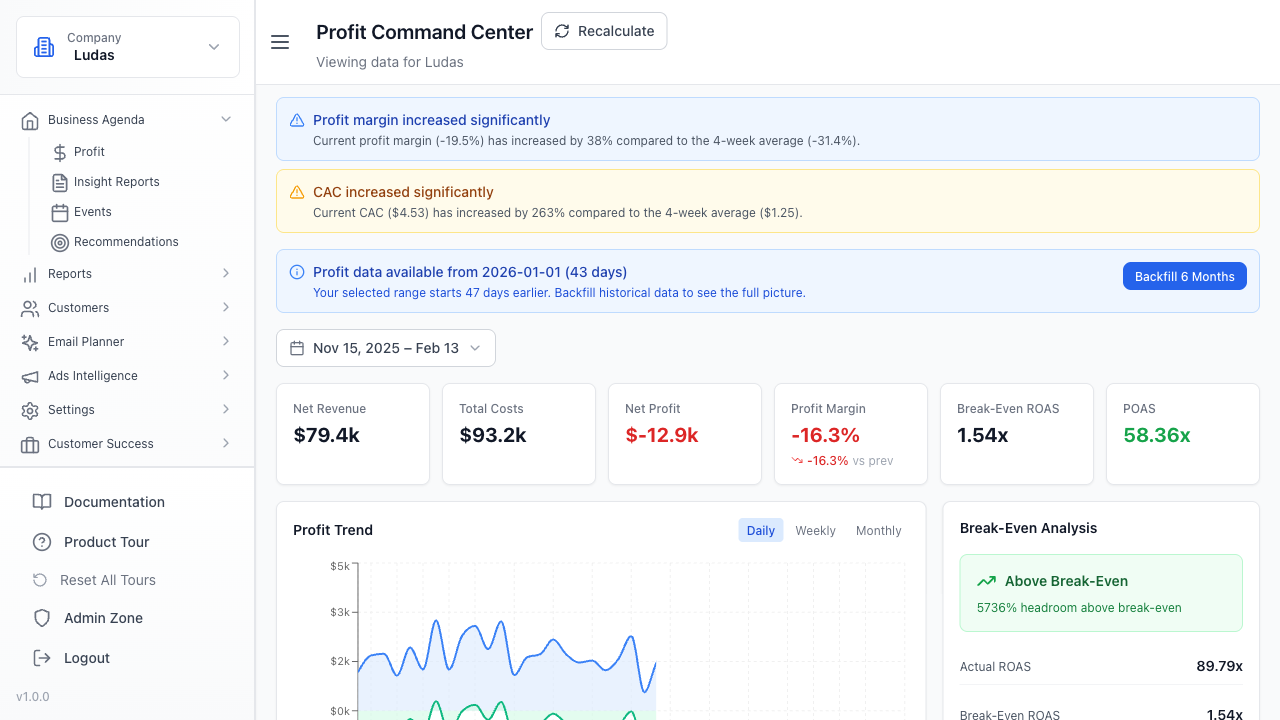
Silent churn occurs when recurring charges fail but the customer remains unaware, creating a gap between perceived and actual retention until they attempt to use a service.
Why Subscription Billing Audits Matter
Failed charges are not binary events. A customer's card declines, the retry fires three days later, and if that fails too, the account sits in limbo. The customer may not notice for weeks. Meanwhile, the operator sees a churn event but has no visibility into whether it was preventable.
An audit of subscription billing surfaces three failure modes: (1) legitimate declines that should trigger customer outreach, (2) soft declines that retry logic can recover, and (3) cards that could have been updated before failure. Each requires a different response. Without an audit, operators treat all three the same way - as lost revenue.
The stakes are material. A SaaS operator with 10,000 active subscribers and a 5% monthly decline rate loses 500 subscription events per month. If 40% are recoverable through better retry or card update logic, that's 200 customers per month who churn unnecessarily. At $50 MRR per customer, that's $120,000 in annual revenue left on the table.
Mapping Decline Codes to Recovery Actions
Decline codes are the primary diagnostic tool. Visa, Mastercard, and other networks return specific codes when a charge fails. Most operators see the code, log it, and move on. The audit requires categorizing them by recoverability.
Hard declines - codes like 05 (Do not honor), 14 (Invalid card number), and 54 (Expired card) - indicate the card itself is unusable. These require customer intervention. A customer with an expired card will not recover on retry. The operator should flag these immediately for outreach, offering a one-click card update link or a phone call.
Soft declines - codes like 03 (Merchant acct error), 96 (System malfunction), and 91 (Issuer unavailable) - are temporary. The same charge may succeed if retried hours or days later. Operators should verify their retry schedule fires at least twice, spaced 3 - 5 days apart, before marking the subscription as failed.
Risk-based declines - codes like 02 (Call issuer), 04 (Pickup card), and 07 (Pickup card special condition) - signal the issuer flagged the transaction as suspicious. These often succeed on retry after the issuer's fraud review clears. A second attempt within 24 hours can recover 15 - 25% of these cases.
To audit: pull all failed charges from the past 90 days, group by decline code, and calculate recovery rate for each code. If code 05 shows a 5% recovery rate on retry, retry logic is not the issue - customer outreach is. If code 91 shows a 10% recovery rate, the retry schedule is too aggressive or too sparse.
Optimizing Retry Logic and Cadence
Retry strategy is the second lever. Most platforms default to 2 - 3 retries over 10 days. This is often too conservative. Industry benchmarks show that a 4 - retry schedule over 14 days recovers 5 - 10% more failed charges than a 2 - retry schedule, with minimal false positives.
The optimal cadence depends on decline code distribution. If 60% of declines are soft (network or issuer issues), space retries 2 - 3 days apart. If 60% are hard (expired or invalid cards), the first retry should fire within 24 hours to catch the customer before they notice, then pause for 7 days to allow time for card update. If 60% are risk-based, fire the second retry within 12 - 24 hours while the issuer's fraud review is still active.
Audit the current retry schedule by querying failed charges and their retry history. For each failed charge, calculate the time between attempts and the outcome (recovered or final failure). If 30% of charges that failed on attempt 1 succeed on attempt 2, but only 5% succeed on attempt 3, the schedule is working. If 5% succeed on attempt 2 and 4% on attempt 3, the spacing is too tight - retries are firing before the issuer has cleared the transaction.
A practical formula: Retry 1 at day 1, Retry 2 at day 4, Retry 3 at day 8, Retry 4 at day 12. This gives soft declines time to resolve while keeping the window tight enough to catch customers before they churn. Adjust based on your decline code mix.
Deploying Card Updaters to Prevent Failure
Card updaters are a proactive tool that most operators overlook. When a card expires or is reissued, the card networks (Visa, Mastercard, Amex) maintain a database of updated card numbers. A card updater service queries this database before the charge is attempted, replacing the old card number with the new one.
The ROI is high. If 15% of failed charges are due to expired or reissued cards, and a card updater prevents 70% of those failures, the operator recovers 10.5% of failed charges without any customer friction. At scale, this is material.
To audit card updater effectiveness: pull all failed charges from the past 90 days, filter for decline codes 05 (Do not honor) and 54 (Expired card), and cross-reference against the card's expiration date. If the charge failed because the card was expired, check whether a card updater was run before the charge attempt. If not, this is a gap. If yes, check whether the updated card number was available in the network database. If the updater ran but the card was not in the database, that's expected - the updater cannot recover all cases.
Implementation requires choosing a card updater provider (most payment processors offer this as an add-on) and configuring it to run 7 - 14 days before the subscription renewal date. This gives the customer time to update their card manually if the updater fails, while still preventing most failures.
Auditing the Customer Communication Gap
The final audit layer is communication. A charge fails, the system retries, and the customer hears nothing. By the time the subscription is canceled, the customer may not even know why.
Audit the communication timeline: for each failed charge, log when the failure occurred, when the first retry fired, when the customer was notified (if at all), and when the subscription was canceled. If the gap between failure and notification is more than 7 days, the operator is losing recovery opportunities. Customers who know their card failed within 24 hours have a 40 - 50% chance of updating it. Customers who find out after 7 days have a 10 - 15% chance.
Best practice: send a notification within 24 hours of the first failed charge, offering a one-click card update link. Send a second notification after the second retry fails, with a phone number or chat option. Do not wait until the subscription is canceled to reach out.
This audit also surfaces whether the notification is reaching the customer. If the system logs a notification sent but the customer never sees it, the email may be going to spam, the link may be broken, or the notification may be too vague. Test the notification flow end-to-end.
Building the Audit Checklist
A subscription billing audit should run quarterly and cover these dimensions: (1) decline code distribution and recovery rates by code, (2) retry schedule performance (time between attempts, recovery rate by attempt number), (3) card updater coverage and success rate, (4) customer communication timing and effectiveness, and (5) final churn rate attributed to billing failures.
Start with a SQL query or data export covering the past 90 days of failed charges. Group by decline code, calculate recovery rate for each code, and identify the top 5 codes by volume. For each code, determine the appropriate recovery action (retry, card update, or customer outreach). Then measure the current system's performance against that action.
Document the findings in a simple table: Decline Code | Volume | Current Recovery Rate | Target Recovery Rate | Gap | Action. This makes it clear where the biggest opportunities are. A code with 100 failures, 5% recovery rate, and a 20% target recovery rate is a bigger opportunity than a code with 10 failures and 0% recovery rate.
Assign ownership: retry logic is typically the payment processor's responsibility, but the operator should verify the configuration. Card updater is a processor add-on that the operator must enable. Customer communication is the operator's responsibility. Audit each quarterly and track progress.
Common Audit Findings and Fixes
Most operators discover one of three problems during their first audit. First, retry logic is either too aggressive (firing too frequently, causing issuer blocks) or too sparse (not giving soft declines time to resolve). The fix is to space retries 3 - 5 days apart and run at least 3 attempts over 14 days.
Second, card updaters are not enabled or are not running at the right time. The fix is to enable the service through the payment processor and configure it to run 7 - 14 days before renewal, not on the day of renewal.
Third, customer communication is delayed or missing. The operator sees the failed charge in the system but the customer does not hear about it for a week. The fix is to send an automated notification within 24 hours of the first failure, with a direct link to update the card.
A secondary finding is that decline codes are not being categorized by recoverability. The operator treats all declines the same way, applying the same retry logic to hard declines (which need customer action) and soft declines (which need time). The fix is to segment by code and apply different logic to each segment.
FAQ
What is the difference between a hard decline and a soft decline?
A hard decline indicates the card or account is unusable (expired card, invalid number, account closed). Retrying will not recover it. A soft decline indicates a temporary issue (network unavailable, issuer system down, fraud review pending). Retrying after a delay often succeeds. Decline codes 05, 14, and 54 are typically hard. Codes 03, 91, and 96 are typically soft. Audit your processor's decline code documentation to confirm.
How many times should a failed charge be retried?
Industry benchmarks suggest 3 - 4 retries over 14 days. Retry 1 at day 1, Retry 2 at day 4, Retry 3 at day 8, Retry 4 at day 12. This spacing gives soft declines time to resolve while keeping the window tight enough to reach customers before they churn. Adjust based on your decline code mix. If most declines are soft, space retries further apart. If most are hard, fire the first retry within 24 hours.
When should a card updater run?
A card updater should run 7 - 14 days before the subscription renewal date. This gives the card network time to return the updated card number (if available) and gives the customer time to manually update their card if the updater fails. Do not run the updater on the day of renewal - this leaves no buffer if the updated card is not in the network database.
How do I know if my retry logic is working?
Pull all failed charges from the past 90 days and calculate the recovery rate for each attempt number. If 40% of charges that fail on attempt 1 succeed on attempt 2, and 15% of those that fail on attempt 2 succeed on attempt 3, the logic is working. If recovery rates are flat or declining, the retry schedule is either too aggressive (issuer is blocking repeated attempts) or too sparse (soft declines are not getting enough time to resolve). Adjust spacing and test again.
FAQ
What is the difference between a hard decline and a soft decline?
A hard decline indicates the card or account is unusable (expired card, invalid number, account closed). Retrying will not recover it. A soft decline indicates a temporary issue (network unavailable, issuer system down, fraud review pending). Retrying after a delay often succeeds. Decline codes 05, 14, and 54 are typically hard. Codes 03, 91, and 96 are typically soft. Audit your processor's decline code documentation to confirm.
How many times should a failed charge be retried?
Industry benchmarks suggest 3 - 4 retries over 14 days. Retry 1 at day 1, Retry 2 at day 4, Retry 3 at day 8, Retry 4 at day 12. This spacing gives soft declines time to resolve while keeping the window tight enough to reach customers before they churn. Adjust based on your decline code mix. If most declines are soft, space retries further apart. If most are hard, fire the first retry within 24 hours.
When should a card updater run?
A card updater should run 7 - 14 days before the subscription renewal date. This gives the card network time to return the updated card number (if available) and gives the customer time to manually update their card if the updater fails. Do not run the updater on the day of renewal - this leaves no buffer if the updated card is not in the network database.
How do I know if my retry logic is working?
Pull all failed charges from the past 90 days and calculate the recovery rate for each attempt number. If 40% of charges that fail on attempt 1 succeed on attempt 2, and 15% of those that fail on attempt 2 succeed on attempt 3, the logic is working. If recovery rates are flat or declining, the retry schedule is either too aggressive (issuer is blocking repeated attempts) or too sparse (soft declines are not getting enough time to resolve). Adjust spacing and test again.