
Apparel & Fashion LTV Benchmarks 2026: What Good Looks Like
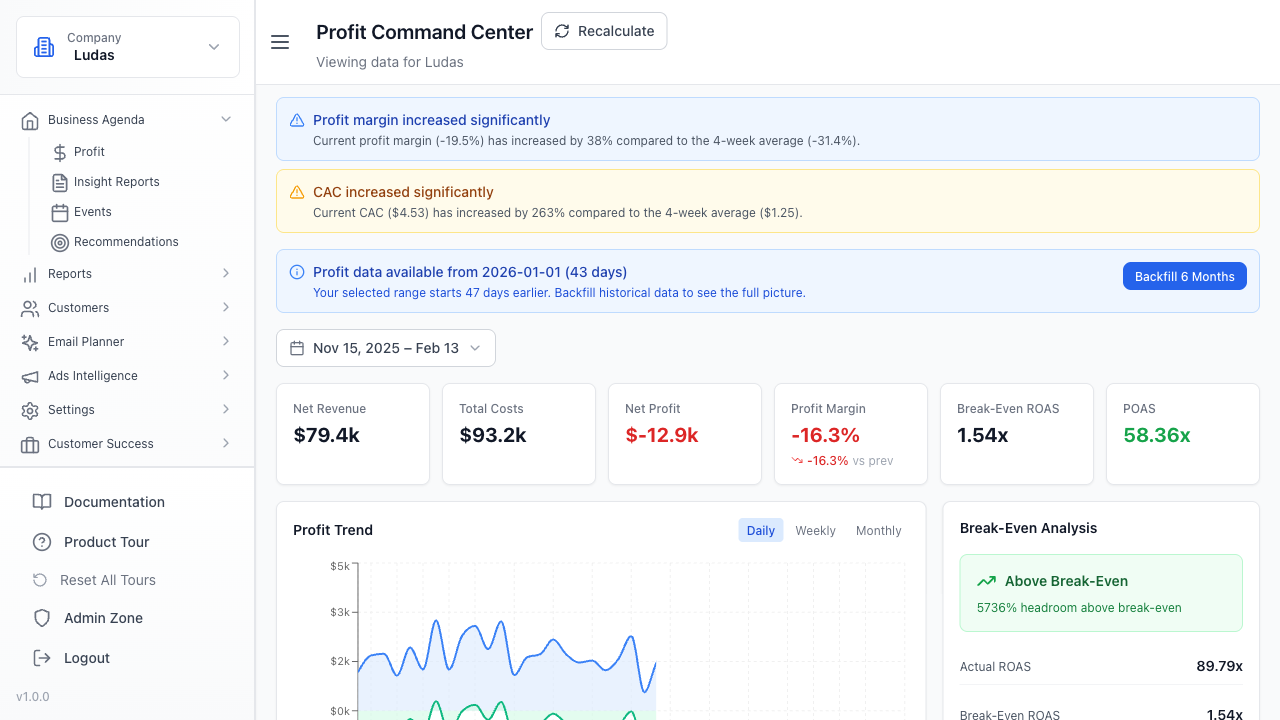
Lifetime value (LTV) is the total profit a customer generates from their first purchase through their final transaction, expressed as a dollar figure or ratio against customer acquisition cost (CAC).
LTV Ranges for Apparel Brands in 2026
Apparel and fashion DTC brands on Shopify cluster into three tiers by LTV maturity. Early-stage brands (under 12 months, minimal repeat) sit at $80 - $150 LTV. Mid-market brands (1 - 3 years, established email and SMS) land at $200 - $400. Mature brands with strong retention, loyalty programs, and seasonal repurchase cycles hit $500 - $1,200+.
These ranges assume gross margin of 55 - 70% (typical for apparel after COGS and fulfillment). If your margin is lower, LTV will compress proportionally. A brand with 45% margin will see roughly 20% lower LTV across the board. Conversely, luxury and premium segments (margin 70%+) can push into the $1,500+ range even with modest repeat rates.
The spread widens in 2026 because retention tools - email automation, SMS flows, loyalty platforms, and predictive churn models - are now table stakes. Brands that invest in these see 2 - 3x LTV lift versus those relying on paid acquisition alone.
LTV:CAC Ratio Floors and Targets
The baseline floor for apparel brands is a 3:1 LTV:CAC ratio. This means if you spend $30 to acquire a customer, that customer must generate $90 in lifetime profit. Below 3:1, unit economics deteriorate and scaling becomes a cash burn exercise. Brands operating at 2:1 or lower are either in growth-at-all-costs mode (unsustainable) or have a retention problem.
Healthy mid-market apparel brands target 4:1 to 5:1. This ratio leaves room for marketing spend increases, seasonal promotions, and inventory write-downs without margin compression. A 4:1 ratio on a $250 LTV customer means CAC of $62.50 - still viable for paid channels (Facebook, TikTok, Google) when blended efficiently.
Top-quartile brands (those with strong repeat and seasonal loyalty) hit 6:1 to 8:1. These operators have cracked repeat purchase behavior, often through subscription models, VIP tiers, or seasonal collections that drive predictable repurchase windows. At 6:1, a $500 LTV customer can sustain a $83 CAC and still leave margin for operations, overhead, and reinvestment.
Payback Window: The Critical Metric
Payback window is the number of days or months required for a customer's gross profit to equal their acquisition cost. For apparel, this is the most operationally useful metric because it directly impacts cash flow and inventory planning.
Industry benchmark: 60 - 90 days for healthy apparel brands. This means a customer acquired in January should generate enough gross profit by late March or early April to cover their CAC. Brands with payback windows longer than 120 days are either acquiring too expensively or have weak first - purchase margins.
Fast - fashion and trend - driven brands (streetwear, seasonal drops) often compress payback to 30 - 45 days because first - purchase AOV is higher and repeat intent is immediate. Basics - focused brands (everyday wear, essentials) typically see 75 - 100 day payback because AOV is lower but repeat is more predictable.
Formula: Payback Window (days) = (CAC / (Gross Profit per Customer / Customer Lifetime in Days)). If CAC is $50, gross profit per customer is $200, and average customer lifespan is 365 days, payback is (50 / (200/365)) = 91 days.
Repeat Rate and Its Impact on LTV
Repeat purchase rate (customers who buy more than once within 12 months) is the primary driver of LTV in apparel. Benchmark repeat rates sit at 25 - 35% for new brands, 40 - 55% for established brands, and 60%+ for loyalty - heavy brands with subscription or VIP programs.
A 30% repeat rate with an average repeat AOV of $85 and 2.1 repeat purchases per repeater generates roughly $51 in repeat revenue per acquired customer. On a $120 first - purchase AOV with 65% gross margin, that's $78 first - purchase profit plus $33 repeat profit = $111 LTV. Increase repeat rate to 45% and LTV jumps to $155 - a 40% lift from retention alone.
Seasonal apparel brands see repeat clustering around specific windows (back - to - school, holiday, resort wear). Tracking repeat rate by cohort and season is more useful than annual repeat rate. A summer collection buyer may have 0% repeat in Q4 but 80% repeat the following summer.
Channel - Specific CAC and LTV Variance
Paid social (Facebook, Instagram, TikTok) averages $35 - $65 CAC for apparel brands, depending on audience saturation and creative quality. Brands with strong UGC and influencer content trend toward the lower end. Luxury and niche brands trend higher.
Google Shopping and search average $50 - $90 CAC because intent is higher but competition is fierce. Brands with strong SEO and organic search traffic can reduce blended CAC significantly by mixing paid and organic.
Email and SMS are retention channels, not acquisition, but they drive repeat purchases at near - zero marginal CAC. Brands that segment email by purchase history and send targeted repeat offers see 15 - 25% of repeat revenue from email alone, which inflates LTV without increasing CAC.
Affiliate and influencer partnerships range $40 - $120 CAC depending on commission structure and influencer tier. Performance is highly variable; track by influencer and adjust spend accordingly.
Margin Assumptions and LTV Sensitivity
LTV calculations require clarity on margin definition. Gross profit margin (revenue minus COGS and fulfillment) is the standard for LTV math. Operating margin (gross profit minus marketing, payroll, and overhead) is not used in LTV:CAC ratios because CAC is already a marketing expense.
Apparel brands typically operate at 55 - 70% gross margin. Brands with in - house fulfillment and low COGS (basics, private label) hit 70%+. Brands with third - party logistics, high returns, and licensed designs drop to 50 - 60%.
A 10% margin swing materially impacts LTV. A brand at 60% margin with $200 revenue per customer generates $120 LTV. Drop to 50% margin and LTV falls to $100 - a 17% decrease. This is why inventory management, returns rate, and fulfillment efficiency are LTV levers, not just retention.
Benchmarking Your Brand Against 2026 Standards
Start by calculating your LTV using 12 months of cohort data. Segment by acquisition channel and customer cohort (month acquired). This reveals which channels and periods produce higher - value customers. A brand may have a blended LTV of $250 but $180 from paid social and $380 from organic - a signal to shift budget or improve paid creative.
Next, calculate LTV:CAC by channel. If paid social CAC is $50 and LTV is $180, ratio is 3.6:1 - acceptable but not strong. If organic CAC is $0 and LTV is $380, ratio is infinite - prioritize organic growth and SEO.
Track payback window monthly. If payback is extending (60 days in Q1, 90 days in Q2), either CAC is rising or first - purchase margin is falling. Investigate pricing, discount depth, and paid spend efficiency. Payback window is a leading indicator of unit economics stress.
Compare your repeat rate to cohort benchmarks. If 12 - month repeat is 28% and industry benchmark is 40%, retention is the bottleneck. Audit email flows, product - market fit, and quality of first - purchase experience before scaling acquisition.
FAQ
What's the difference between LTV and repeat revenue?
LTV is the total gross profit a customer generates (first purchase plus all repeats). Repeat revenue is only the profit from purchases after the first. A customer with $100 first - purchase profit and $50 repeat profit has $150 LTV but $50 repeat revenue. LTV is the metric for unit economics; repeat revenue is the metric for retention health.
Should I include refunds and returns in LTV calculation?
Yes. LTV should reflect net revenue after refunds and returns. If your return rate is 20%, your effective first - purchase revenue is 80% of gross revenue. Apparel brands typically see 15 - 25% return rates; factor this into margin assumptions. High return rates compress LTV significantly and signal product - market fit or quality issues.
How often should I recalculate LTV benchmarks?
Recalculate quarterly using trailing 12 - month data. This smooths seasonal variance and reveals trends. Monthly calculations are too noisy for apparel because of seasonal cohorts. If you're testing major changes (pricing, product mix, retention tactics), run cohort analysis monthly to detect impact quickly.
Why do luxury apparel brands have higher LTV:CAC ratios?
Luxury brands have higher gross margins (70%+), lower repeat rate requirements (customers buy less frequently but at higher AOV), and lower CAC because audience is smaller and more targeted. A luxury brand with 20% repeat rate and $800 AOV can hit 6:1 LTV:CAC. A basics brand needs 45%+ repeat rate to match that ratio because AOV is lower.
FAQ
What's the difference between LTV and repeat revenue?
LTV is the total gross profit a customer generates (first purchase plus all repeats). Repeat revenue is only the profit from purchases after the first. A customer with $100 first - purchase profit and $50 repeat profit has $150 LTV but $50 repeat revenue. LTV is the metric for unit economics; repeat revenue is the metric for retention health.
Should I include refunds and returns in LTV calculation?
Yes. LTV should reflect net revenue after refunds and returns. If your return rate is 20%, your effective first - purchase revenue is 80% of gross revenue. Apparel brands typically see 15 - 25% return rates; factor this into margin assumptions. High return rates compress LTV significantly and signal product - market fit or quality issues.
How often should I recalculate LTV benchmarks?
Recalculate quarterly using trailing 12 - month data. This smooths seasonal variance and reveals trends. Monthly calculations are too noisy for apparel because of seasonal cohorts. If you're testing major changes (pricing, product mix, retention tactics), run cohort analysis monthly to detect impact quickly.
Why do luxury apparel brands have higher LTV:CAC ratios?
Luxury brands have higher gross margins (70%+), lower repeat rate requirements (customers buy less frequently but at higher AOV), and lower CAC because audience is smaller and more targeted. A luxury brand with 20% repeat rate and $800 AOV can hit 6:1 LTV:CAC. A basics brand needs 45%+ repeat rate to match that ratio because AOV is lower.