
AI-Powered Customer Retention: How Machine Learning Predicts and Prevents Churn
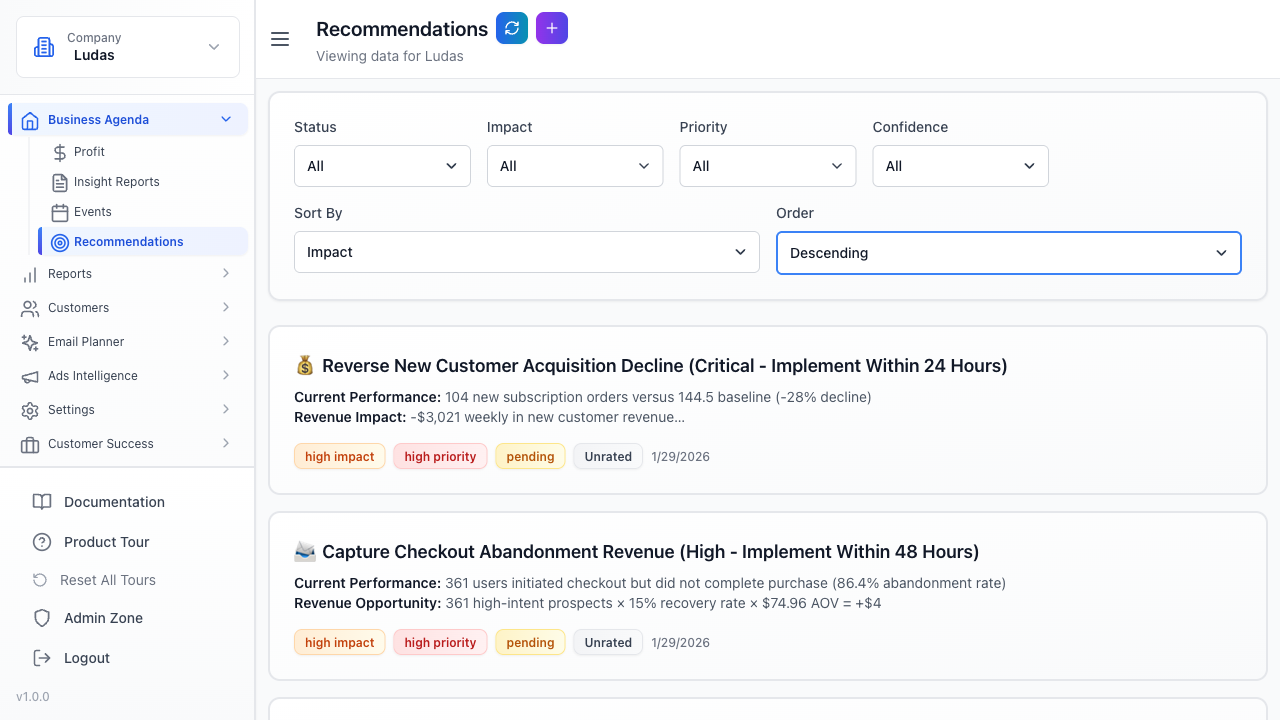
AI-powered customer retention uses machine learning models to predict which customers are likely to churn and trigger automated interventions before they leave, reducing churn rates by 30-50% compared to rule-based approaches. The fundamental advantage of AI over traditional retention methods is speed and precision - a machine learning model can analyze hundreds of behavioral signals across thousands of customers simultaneously and identify at-risk individuals weeks before a human analyst would notice the warning signs.
Traditional retention strategies rely on static rules: if a customer has not purchased in 90 days, send a win-back email. If a subscriber skips two shipments, flag them as at-risk. These rules work, but they are blunt instruments. They treat all 90-day-lapsed customers the same, regardless of whether a specific customer's normal purchase cycle is 30 days or 120 days. AI models learn each customer's individual patterns and detect deviations from those patterns, enabling retention teams to intervene with the right message, at the right time, through the right channel.
How AI Improves Retention: The Core Mechanisms
Churn Prediction Models
Churn prediction is the foundation of AI-powered retention. These models analyze historical customer data to identify patterns that precede churn, then score active customers on their probability of churning within a defined time window (typically 30, 60, or 90 days).
The most effective churn prediction models for e-commerce use these input features:
Behavioral signals:
- Days since last purchase (relative to the customer's own purchase cadence)
- Trend in order frequency (increasing, stable, or declining)
- Trend in order value (increasing, stable, or declining)
- Email engagement changes (opens, clicks, unsubscribes)
- Site visit frequency and recency
- Support ticket volume and sentiment
- Subscription modifications (skips, pauses, downgrades)
Transactional signals:
- Product category concentration versus exploration
- Discount dependency (percentage of orders with promo codes)
- Return rate trends
- Payment failure history
Engagement signals:
- Loyalty program participation
- Review submission
- Referral activity
- Social media engagement
A well-trained churn prediction model achieves 75-85% accuracy in identifying customers who will churn within the next 30 days. This gives retention teams a 2-4 week window to intervene before the customer makes the final decision to leave.
Customer Health Scoring
Where churn prediction answers "will this customer leave?", customer health scoring answers "how strong is this customer's relationship right now?" Health scores combine multiple behavioral signals into a single composite metric - typically scaled 0 to 100 - that represents the overall quality of the customer relationship.
AI enhances health scoring by:
- Dynamically weighting signals based on what actually predicts retention for your specific business. A model might learn that email engagement is 3x more predictive than site visits for your brand.
- Detecting non-obvious patterns. A customer who switches from buying full-price to only buying during sales might appear healthy by spend metrics but is actually showing declining brand commitment.
- Adjusting for seasonality. A customer who goes quiet in January is not necessarily churning if your product is seasonal. AI models learn these patterns automatically.
- Establishing individual baselines. Instead of comparing all customers to a single benchmark, AI establishes each customer's personal baseline and flags deviations from that norm.
Automated Interventions
The value of prediction is only realized when it triggers action. AI-powered retention systems connect churn predictions and health score changes to automated intervention workflows:
| Risk Level | Health Score | Automated Intervention |
|---|---|---|
| Low risk | 70-100 | Continue standard engagement cadence |
| Moderate risk | 50-69 | Increase email frequency, send personalized product recommendations |
| High risk | 30-49 | Trigger win-back sequence, offer incentive, escalate to retention team |
| Critical risk | 0-29 | Immediate outreach (email + SMS), premium offer, personal call for high-CLV customers |
The automation layer ensures that no at-risk customer falls through the cracks, regardless of team size. A brand with 50,000 active customers cannot manually monitor health scores - but an automated system can respond to every risk signal in real time.
Personalized Retention Campaigns at Scale
AI enables retention campaigns that are personalized at the individual level, not just the segment level. While traditional segmentation groups customers into 5-10 buckets, AI can generate individualized recommendations for:
- Offer type: Which incentive will resonate with this specific customer? Some customers respond to percentage discounts, others to free shipping, others to exclusive access. AI models learn individual preferences from past behavior.
- Channel selection: Should the retention message be sent via email, SMS, push notification, or direct mail? AI identifies the channel each customer is most responsive to.
- Timing: When is this customer most likely to engage with a retention message? AI optimizes send times based on individual engagement patterns, not brand-wide averages.
- Content: Which products should be featured? AI selects the products most likely to drive a purchase based on the customer's browse and purchase history.
Personalized retention campaigns outperform segment-based campaigns by 20-40% in conversion rate and 15-25% in revenue per contact. The incremental improvement comes from matching the right offer to the right customer through the right channel at the right time.
Churn Prevention in Practice
Early Warning Systems
The most valuable application of AI in retention is the early warning system - identifying customers who are beginning to disengage before they reach the point of no return. Traditional approaches catch customers after they have already lapsed. AI catches them while they are still active but showing early signs of decline.
Early warning signals that AI models detect include:
- A customer who typically opens 80% of emails drops to 40% over two weeks
- A monthly buyer's inter-purchase interval extends from 28 days to 42 days
- A subscriber who normally customizes their box stops making modifications
- A previously engaged loyalty program member stops redeeming points
- Site visit duration decreases from an average of 4 minutes to under 1 minute
Each of these signals alone might not warrant action. But when an AI model detects multiple declining signals simultaneously, it recognizes a pattern that precedes churn with high confidence.
Proactive versus Reactive Retention
The distinction between proactive and reactive retention is the core value proposition of AI in this space:
| Approach | Timing | Typical Save Rate | Cost per Save |
|---|---|---|---|
| Reactive (win-back after lapse) | 30-90 days after last purchase | 3-10% | $15-30 per reactivation |
| Rule-based proactive | When static thresholds are breached | 10-15% | $8-15 per save |
| AI-powered proactive | When risk signals emerge | 20-35% | $3-8 per save |
AI-powered proactive retention costs less per save because interventions happen earlier when the customer is still warm. A personalized email sent when a customer's health score first drops below 60 is far more effective than a discount-heavy win-back email sent 90 days after they stopped purchasing.
Case Study Benchmarks
Across e-commerce brands implementing AI-powered retention, the following results are representative of what well-executed programs achieve:
- Churn reduction: 30-50% decrease in voluntary churn within 6 months of implementation
- Revenue preservation: 15-25% more revenue retained from at-risk customers compared to rule-based approaches
- Campaign efficiency: 40-60% improvement in revenue per retention email when AI personalizes content, timing, and offer
- Time savings: 70-80% reduction in manual effort for retention teams, shifting from reactive firefighting to strategic optimization
- Payback period: Most brands see positive ROI within 60-90 days of implementing AI retention tools
The compounding effect is significant. Each month that AI prevents churn, the retained customers generate additional revenue and some become advocates who reduce future acquisition costs through referrals and organic word-of-mouth.
The Future of AI in Customer Retention
Several trends are shaping how AI-powered retention will evolve over the next few years:
Predictive Lifetime Value
Current AI models focus on predicting churn - a binary outcome. The next generation of models will predict the trajectory of each customer's lifetime value, enabling brands to invest in retention proportional to the customer's future value, not just their past spend. A new customer showing early signals of becoming a champion gets different treatment than a customer whose trajectory suggests they will plateau at one order per quarter.
Multi-Touch Attribution for Retention
Understanding which retention touchpoints actually drive results is becoming more sophisticated. AI models will attribute retained revenue across email, SMS, loyalty programs, product improvements, and customer service interactions - giving brands a clear picture of retention ROI by channel and tactic.
Real-Time Intervention
As AI processing speeds increase, the gap between signal detection and intervention shrinks. Future systems will detect a declining engagement pattern and trigger a response within minutes - adjusting the on-site experience for a returning visitor, personalizing the next email in queue, or updating retargeting creative in real time.
Conversational Retention
AI-powered chatbots and agents that can have retention conversations with at-risk customers in real time - understanding the customer's concern, offering relevant solutions, and processing changes (pauses, downgrades, product swaps) without human intervention.
Getting Started with AI Retention
Implementing AI-powered retention does not require building models from scratch. The process starts with consolidating your customer data - purchase history, engagement signals, support interactions, and subscription status - into a unified view.
From there, the key steps are:
- Establish baseline metrics: Measure current churn rate, retention rate, repeat purchase rate, and CLV by segment
- Implement health scoring: Start with a rule-based health score and evolve toward an ML-driven model
- Build automated workflows: Connect health score changes and churn predictions to intervention sequences
- Test and learn: A/B test retention offers, timing, and channels to identify what drives the best outcomes
- Iterate on the model: Feed results back into the model to improve prediction accuracy over time
Finsi's retention intelligence platform provides the infrastructure for AI-powered retention out of the box - from churn prediction and health scoring to automated intervention workflows - so brands can focus on strategy rather than data engineering.
Frequently Asked Questions
How does AI predict customer churn in e-commerce?
AI churn prediction models analyze hundreds of behavioral, transactional, and engagement signals from historical customer data to identify patterns that precede churn. These signals include changes in purchase frequency relative to each customer's own cadence, declining email engagement, increasing support ticket volume, subscription modifications like skips and pauses, and shifts in discount dependency. A well-trained model achieves 75-85% accuracy in identifying customers who will churn within 30 days, giving retention teams a 2-4 week intervention window. Unlike static rules that treat all customers the same, AI establishes individual baselines and detects deviations from each customer's personal patterns.
Does AI actually reduce churn rates?
Yes - AI-powered retention programs consistently reduce churn by 30-50% compared to rule-based approaches. The improvement comes from three factors: earlier detection of at-risk customers (weeks before manual analysis would catch them), personalized interventions matched to individual customer preferences, and automated execution that ensures no at-risk customer falls through the cracks. AI-powered proactive retention achieves 20-35% save rates at $3-8 per save, compared to reactive win-back campaigns that achieve only 3-10% save rates at $15-30 per reactivation. Most brands see positive ROI within 60-90 days of implementing AI retention tools. Start a free trial to see churn predictions for your customer base.
What data does AI need to predict churn effectively?
At a minimum, AI churn models need purchase history (order dates, amounts, products), email engagement data (opens, clicks, unsubscribes), and customer tenure. More advanced models also incorporate site visit behavior, support ticket history and sentiment, subscription modifications, loyalty program activity, referral behavior, and return rates. The more behavioral signals available, the more accurate the predictions become. Finsi's retention intelligence platform consolidates data from your e-commerce platform, email provider, and support tools into a unified customer view, so the AI model has the richest possible signal set without requiring a data engineering team.
What is the ROI of AI-powered retention tools?
The ROI of AI retention tools is typically 5-10x within the first year. Across e-commerce brands, well-executed AI retention programs deliver 15-25% more revenue retained from at-risk customers, 40-60% improvement in revenue per retention email, and 70-80% reduction in manual effort for retention teams. The payback period is usually 60-90 days. The compounding effect makes the long-term ROI even stronger - each customer retained through AI-powered intervention generates revenue for the remainder of their lifetime and may refer new customers who reduce future acquisition costs. Founders and finance leaders can use profit intelligence to measure the exact revenue impact of retention improvements.
How does AI retention compare to manual or rule-based retention?
AI-powered retention outperforms manual and rule-based approaches across every dimension. Rule-based systems use static thresholds (e.g., "flag customers who have not purchased in 90 days") that treat all customers identically and only catch issues after they have fully developed. AI models learn each customer's individual behavior patterns, detect subtle multi-signal declines weeks earlier, and personalize the intervention type, channel, timing, and offer for each customer. The result is 20-35% save rates versus 10-15% for rule-based and 3-10% for reactive approaches, at a lower cost per save. AI also scales effortlessly - a brand with 50,000 customers cannot manually monitor health scores, but smart segmentation and automated workflows handle it in real time.
Stop guessing. Start knowing.
Finsi connects your e-commerce data, tells you what to do, and executes it — email campaigns, ad optimization, retention flows. Free 30-day trial.
Start Free Trial